
SYSTEMIC DIAGNOSTICS // FIDUCIARY ARCHIVE
THE FIDUCIARY REGISTRY
Independent, non-smoothable intelligence logs and systemic diagnostics compiled over more than a decade of tracing transaction metadata. This archive operates as a sovereign database built to strip away narrative seduction, exposing where portfolio assets are weaponised as pawns within private equity's opaque black box. It equips Level 1 allocators with the precise metrics required to enforce baseline accountability and cleanly separate authentic operational execution from debt-engineered luck.
The Humbug Economy: Narrative Seduction, Mega-Cap Hype, and the Death of Baseline Arithmetic
In a market fuelled by leverage and financial engineering, executive bravado routinely masks a stark lack of genuine competence. Using a leaked $2 trillion AI prospectus as a case study, this forensic diagnosis reveals how the "Humbug Economy" replaces baseline arithmetic with narrative seduction. Discover why allocators must use Invariant Telemetry to pull back the green screen and protect Level 0 capital from structural decay.

"Exactly so! I am a humbug." — W.W. Denslow's original 1900 illustration of Dorothy, Toto, and the Wizard behind the folding green screen.
I. The Anesthesia of Executive Bravado
‘Confidence’, ‘bravado’, and narrative polish are far too easily mistaken for true strength or value.
In markets fuelled by leverage, hype, and financial engineering, executive bravado routinely masks a stark lack of genuine competence. When did we stop to question?
On the surface, portfolio companies and pre-IPO entities are paraded as glittering trophy assets – a masterclass in financial engineering, market tailwinds, and artificially expanded Internal Rate of Return (IRR), with the audience ‘trusting’ every single word. Yet, when you step out of the comfortable glow of the ‘Streetlight Effect’ – searching for health only where the light is convenient – and observe raw operational reality, the narrative instantly disintegrates.
Traditional due diligence has become an exercise in passive consensus. Management pitch decks are rubber-stamped by advisory firms charging billable hours to compile consulting salads, while institutional allocators are fed smoothed accounting metrics designed to simulate ‘Alpha’ out of pure market ‘Beta’ and cheap debt. This creates a dangerous Illusion of Health. Underneath the surface-level polish, internal operational decay, customer disconnects, and un-hedged liabilities quietly hollow out the enterprise core.
II. Toto as Invariant Telemetry: Looking Behind the Green Screen
It is the corporate world’s classic Wizard of Oz narrative.
In L. Frank Baum’s original 1900 text, the grand ruler of Oz was not exposed by a rival army, nor by a complex financial audit. He was revealed by Toto the dog, who trotted into the corner of the room and knocked over a small folding green screen. The larger-than-life persona controlling the thunder, smoke, and noise collapsed instantly into an ordinary man operating a mechanical set of levers, forced to confess: ‘Exactly so! I am a humbug.’
• Searches under convenient, pre-approved accounting metrics.
• Accepts management pitch decks and green dashboard views.
• Confounders: Adjusted EBITDA, smoothed IRR, and debt-driven multiples.
• Result: Trapped inside the CEO Bubble.
• Steps past the bright light into un-smoothable baseline data.
• Traces raw transaction metadata directly from Level 5 to Level 0.
• Knocks over the narrative wrapper to inspect core operational physics.
• Result: Exposes the Hollow Core before liquidity events.
Toto represents Invariant Telemetry. He does not listen to executive narratives, he is un-seduceable by corporate hospitality, and he cannot be bought with performance-fee promises. He simply reacts to smell, friction, and ground truth.
In modern private equity and venture capital, institutional allocators rarely lack data; they lack independent rulers. When due diligence is restricted to the financial metrics provided by the sellers themselves, allocators are looking at a rigged mirror. To break this one-way mirror, you do not need bigger financial models or AI prompt generators; you need an un-smoothable, diagnostic lens capable of pulling back the green screen.
III. The Half-Trillion-Dollar Humbug: A Real-Time Diagnosis
Look no further than a recently leaked, confidential IPO prospectus from one of the world’s leading frontier AI laboratories. Pitching a valuation target of over $2 trillion, the headline numbers revealed to the market provide a textbook case study in narrative hype completely eclipsing economic reality:
Target Valuation: >$2,000,000,000,000 ($2 Trillion+)
Annual Revenue (2025): ~$4.6 Billion
Operating Loss (2025): ~$8 Billion
Net Loss (2025): ~$42 Billion (including ~$34B in non-cash financing charges)
Future Infrastructure & Cloud Commitments: ~$518 Billion
2025 Revenue Target
2025 Operating Loss
Net Loss (incl. $34B Non-Cash Charge)
Future Compute Commitments
Diagnostic Takeaway: Generating $4.6 billion in top-line revenue while burning $8 billion in operational cash and locking the enterprise into $518 billion in non-cancellable compute liabilities represents an unprecedented unit-economic imbalance. When a business relies on terminal multiple expansion to offset structural operational deficits, it is no longer an asset; it is a financial wrapper on an un-hedged liability.
Narrative hype over economic reality? Absolutely.
When an enterprise commits over half a trillion dollars in future capital expenditures to generate single-digit billions in top-line revenue—all while losing nearly double its revenue at the operating level—it has crossed from growth investing into the realm of Space Alchemy. The market is asked to underwrite a $2 trillion valuation not on current operational efficiency, but on the narrative promise that scaling compute will magically solve underlying unit-economic friction.
IV. The Epistemological Drift Toward Corporate Idiocracy
When did we stop to think?
It feels like we are walking perilously towards Mike Judge’s Idiocracy (2006)—a world where critical thinking, root-cause inquiry, and baseline arithmetic are systematically replaced by blind cheerleading and institutional consensus.
The most dangerous phase of institutional decay is the quiet 'Illusion of Health'. When $2 trillion valuations attached to $8 billion operating losses are swallowed without inquiry, the market suffers from systemic cognitive closure. We are replacing hard operational telemetry with emotional belief—mistaking executive noise for enterprise velocity.
In Judge’s dystopian satire, society falters not because it lacks technology, but because it abandons the willingness to ask why. It replaces empirical observation with slogan-driven repetition.
We see the exact same pathology inside boardrooms, investment committees, and GP pitch meetings. Executives swallow their own narrative wrappers, operating inside a self-referential CEO Bubble where lower-level operational warnings are filtered out long before they reach the board.
It is an uncomfortable world, especially when the thin veneer of confidence dissolves instantly the moment you look past the hype and see the hollow core underneath.
V. Reclaiming Fiduciary Sovereignty for Level 0 Capital
Where does this structural decay ultimately land? Who bears the cost when the green screen falls over and the humbug is exposed?
Capital begins at the absolute zenith of this system: Level 0—the post-tax human bedrock of civil servants, teachers, and firefighters, alongside generational UHNW estates.
This wealth cascades down through Level 1 Limited Partners and advisory vectors to Level 3 General Partners, where institutional traceability disappears into financial engineering, NAV mark-ups, and fee extraction.
Capital is deployed into day-to-day corporate operations. Beneath surface-level spreadsheet metrics, hidden operational plaque and structural friction accumulate, silently hollowing out the enterprise core[cite: 1, 3, 5].
The ultimate survival of this entire vertical pipeline is determined at the Level 5 End-Customer node. When a fund sponsor relies on narrative wrappers over operational execution, the circuit snaps, hollowing out the asset and leaving the Level 0 originators holding nothing but structural deficits[cite: 3, 38].
The cost of narrative seduction is never borne horizontally by the architects who design the financial wrappers. It is borne vertically.
When General Partners manipulate Net Asset Value (NAV) mark-ups, deploy ‘lazy leverage’, or push toxic Continuation Vehicles (CVs) to hide decaying assets, the liquidity deficit flows all the way down to Level 0.
Level 0 is the post-tax human bedrock of our economy. It is the capital of civil servants, teachers, firefighters, municipal pension funds, and generational Ultra-High-Net-Worth (UHNW) estates. When a $2.5 billion trophy asset turns out to be a zombie asset trapped in a 20% bankruptcy loop, it is Level 0 capital that pays the ‘Integrity Tax’.
Institutional allocators do not need to fill out passive ESG questionnaires or review billable-hour consulting reports. They must demand independent, non-smoothable diagnostic evidence that isolates authentic GP operational skill from debt-engineered market luck.
Let’s pinpoint the exact friction and validate the absolute truthfulness and trustworthiness of the manager holding your capital.
“To see the invisible, we simply need new rulers.” — Morten J. Sørensen
The 30-Year Promise vs. The 5-Year Flip: A diagnostician’s view on EIOPA, Private Equity, and the structural blind spots of EU insurance regulation.
EU insurance regulators face a structural paradox: balancing 30-year policyholder liabilities against aggressive 5-year Private Equity return loops. Discover why legacy supervisory frameworks and the "Streetlight Effect" fail to protect policyholders, and how Invariant Telemetry can expose the true operational health of PE-backed insurers before cases like the Eurovita collapse repeat.

The "Streetlight Effect" in action: Regulators are often constrained to examining static balance sheets (illuminated), while the complex, operational risks of Private Equity ownership hide in the shadows
Recently, Reuters reported that EU insurance regulators are demanding a long-term view from private equity buyers.
When evaluating these Private Equity (PE) acquisitions, regulators face a structural paradox: they must balance 30-year policyholder liabilities against PE return loops built for aggressive 5-to-7-year turnarounds.
This is not a failure of due diligence. It is a fundamental obstacle of legacy supervisory frameworks. Seeking to sharpen oversight beneath the same failing, lobby-bound streetlight is impossible; regulators must step outside that light.
The Streetlight Effect in Regulation
Current protocols evaluate PE buyers based on qualitative assurances—essentially, requesting ‘post-acquisition strategies’. This “we promise to do our best” model lacks a sovereign, invariant, and un-smoothable operational-health monitor backed by enforceable accountability.
Regulators remain trapped by the ‘Streetlight Effect’: examining static balance sheets where accounting rules cast light, while operational risks silently migrate into unmonitored corners.
This regulatory blind spot overlooks three critical structural realities:
Financial Engineering: PE buyers frequently route policyholder capital into illiquid private credit, or transfer risk via complex funded reinsurance into offshore hubs like the Cayman Islands.
Geographic Concentration: While PE holds a seemingly modest 2.4% of overall EU insurance assets, this average conceals extreme, localized concentration.
The Transatlantic Fallacy: Investors vastly overestimate how easily US and UK playbooks can be transplanted to continental Europe. They ignore distinct product structures, consumer behaviors, legal frameworks, and the stark reality of PE’s 20% failure rate.

Figure 1: Why macro averages mislead: While PE holds just 2.4% of total EU insurance assets, localized concentration reaches up to 20% in specific national markets.
The Eurovita Warning
We do not have to guess what happens when these realities are ignored. We witnessed it in 2023 with the Italian insurer Eurovita, backed by PE firm Cinven.
In that instance, self-reported assurances masked deep liquidity decay. The true state of the insurer was obscured until regulatory intervention didn’t just become necessary—it became imperative to prevent widespread fallout. It is a textbook example of what happens when regulators rely on static reporting rather than real-time operational reality.
The Solution: Invariant Telemetry
So, what becomes possible if regulators move beyond static compliance questionnaires?
They must evaluate execution via an Invariant Insurance Telemetry Repository (IITR)—a real-time, tamper-proof record of operational reality. Measuring an insurer through invariant telemetry elevates supervision from governance theatre to empirical clarity.
It proves, mathematically and operationally, whether a General Partner is acting as an ‘Operational Architect’—enhancing genuine efficiency—or merely relying on aggressive cost-cutting and offshore risk-shifting.
Tying approval covenants directly to certified operational health under Solvency II Pillar 2 restores true authority to regulators. If the European Insurance and Occupational Pensions Authority (EIOPA) is to protect European policyholders, it cannot rely on empty promises.
To govern the unmanageable, we simply need new rulers. For supervisory authorities and policy leaders, the invariant models and architectural frameworks required to establish this operational panopticon stand fully engineered. It is time to use them.
The Architecture of Trust: Underwriting Operational Integrity over Narrative Seduction
What do a €20 social media scam and a multi-billion-dollar corporate "Space Alchemy" play have in common? Structurally, absolutely everything. The CRAP Index forensically diagnoses and exposes how engineered narrative wrappers hollow out operational core realities, empowering institutional allocators to protect Level 0 capital (Individual Contributor).

What do a €20 social media consumer scam and a multi-billion-dollar corporate “Space Alchemy” play have in common?
If one looks closely at the underlying data, the answer is clear: on the surface, absolutely nothing; structurally, absolutely everything.
When observing the unregulated proliferation of advertisements for a miracle "Mini AC" room cooling unit—purporting to cool a 37-square-metre room from 37°C to 17°C in a mere three minutes, sometimes even 90 seconds—one’s clinical intuition might suggest that its marketing architecture mirrors a complex corporate restructuring plan or a speculative mega-cap asset turnaround. This intuition is entirely correct. In systems dynamics, network science, and forensic corporate diagnostics, the topographical layout of the deception is identical. There is always room for a plethora of meaningless words designed explicitly to make the impossible sound possible.
Both models operate inside an Opaque Black Box. Both rely upon a highly premium-priced narrative wrapper—engineered from systemic operational friction (the CRAP Index, detailed below)—explicitly designed to exploit intense human desire, status-seeking, or a competitive fear of missing out (FOMO). To a most disastrous degree, both configurations use the narrow, convenient beam of the Streetlight Effect to manipulate surface-level compliance metrics while completely hollowing out the absolute reality and truth of the underlying operational core.
Whether the asset is a cheap plastic box containing wet cardboard and a five-volt computer fan worth a few euros, or a hyper-capital-intensive infrastructure empire loaded with billions in debt to fund an artificial orbital AI monopoly, the mechanics of the illusion remain identical. Once a forensic scan is applied to the raw asset, the physics of the system reveals the same immutable truth: when a value proposition separates its authored perception from the absolute reality of its execution, structural failure is the only remaining mathematical boundary condition.
Decisively, a critical mass of capital allocators and consumers invariably swallows these engineered lies, providing the systemic momentum required to justify their continuation. The tragedy inherent in this architecture is that by the time reality collapses the facade, immense pools of investor value have already been extracted by the architects of the illusion. The venture or asset is quietly liquidated or buried under sequential refinancing rounds, leaving both everyday retail consumers and institutional pension funds holding nothing but structural deficits. The sponsor then seamlessly transitions to the next target asset, rebooting the playbook with absolute impunity. This loop persists because desire drives us all to stare and look under that same streetlight, hoping we have found that unique something which no one else has seen, and then pretending we possess genuine operational skill rather than owning the fact that we simply have better words to cover our market luck.
The Architectural Breakdown: Mapping the Twin Illusions
The reason the financial establishment has never been able to resolve these systemic inquiries, nor ever will, is that they operate under the restrictive cognitive bias of the Streetlight Effect—searching for structural value only where it is easiest to measure. Legacy operators function as “lightbulb consultants”, attempting to replace an isolated component under an antiquated streetlamp in the unexamined hope of illuminating a new operational reality. They innocently believe that to render governance observable, they must compel fiduciaries to complete longer compliance questionnaires, submit retrospective disclosures, or execute look-back administrative audits.
They seek validation within self-reported, backward-engineered General Partner documents—attempting to gauge true luminescence by analysing the paint layers of Giacomo Balla’s oil painting Street Light (1909), rather than measuring the actual photons colliding with, and scattering off, the real-world obstacles hidden within dark alternative asset classes. Human eyes are biologically limited to the visible spectrum, and standard due diligence is no different. It only sees the yellow stars of engineered valuation spikes, mega-cap hype, and blockbuster debt syndications. The operational screams—the red stars of compounding structural decay—are perfectly clear once you deploy the algorithm required to scan the invisible spectrum of “Shadow Data” and display the artefacts.
Advancing the topology of directed delegation from a conceptual blueprint into an adopted sovereign regulatory standard requires the absolute rejection of these linear, administrative metrics. To make governance empirically observable, the architecture must bypass subjective corporate narratives entirely—one that is fundamentally independent of subjective experiences and fluid opinions. It requires an active empirical invariant measurement layer capable of tracking the unique, raw kinetic collision signatures embedded within the asset's transaction metadata at the absolute root-cause level.
To achieve this, the system maps the full end-to-end transaction flow across every primary node, starting from Level 0: The Individual Contributor—the firefighters, teachers, and civil servants whose capital forms the bedrock of sovereign wealth vehicles, passive index funds, and pension allocators. Through the optimisation of allocation algorithms, the active intent of the Level 0 contributor is too often decoupled from reality, funnelled automatically into premium narrative wrappers carrying massive structural dilution.

FIGURE 2: The Closed-Loop Tracking Layout. Mapping the structural descent from Level 0 Post-Tax Capital through intermediate fiduciary vectors down to the terminal Level 5 Customer Node
Without checking this circuit, capital energy is harvested programmatically at the boundary, completely shielding issuers behind concentric, insulated governance firewalls.
To counter this boundary condition, the asset must be evaluated precisely as a cardiologist examines a patient:
The clinical presentation “appears” flawless (the curated trophy narrative).
The establishment dictates standard observation (conventional reporting metrics).
The scan exposes absolute, internal plaque buildup (as an uninfluenced, invariant percentage).
The protocol is derived from the exact physical and computational science underlying a medical Coronary Artery Calcium (CAC) scan. LPs could hold such a key today—fundamentally changing the internal power dynamics across Level 1 through Level 3 entirely. By running an empirical CAC scan equivalent—utilising external shadow data to trace operational telemetry—LPs can tangibly calculate invariant health without ever demanding transparency or requiring GP permission. By looking past the exterior of the black box, a thirteen-year ambiguity collapses, and true operational skill is finally separated from market luck.
1. Narrative Alchemy: “NASA Space Scientists” versus “Tech-Style Multiples”
The Consumer Scam: The advertisement constructs a high-octane origin story. A fictional inventor named “Steve” reverse-engineers a device using “liquid compressed cooling cartridges” and “NASA space scientists” parameters to disrupt a multi-billion-pound industry. This science-fiction narrative acts as an emotional permission slip to bypass basic thermodynamics and critical thinking.
The Financial Engineering: The macro-scale corporate manifestations employ an identical playbook. Insiders and advisors take core industrial, connectivity, or aerospace infrastructure and carve out highly speculative segments. They brand this internal engineering shift as an exponential “AI and orbital data paradigm”, chasing speculative, hyper-growth tech multiples (often exceeding 50x to 65x EV/EBITDA) from an uncritical market. The narrative wrapper glitters beautifully under the Wall Street streetlight, masking the reality that incoming public investors are paying a premium entry price of $135.00 per share for an underlying asset baseline carrying an un-bookable pro forma NAV of a meagre $3.32. The $126.13 per share gap is legally categorised as paper dilution—swapping capital for pure, on-paper nothingness while physical assets are completely starved of cohesive operational capital. This science-fiction narrative acts as an emotional permission slip to bypass basic thermodynamics and critical thinking.

FIGURE 3: The SpaceX Dilution Ledger and the GAAP Observability Gap. Detailing the extreme mathematical disconnect between the market purchase price and tangible assets recorded on the balance sheet.
2. The Boundary Surcharge: Hidden Handling Fees versus NAV Squeezing
The Consumer Scam: The consumer is seduced by an unverified headline price (e.g., RRP €140 reduced to only €70 with a promised 50% discount alongside a waterfall of claimed performance benefits). However, the checkout interface deliberately hides shipping, processing, and transaction markups until the final checkout trigger is pulled, executing a non-disclosed surcharge that raises the real cost by ±21% to over €85. At that point, reading the returns policy is entirely futile.
The Financial Engineering: General Partners (GPs) and financial architects execute the exact same capital harvest. Through the mechanisms of NAV Squeezing, dividend recapitalisations, and sudden structural capital raises, sponsors layer high-yield debt onto the capital structure to pay themselves unearned performance rewards, syndicate risks, and fund speculative infrastructure.
In a staggering manifestation of this pathology, SpaceX raised a historic $86 billion in an equity IPO at a $1.78 trillion valuation, only to turn right around less than two weeks later to execute a blockbuster $25 billion debt sale to service its unmodelled burn. This rapid, sequential capital harvesting creates a programmatic conduit that siphons value straight from Level 0 individual contributors—the everyday firefighters, teachers, and civil servants whose automated passive indexing engines are forced by revised benchmark weighting algorithms to absorb the low-float asset debut.
3. Core Cannibalisation: Cardboard Soup versus the AI Cash Burn
The Consumer Scam: Once the Opaque Black Box of the mini cooler is opened, the reality is exposed as an anaemic computer fan blowing air across strips of damp cardboard. It does not cool the room; it merely humidifies the air, creating a breeding ground for mould, mildew, and respiratory pathogens. The product actively destroys its own functional environment.
The Financial Engineering Reality:To satisfy the spreadsheet and appease public retail mania, corporate architects leverage highly profitable, terrestrial connectivity monopolies (such as Starlink) to fund speculative, hyper-capital-intensive segments. Beneath the narrative wrapper, the newly retrofitted segments act as a massive cash incinerator. In fiscal year 2025, uncapitalised AI infrastructure CapEx scaled exponentially to $12,727 million, dragging company-wide operations down to a consolidated net loss of $4.9 billion on revenues of $18.7 billion. To satisfy interest obligations, the executive team must execute aggressive "Value Engineering" and cost-shifting, leaving the foundational segments vulnerable to structural decay.
The Financial Transmission Mechanism: The CRAP Index
When an asset substitutes narrative alchemy for an operational execution playbook, the customer’s and bondholder’s resulting disillusionment is not an abstract, qualitative sentiment; it transmits directly to the balance sheet as a binding liability. This systemic erosion can be quantified through the CRAP Index, measuring the absolute Integrity Tax paid when process, data, and reality disconnect:

FIGURE 4: Root-Cause Contagion Graph. Quantifying the precise financial transmission vectors where underlying operational friction maps directly to enterprise and credit value decay.
C – Customer & Bondholder Churn Surcharge: In the consumer scam, the buyer realises the unit is junk and vows never to purchase from the platform again. In mega-cap asset management, when actual cash flows fail to match narrative expectations, a severe friction occurs between equity and credit markets. Fixed-income investors—who lend based on actual cash flows rather than expectations—quietly flee the brand, triggering an immediate sell-off. SpaceX’s long-term debt maturing out to 2056 saw credit spreads widen dramatically to 2.01 percentage points within days of issuance, pushing yields to nearly 6 per cent—trading metrics closer to speculative, junk-rated borrowers than investment-grade assets.
R – Return and Process Inefficiencies: The accumulation of infrastructure friction, uncapitalised operational losses, delayed delivery latencies, and supply chain blockages. This represents the primary ledger lines of the Ghost Economy Deficit (GED)—the invisible drag that flatlines sustainable growth.
A – Attrition and Warranty Claims: The compounding operational overhead required to manage systemic product defects, resolution fatigue, credit card chargebacks, and regulatory compliance interventions.
P – Pace of Operational Scale: The exponential multiplier determined by the velocity and volume of the asset’s deployment across an unreachable Total Addressable Market (TAM).
When an asset carries a catastrophic Asset Inefficiency Score (AIS), the CRAP Index compounds exponentially. The sponsor is forced to burn immense amounts of equity and marketing capital simply to maintain a broken equilibrium, frantically chasing new users, retail meme-stock followers, or reactive mergers to replace the core audience that is actively escaping the asset core.
The Epistemological Fallacy: Defying Thermodynamics and Economics
The fatal error shared by the creator of the internet scam and the architects of aggressive financial engineering is an identical epistemological blind spot: they believe they can break the laws of physics and economics with impunity.
The internet marketer knows their plastic device cannot drop a room by 17°C in three minutes or less via a basic USB cable, but there are no safeguards to stop them. As any HVAC design engineer will demonstrate, executing that thermal shift requires an absolute cooling capacity exceeding 10 kW—an energy draw that would instantly incinerate a standard USB plug.
In exact parallel, the private equity or mega-cap financial engineer believes they can layer debt loads past critical boundaries, project a $28.5 trillion addressable market that assumes a single company can capture 30 per cent of planet Earth’s entire economic output, and somehow still maintain an anti-fragile corporate legacy. As Allianz CIO Ludovic Subran dryly observed on the friction between narrative and debt servicing:
“Equity investors, you can take them to Mars. Bond investors are, like, ‘where is my coupon?’”
This is the corporate manifestation of Frédéric Bastiat’s and Henry Hazlitt’s classical warning: they focus exclusively on the immediate, localised cash extraction (what is seen under the corporate streetlight) while remaining structurally blind to the long-term, adverse ripple effects that destroy the asset’s structural integrity across all groups (what is unseen in the shadows).
Robust top-line metrics and paper Net Asset Values (NAVs) mean absolutely nothing if the backstage operational execution is failing. You cannot financially engineer your way out of the causal inefficiencies of a broken customer and credit reality. Eventually, mathematics always solves for X, and gravity wins—even in space.
The Governance Moat: Architecture of the Insulation Firewall
Because the true value of these structures is entirely un-booked and detached from traditional public market cash flows, management pre-emptively engineers airtight corporate defence mechanisms. This ensure that public market impatience, credit volatility, or hostile activist shareholders can never legally force them to defend a balance sheet that fails to reflect reality. The governance framework operates with absolute, clinical insulation through three distinct layers of corporate masonry:
Absolute Voting Concentration: Public retail investors are issued common stock carrying 1 vote per share, while insiders hold Class B shares carrying 10 votes per share, concentrating unilateral control over board compositions and strategic capital allocation.
The Activism Firewall: Under section 21.552(a)(3) of the Texas Business Organizations Code (TBOC), bylaws specify that any shareholder or group seeking to maintain a derivative legal suit or proposal must continuously hold at least 3 per cent of the outstanding voting shares for six months. At a premium entry price of $135.00, entering that governance gate requires an insurmountable capital position of approximately $53 billion, rendering traditional activist pressure legally impossible.
Class Action Immunisation: Forum selection bylaws explicitly prohibit shareholders from bringing internal corporate disputes as a collective mass action, forcing individual adjudication to completely neutralise minority shareholder leverage.

FIGURE 5: The Architecture of Insulation. Concentric structural rings engineered to harvest public liquidity while completely immunising management from public market accountability.
Unlocking the Clinical Eye
The antidote to this systemic manipulation is a state of total operational detachment. When a diagnostic strategist or investor is entirely unconcerned with personal accumulation, corporate benefits, or the seductive traps of immediate financial padding, their vision is cleared. They sit silently in the panopticon, observing unobstructed. They are no longer operating within the emotional field of the seller's narrative. That is Sovereign Trust.
By operating entirely outside the emotional gravity of the prize, the diagnostician can forensically strip away the narrative wrapper, pierce the Opaque Black Box of standard operations, and expose the structural lies sitting silently underneath.
“For those of us who want to see the truth, interrogating Invariant Telemetry breaks the GPs’ hold on the one-way mirror of sovereignty, moving LPs from passive “Price Takers” to Sovereign Arbitrators of Value.”
Lacking the desire to possess the asset means one possesses the freedom to independently deconstruct it. Where colleagues and competitors are blinded by the bright allure of polished pitch decks, the detached observer employs a calm, clinical eye.
By utilising independent, uninfluenced telemetry—an invariant, uncorruptible Organisational CT Scan—investors, strategists, and LPs can bypass the smoke and mirrors of standard due diligence, trace the raw operational breadcrumbs back to their absolute root causes. These are seen, and thus measurable, through the Small-World Network lens tracing the friction points from Level 5 right through the organisational pyramid up to Level 0, the ultimate funding source. The panopticon has been built; it is time for the LPs to step into the watchtower. This framework alone insulates sovereign capital from the catastrophic 20% bankruptcy loop.
Turn on the lights, discard the commoditised playbooks, and look at the world precisely as it executes, rather than how it chooses to portray itself.
To see the invisible, we simply need new rulers.
The Space Alchemy: Exposing the Observability Paradox and the Streetlight Effect in the $1.77T SpaceX IPO
The $1.77 trillion SpaceX IPO isn't just a market milestone; it is a masterpiece of financial alchemy. By applying an Organisational CT Scan to the prospectus, this forensic diagnosis exposes a 93 per cent immediate paper dilution, a massive AI cash incinerator, and the engineered Nasdaq index rules designed to passively harvest your capital while immunising management behind a $53 billion governance firewall.

The global capital markets are currently transfixed by the dazzling trajectory of the upcoming Space Exploration Technologies Corp. public offering. Under the trading symbol $SPCX, the company seeks to execute the largest initial public offering in corporate history, aiming to raise $75 billion gross by offering 555,555,555 Class A common stock base shares at a targeted price of $135.00 per share. The resulting market capitalisation positions the entity at a staggering implied valuation of approximately $1.77 trillion.
Beneath the current wave of retail mania—underpinned by absolute devotion to the founder and amplified by an unusually high 30 per cent retail allocation carved from a public float constituting a mere 4 per cent of total outstanding shares—lies an architectural optical illusion. Traditional equity research stands divided; whilst speculative retail momentum demands a premium based on blind faith, traditional institutional valuation models discount the target pricing by up to 48 per cent, citing unproven monetisation pathways, and structural opacity.
To approach an offering of this magnitude like a true forensic diagnostician—a Strategic Bloodhound—one must deliberately look away from the flashing lights of the rocket pads and conduct an Organisational CT Scan on the raw ledger. When one strips away the narrative hype, the prospectus exposes an extraordinary structural asymmetry designed to harvest deep public capital whilst completely immunising management from public market accountability.
1. The GAAP Optical Illusion: Purchasing the Un-Bookable Asset Engine
The primary friction point for any rational capital allocator reviewing the prospectus is the severe, mathematical disconnect between the market purchase price and the tangible assets recorded on the balance sheet. The accounting mechanics map out an immediate redistribution of wealth across the share pool that defies traditional public equity expectations:
The Premium Entry Price: Public investors are required to pay $135.00 per share.
The Underlying Asset Baseline: Prior to the public cash injection, the company's historical net assets yield an underlying pro forma net asset value (NAV) of a meagre $3.32 per share.
The Post-IPO Equilibrium: After pooling the massive $74.4 billion in net public cash straight into the general corporate treasury, the as-adjusted pro forma NAV crawls up to exactly $8.87 per share.
The prospectus does not conceal this stark asymmetry; it explicitly categorises the remaining $126.13 per share gap as immediate “dilution in pro forma net asset value per share to new investors”. Every new incoming investor is effectively swapping $126.13 per share for pure, on-paper nothingness.
The Dilution Ledger
Investor Subscription Price: $135.00
Post-Offering Pro Forma NAV: $8.87
Immediate Paper Dilution: $126.13

Figure 1: The SpaceX Dilution Ledger and the GAAP Observability Gap
However, a deeper diagnostic scan reveals that this extreme dilution is not a simple accounting penalty, but rather a vivid demonstration of the Observability Paradox in deep-tech asset classes. Under modern financial reporting standards (U.S. GAAP), standard corporate accounting rules impose a structural “Streetlight Effect”. Because companies are legally restricted from capitalising long-term developmental milestones on the balance sheet, SpaceX is mandated to immediately expense its ultra-heavy innovation costs through the statement of operations.
When the firm expenses $3+ billion developing its Starship launch system or $5+ billion building out advanced xAI compute models and infrastructure in a single fiscal year, those billions are instantly wiped from the asset ledger. Consequently, decades of revolutionary engineering intellectual property, flight data, and frontier model weights are recorded on the official balance sheet at exactly $0.00.
When an investor pays $135.00 per share, they are not buying a fractional stake in existing physical steel, concrete, or solar arrays. They are paying an extraordinary premium to bypass the regulatory blindness of standard corporate accounting and purchase an un-bookable operational capacity.
2. Deconstructing the Science Fiction Narrative: The AI Cash Burn
To evaluate whether this un-bookable engine can ever manufacture monetisable tokens fast enough to justify a valuation premium reliant on exponential, flawless execution, one must isolate the underlying corporate segment metrics. The ledger exposes a highly profitable terrestrial connectivity monopoly that is being structurally leveraged to fund a speculative, hyper-capital-intensive leap into an orbital data economy.
The reportable segments present two entirely separate financial dimensions:
Consolidated Segment Performance (FY 2025)
Whilst the Starlink consumer and enterprise engine operates beautifully—generating strong segment income from operations—the newly integrated AI segment is a massive cash incinerator. The AI segment dragged company-wide operations down to a consolidated net loss of $4,937 million in 2025, driven by a rapid, uncapitalised CapEx scale-up from $463 million in 2023 to $12,727 million in 2025.
As Wall Street legend Steve Eisman succinctly summarised the situation on CNBC:
“What I love about the S-1 is that it reads like a science fiction novel. It really does.”
For the experienced asset allocator, this structural configuration reveals a familiar operational playbook. The architect of this offering possesses a documented track record of utilising long-duration, narrative-driven technological horizons—most notably demonstrated via historical capitalisation cycles within the electric vehicle sector—to command immense capital premiums from an inelastic retail investor base long before the underlying technology achieves commercial maturity. Furthermore, the alleged subsequent retrofitting of digital agreements to manage downside liability underscores a broader corporate strategy: leveraging absolute public market devotion to fund highly speculative infrastructure, whilst structurally shielding the issuer from legal volatility, operational compliance metrics, and financial downside when execution timelines inevitably expand.
The primary structural pathogen hidden in the prospectus narrative lies in the company's definition of its Total Addressable Market (TAM). SpaceX claims a quantifiable TAM of $28.5 trillion, of which an astonishing 85 per cent ($26.5 trillion) is tied entirely to artificial intelligence applications and enterprise infrastructure.
To put this macro projection into perspective: a $28.5 trillion addressable market implies that a single corporate entity intends to capture nearly 30 per cent of the entire economic output of planet Earth—and plans to do it by selling highly commoditised, non-differentiable Large Language Models (LLMs) rather than core orbital launch systems.
To achieve those metrics, the firm would effectively need to automate the cognitive output of the entire global working population—all 3.5 billion of us.
Conveniently, the prospectus reveals that the founder's multi-trillion-dollar equity bonus tranches trigger only if he establishes a permanent Mars colony of at least one million inhabitants. Removing a million workers from the terrestrial tax base may satisfy interplanetary ambitions, but it represents an unprecedented operational risk for public market investors who require near-term cash generation over long-term cosmic execution velocity.
3. The Synthetic Index Engine: Nasdaq’s Mandatory Institutional Conduit
To ensure the success of this capital harvest despite severe institutional scepticism, the structural layout extends far beyond the corporate bylaws of the firm. It has required an extraordinary regulatory realignment of the public market infrastructure itself. To facilitate the immediate inclusion of SpaceX into major benchmarks like the Nasdaq-100, Nasdaq has adjusted its historical “seasonin” and weighting rules specifically to accommodate megacap private companies launching initial public offerings.
This synthetic demand engine operates via four radical modifications to standard index methodology:
The “Fast Entry” Protocol: Nasdaq has compressed the mandatory seasoning period—the traditional window a security must trade on the open exchange before index admission—from the historic three months down to just 15 trading days.
The Eradication of Minimum Free Float: Historically, an enterprise required a minimum 10 per cent public float to qualify for index inclusion. Nasdaq has scrapped this requirement entirely to accommodate SpaceX, which is listing with a tightly restricted public float of just 4 per cent of total shares.
The Low-Float Weighting Multiplier: To prevent a highly constrained float from resulting in an artificially muted index presence, Nasdaq has introduced a protocol applying a corporate threefold (3x) multiplier to the weighting calculation of any listing with a float below 20 per cent.
Aggregated Market Capitalisation Metrics: The index updated its methodology to aggregate unlisted and listed share classes collectively, properly capturing the true scale of the entity's megacap valuation for eligibility tracking.
The net effect of these structural interventions is an intentional systemic siphon. It legally compels passive index trackers, automated exchange-traded funds (ETFs), and institutional portfolios to purchase millions of shares of the company shortly after its trading debut. It creates guaranteed programmatic buying pressure on a low-float asset, whilst allowing insiders to preserve absolute control over corporate direction.
From an end-to-end systems perspective, this programmatic conduit exposes a profound boundary condition within the global capital architecture. To map the transaction flow with absolute topological completeness, a forensic diagnostic cannot merely analyse intermediate institutional intermediary nodes; it must trace the circuit to its primary source of capital energy—Level 0: The Individual Contributor.
Whether that contributor is an ultra-high-net-worth patriarch insulating a multi-generational family office estate, or a self-employed freelancer diligently allocating monthly surpluses to secure a retirement pension thirty years hence, these human lives constitute the absolute foundation underlaying sovereign wealth vehicles, mutual funds, and pension allocators.

Figure 2: End-to-End System Topology - Programmatic Capital Harvesting from Level 0 to the Asset Core
Without the individual contributor, the intermediate institutional layers possess zero sovereign capital to deploy.
Through Nasdaq's strategic optimisation of indexation algorithms, the active intent of the Level 0 contributor is entirely decoupled from allocation reality. The individual savings of a freelancer choosing a broad-market passive vehicle are automatically, invisibly, and systematically funnelled into $SPCX to absorb an asset carrying an immediate 93 per cent paper dilution down to book value. Capital energy is harvested programmatically at the system's boundary, leaving the primary wealth creator with zero control over whether or not their savings are weaponised to underwrite interplanetary software alchemy.
4. The Governance Moat: Architecture of the $53 Billion Firewall
Because the true value of the firm is entirely un-booked and detached from traditional public market parameters, management has pre-emptively engineered an airtight corporate defence mechanism. This structure ensures that traditional public market volatility, quarterly earnings anxiety, or hostile activist shareholders can never legally force them to defend a balance sheet that fails to reflect reality.
The governance framework operates with absolute, clinical insulation through three distinct layers of corporate masonry:
Absolute Voting Concentration: Public retail investors are issued Class A common stock carrying 1 vote per share. However, key long-term insiders hold Class B shares carrying 10 votes per share. This dual-class configuration completely concentrates voting dominance, giving Elon Musk unilateral control over board compositions, corporate opportunities, and strategic capital allocation.
The Activism Firewall (The 3% Rule): Under section 21.552(a)(3) of the Texas Business Organizations Code (TBOC), the bylaws specify that any shareholder or group seeking to submit a proposal or maintain a derivative legal suit must continuously hold at least 3 per cent of the outstanding voting shares of the corporation for six months. At the initial public offering price of $135.00, entering that governance gate requires an insurmountable capital position of approximately $53 billion. Traditional activist pressure is rendered legally impossible.
Class Action Immunisation: The forum selection bylaws explicitly prohibit shareholders from bringing internal corporate disputes as a collective mass action or class action. Every dispute must be adjudicated or arbitrated individually, completely neutralising the legal leverage of minority shareholders.
Zero Income Yield: The asset baseline features an explicit confirmation that the company does not anticipate paying any cash dividends in the foreseeable future, stripping away any income padding to protect investors during prolonged infrastructure development timelines.
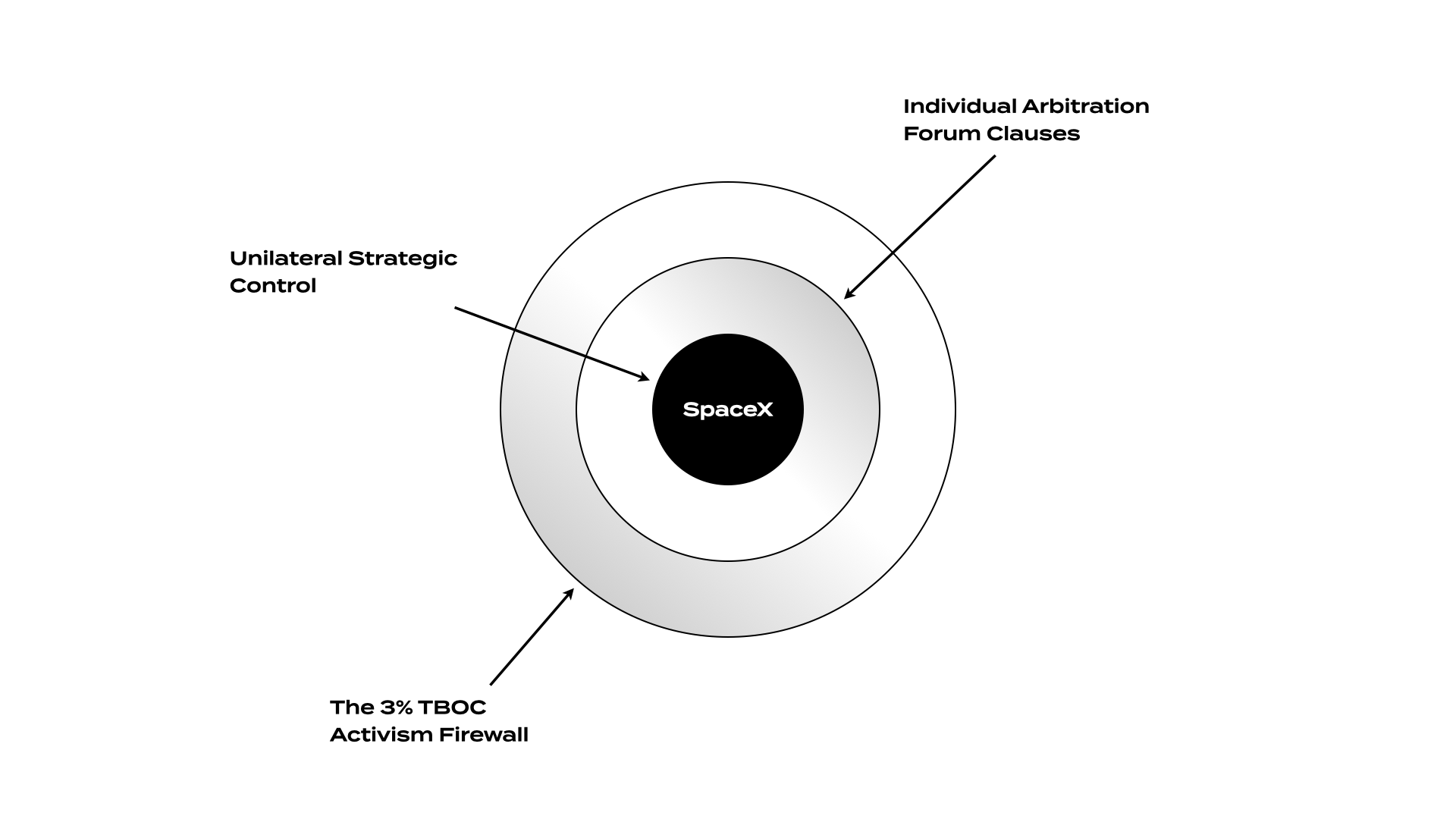
Figure 3: Concentric Corporate Architecture - The Three-Layer Insulated Governance Firewall
The Forensic Diagnostic Verdict
The SpaceX offering represents a historic paradigm shift in the structural layout of the public equity markets. It is not a traditional public listing; it is a giant, late-stage venture capital bridge utilising a public equity framework to harvest sovereign-scale liquidity.
Through custom index adjustments, systemic capital siphoning from Level 0 bounds, and strict governance parameters, management has successfully engineered a capital fortress that completely insulates them from public market impatience.
Investors are not buying a standard, asset-backed stock. They are purchasing a highly premium-priced narrative wrapper around an un-bookable operational ecosystem. The ultimate risk is not the immediate paper dilution down to $8.87; it is whether an investor is willing to trust the narrative completely blindly, knowing that eventually mathematics always solves for X, and gravity always wins—even in space.
Like Eisman, I am not a fan.
When an IPO valuation relies on a market built primarily on speculative AI projections and asteroid mining—rather than core rocket engineering—you are not buying a stock. You are buying a very expensive narrative wrapper.
Sometimes, the best clinical diagnostic is simply knowing when to pass.
(Diagnostic Safety Notice: This essay constitutes a purely clinical, forensic analysis of publicly available regulatory disclosures and prospectus documentation for the purpose of architectural evaluation. It is absolutely not financial advice, a market recommendation, or a live investment tip. I provide this explicit clarification to satisfy overzealous compliance gatekeepers, corporate risk algorithms, and any reader who mistakes baseline asset analysis for a securities endorsement. If you choose to swap your capital for space alchemy, that remains a strictly private matter between your broker, your conscience, and your bank account.)
Beyond the Streetlight Effect: An Alternative Path to LP Autonomy in Continuation Vehicles
With 80% of LPs cashing out of Continuation Vehicles (CVs), the industry is demanding more GP transparency. However, asking for better spreadsheets is merely the “Streetlight Effect”. Discover how LPs can achieve true investment autonomy by bypassing GP narratives and deploying independent operational telemetry—an Organisational CT Scan—to measure invariant asset health.
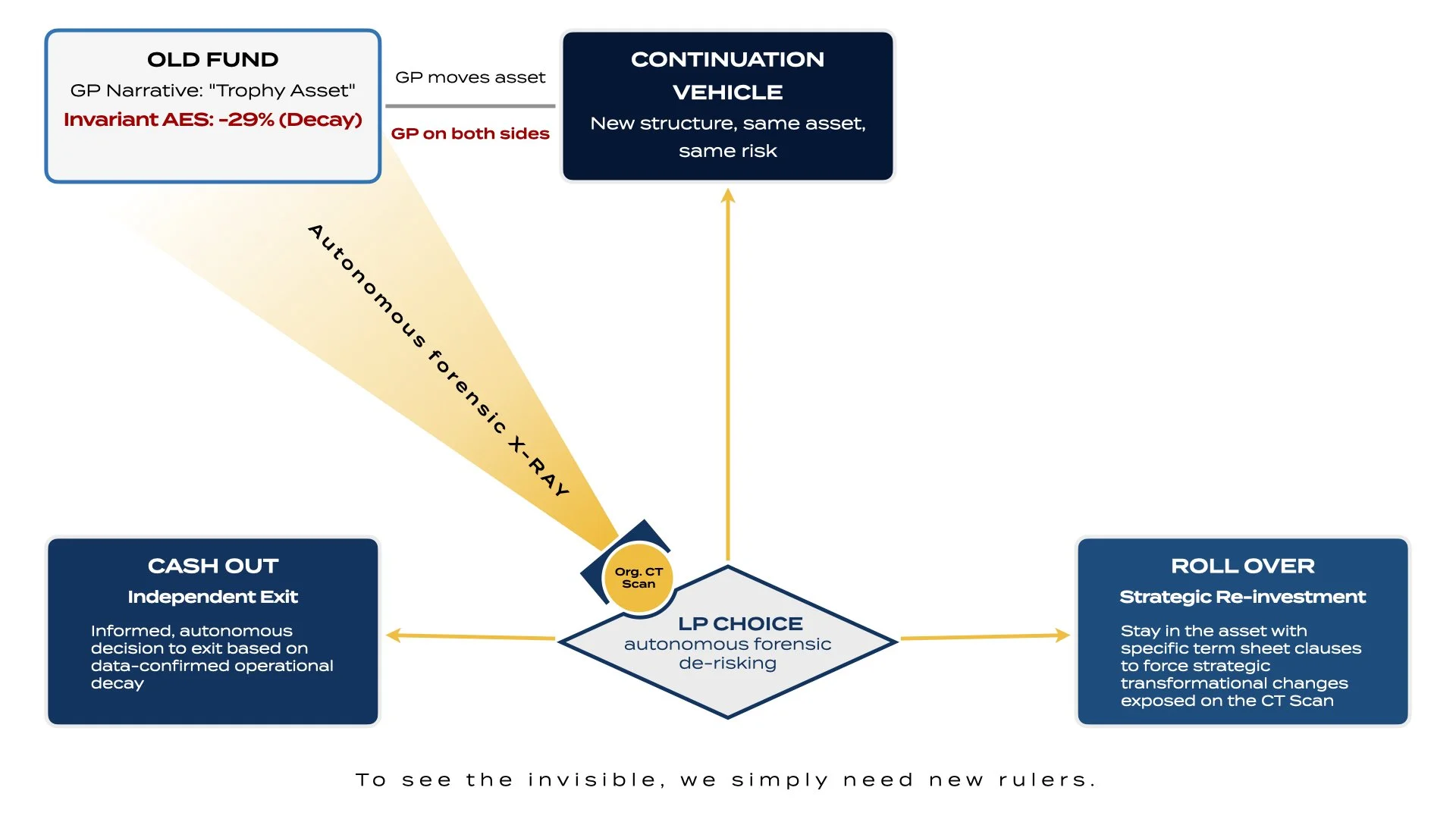
Professor Claudia Zeisberger raises the Private Equity cycle's defining question: when a GP moves a trophy asset into a Continuation Vehicle (CV), “Do LPs actually understand what they're being offered to roll into?”
As a lead diagnostician, my answer is no—but the “why” offers a fascinating opportunity.
This uncertainty drives severe market friction. Alexandra Heal’s Financial Times report “Private equity investor body sounds alarm on ‘conflict vehicles’” highlights a structural symptom: 80% of LPs cash out of CVs, increasingly viewing them as “conflict vehicles”. Consequently, ILPA is rallying General Partners (GPs) for more “transparency”.
I view this challenge differently. Demanding transparency within the current system mirrors the “Streetlight Effect”—searching for the lost keys under a lamppost simply because that is where the light is.
Here, financial models and GP-authored memos are the lamppost. Limited Partners (LPs) ask GPs to turn up the brightness (transparency). Yet, if an asset’s root-cause contagions lie outside that illuminated circle, brighter engineered metrics will not locate the missing keys.
To see the invisible opportunity, we must assess asset health exactly as a cardiologist examines a patient:
The patient “looks” fine (the GP’s “Trophy Asset” narrative).
The doctor prescribes standard treatment (conventional CV pricing and memos).
The scan exposes undeniable arterial plaque as a percentage, confidently providing a risk assessment (hidden structural decay).
A CAC scan bypasses surface symptoms to measure physical reality. If an asset hides a 29% structural decay beneath its financial façade, asking GPs for better spreadsheets will not uncover it.
A suggestion perhaps is move beyond prescribed guidelines hoping for GP collaboration, and instead explore autonomous PE “CAC Scores”.
LPs could hold such a key today. By running an CAC scan equivalent—using external shadow data to trace operational telemetry—LPs tangibly could calculate invariant health without demanding transparency or GP permission.
Shifting to such autonomy, would open an alternative path for LPs in Continuation Vehicles, without conflict. Independent telemetry evolves LPs into autonomous decision-makers.
To see the impossible, we simply bring a new ruler.
Measuring The Unmeasurable: Breaking the One-Way Mirror of Private Equity
Drawing a profound parallel between a flawed medical playbook and the Private Equity industry, this article exposes how standard financial metrics mask the hollowing out of enterprise value. Discover how the Asset Efficiency Score (AES) provides an independent, mathematically verifiable ruler to break PE's one-way mirror, empowering LPs to bypass rigged data and isolate true GP skill from mere market luck.
For the past decade, my work has been purely diagnostic—stepping beyond the standard 'Streetlight Effect' of financial reporting to quantify the unmodelled operational realities that silently hollow out enterprise value. I built the Organisational CT Scan to reverse-engineer these hidden mechanics, helping teams anchor due diligence in measurable friction recovery rather than just treating surface-level metrics.
It is the difference between handing a management team a financial painkiller to temporarily mask the symptoms, versus isolating the root-cause contagion that is actually hollowing out the host.
This relentless focus on exposing the 'unseen' didn't start in a boardroom. It is deeply personal.
For 40+ years, I have lived with Type 1 Diabetes. The established medical 'playbook' dictated I eat 360 grams of carbohydrates daily. This prescribed diet guarantees hyperglycaemic spikes, just as the massive insulin doses required to counteract them guarantee hypoglycaemic crashes. Both extremes silently hollow out the human body. This is the 'playbook' roller-coaster we are expected to endure—where losing a limb is considered an acceptable outcome. It is a playbook that literally prescribes the exact kryptonite that destroys the body. I had to know why.
Just over ten years ago, I rejected this 'normal'. I questioned the truth and reverse-engineered how the system evolved over a century to define the playbook they blindly follow today. When I finally pushed against the system and forced my doctors to give me a simple, fast, non-invasive CAC Scan—a Coronary Artery Calcium (CAC) scan is a non-invasive, low-dose CT scan that measures the amount of calcified plaque in the heart's arteries, providing a score that helps predict future heart attack risk—to prove my internal health, the results shattered their assumptions.
Yet, 99% of the medical ecosystem isn't interested because the truth sits outside their 'Streetlight Effect'—a truth that doesn’t make the industry money. They blindly follow the prescribed 'accepted' lie. The system is rigged in their favour, giving them plausible deniability and liability cover.
The Private Equity Playbook
At the exact same time I began applying my diagnostic lens to corporate assets, I saw the exact same rigged system.
I saw Private Equity’s vast, invisible spider’s web influencing and hollowing out the brands everyday people use—manipulating those assets to serve General Partner (GP) incentives rather than the asset's actual health. The Private Equity industry is structurally misaligned. Taking on a trillion-dollar industry means facing an establishment that desperately needs the current narrative to remain true.
GPs use debt, manipulate IRR, and ride market tailwinds to simulate 'Alpha'—charging astronomical ‘2 and 20’ fees for what is actually just market 'Beta'. Like my doctors over the years, they are following a global playbook that enriches the system while destroying the host, relying on opaque shadow data to hide the reality.
“To see the invisible, we simply need new rulers.” — Morten J. Sørensen
Because internal emotional and operational friction is hard to measure, GPs easily hide behind this shadow data. Without a new ruler for operational reality, Limited Partners (LPs)—the pension funds and sovereign wealth funds supplying the capital—cannot verify if a GP actually generated true value (Skill) or simply rode a wave of leverage and market tailwinds (Luck).
It is time to break the one-way mirror of Private Equity.
The Diagnostic Baseline (AES)
If we are to isolate GP skill, we must measure unseen operational reality, not just financial outputs. A personal cardiac CT scan—revealing internal homeostatic health long before external symptoms appear—sparked the Genesis breakthrough.
Using this concept, we can establish an independent, externally verifiable Asset Efficiency Score (AES). Its inverse, the Asset Inefficiency Score (AIS), quantifies the exact volume of unpriced value actively trapped within a company's human and operational friction, transforming it into a measurable metric:
This establishes an uninfluenced, true operational baseline of the asset—completely independent of its financial market valuation and, crucially, agnostic of the GP's self-reported data.
The Hypothesis: The Variance of Skill
Since we can measure an independent operational baseline friction, we can isolate the GP's actual impact without relying on their data room.
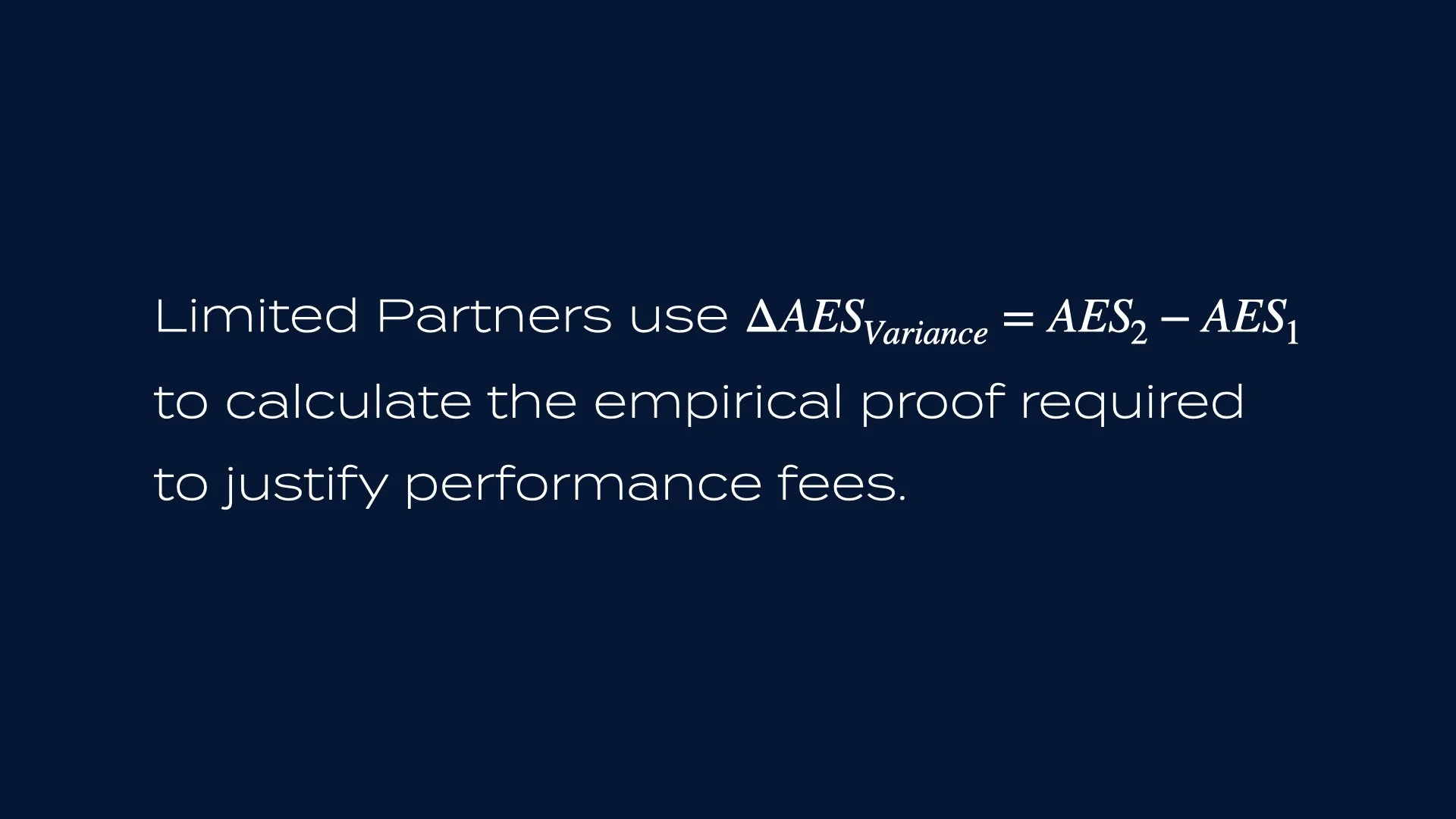
We establish the baseline prior to GP intervention (AES 1) and conduct secondary scans during and following their ownership period (AES 2). That longitudinal variance mathematically strips out market noise to reveal true operational skill and value creation:

Protecting the LPs: The Implication of the Ruler
By measuring Delta AES_Variance, we effectively strip away market exit multiples (M) and sector Beta.
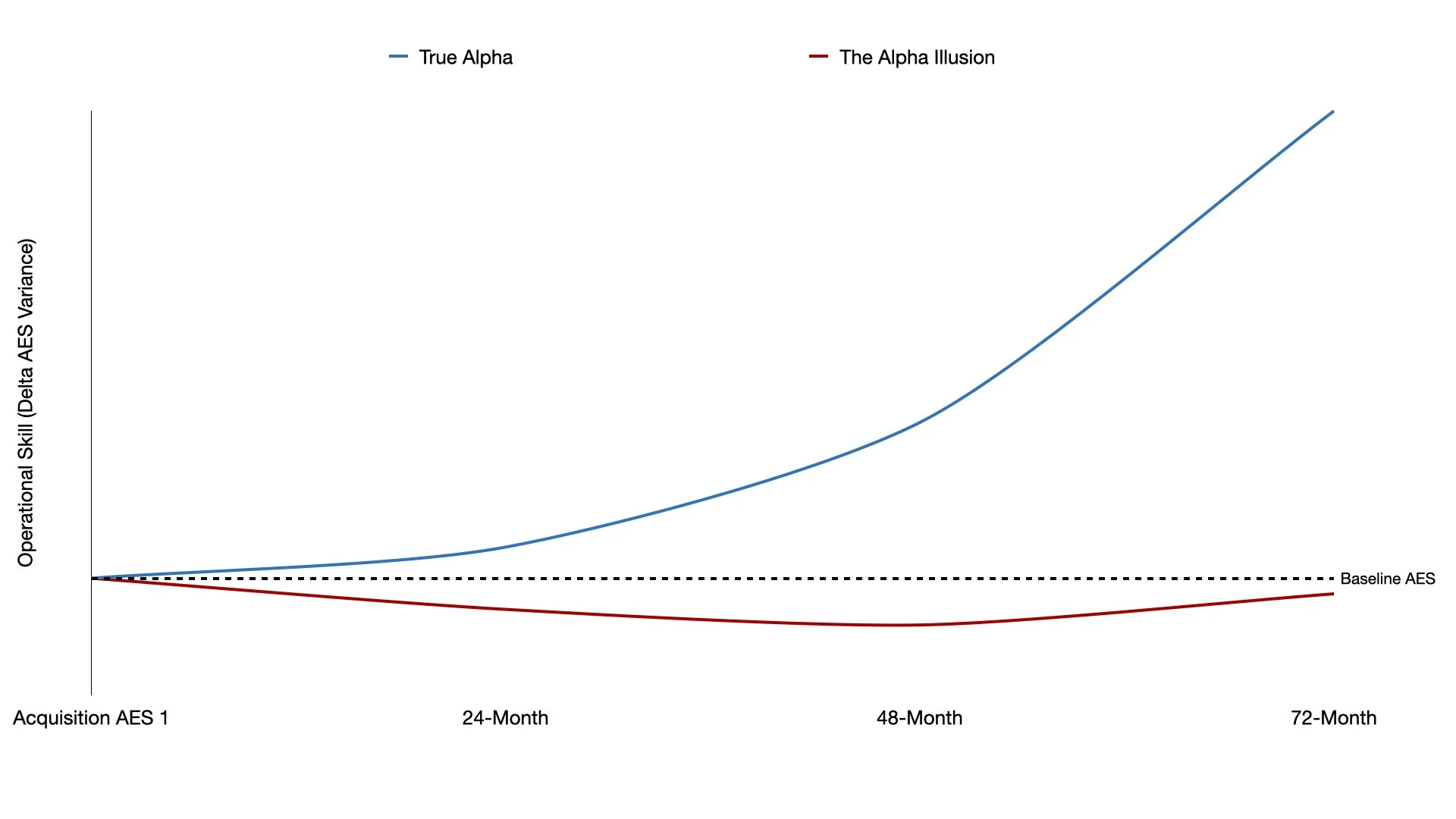
The Alpha Illusion: If Enterprise Value expands but Delta AES_Variance remains static, the outperformance is mathematically proven to be market luck. The GP did not fix the asset; they just held it, manipulating the balance sheet while charging astronomical fees.
True Alpha: A positive Delta AES_Variance isolates true, proprietary skill, providing the missing empirical proof required to potentially justify performance fees.
Because the AIS exposes strictly hidden, trapped EBITDA, resolving this friction is a positive-sum value creator flowing directly into unpriced EV.
The Retroactive Audit: Nothing is Safe
Crucially, because this diagnostic is completely agnostic and externally verifiable, it bypasses the GP's shadow data entirely. LPs no longer have to ask the GP for permission to understand the health of their own capital.
But the implications go far beyond active portfolios. Because the diagnostic relies on independent, uninfluenced metrics, LPs can retroactively build a GP’s historical AUM performance chart. They can effectively audit a GP's legacy funds to mathematically prove whether past ‘Alpha’ was generated by operational skill or merely fuelled by low interest rates and financial engineering.
Nothing is safe from the possibilities of an Organisational CT Scan.
We cannot fix a rigged system by asking the architects of that system for their data. To see the invisible, we simply need new rulers.
The Anatomy of a Fiduciary Rescue: Restructuring a 70-Year Family Legacy
The most dangerous phase of institutional decay is the quiet ‘Illusion of Health’. Operating as Chief Restructuring Officer, I deployed the Organisational CT Scan to rescue a 70-year Single Family Office just 12 months from total bankruptcy. Discover how we dismantled predatory leverage, arrested the Integrity Tax, and found the key to the estate's survival on a single sheet of paper hidden in a 30-year stack.

The most dangerous phase of institutional decay is not the collapse itself; it is the quiet, sustained ‘Illusion of Health’ that precedes it.
I was recently retained on a three-year mandate, holding full living power of attorney, to execute the fiduciary rescue of a highly distressed Single Family Office. Following the principal's severe health diagnosis, I was brought in to stabilise what appeared, on the surface, to be a sophisticated and secure portfolio.
What I discovered beneath the standard reporting was a catastrophic, compounding liquidity crisis.
Upon deploying my proprietary ‘Organisational CT Scan’, the homeostatic baseline of the estate was deemed critical. Just as an individual can appear perfectly fit while harbouring undiagnosed, systemic inflammation, this estate had settled into an unhealthy equilibrium. Systemic structural liabilities had left the Family Office with less than twelve months of liquidity before total, unavoidable bankruptcy. A 70-year generational legacy stood on the precipice of ruin.
Here is how we halted the Integrity Tax, unwound the contagion, and secured the heritage of the asset.
Auditing the ‘Shadow Data’: Breaking the Gestalt Illusion
In the world of generational wealth, standard financial reporting relies heavily on the ‘Streetlight Effect’—searching for value only where the light of conventional metrics shines brightest. The family’s external advisories had effectively trapped the estate inside a ‘CEO Bubble’, feeding the principals only what they wanted to hear while masking the deep, internal decay.
To the untrained eye, the estate’s reporting looked like a complete, unbroken circle. But our brains are wired for Gestalt Closure; we instinctively project completeness onto broken patterns. As a Diagnostician, my job is to ignore the projection and find the gap.
By bypassing the dashboards and forensically auditing over 30 years of physical documentation and tracing the invisible threads within 20,000 digital communications, the true diagnostic exposed a highly predatory ecosystem. The estate was suffering from over €10,000 in monthly recurring capital bleeds, cleverly disguised as ‘advisory subscriptions’ and ‘training services’. These were not legitimate advisories; they were the root-cause contagion feeding a compromised portfolio of (un)regulated alternative assets.
The Execution: Heavy Lifting and Structural Remediation
Value creation in a distressed asset does not begin with generating new revenue; it begins with ruthlessly arresting the bleed. The mandate required immediate, structural remediation across three fronts:
Unwinding the Toxic Debt Stack: The most severe contagion was a multi-layered, predatory leverage structure involving seven interdependent finance deals. The estate had been manipulated into an unsustainable death spiral: a final, rapidly depleting credit facility was being used solely to mask the interest burden of the preceding six loans. This loop was designed by bad actors to manufacture the illusion of profitability. We systematically dismantled this entire leverage stack.
Asset Liquidation and Risk Mitigation: I traced, isolated, and unwound a portfolio of highly toxic investment vehicles—including cryptocurrency, blockchain, and AI schemes—none of which survived rigorous operational due diligence. By halting all predatory subscriptions and liquidating the remaining viable assets, we immediately severed the estate's capital bleed.
Restoring Absolute Financial Integrity: This was not merely an accounting exercise; it was a legal extraction. We mitigated all catastrophic counterparty risks, legally and structurally severing the estate from fraudulent operators to restore foundational financial integrity.
The Turning Point: The 30-Year Stack
The ultimate rescue of the estate was not born from financial engineering, but from the relentless discipline of the diagnostic process.
The turning point—the mechanism that finally rescued the estate from absolute insolvency—was discovered on a single sheet of paper, concealed within a 30-year stack of physical paperwork. That single document, overlooked by years of symptom-based management, provided the leverage required to halt the terminal trajectory.
The Diagnostician’s Verdict
For years, this Family Office existed as a financial Schrödinger’s Cat. It was simultaneously wealthy on paper and entirely bankrupt in operational reality, locked securely inside an Opaque Black Box.
I did not simply wind down the operations of this estate; I structurally transformed its trajectory. By applying the Organisational CT Scan to open that box, we removed the unmeasured friction, the predatory leverage, and the strategic disconnects. We successfully preserved the core heritage of the assets, transitioning the Family Office from a terminal bankruptcy trajectory to a secured, generational legacy, ready for the succeeding inheritor.
Once the truth of an asset is illuminated, you can never unsee it. True operational alpha is not found under the streetlight. It is found by daring to look where others will not.
The Streetlight Effect in Energy: Why Fragmented ROI Keeps You Vulnerable
What happens when a diagnostician applies the Organisational CT Scan to a 120-year-old family home? Conventional wisdom and fragmented metrics predicted financial ruin. But by looking beyond the Streetlight Effect, discover how an interconnected €30,000 energy matrix transformed from a perceived liability into a compounding asset, yielding true energy sovereignty and a 6.8-year systemic ROI.

That was exhilarating. What happens when a diagnostician turns the Organisational CT Scan upon their own family home? Waiting twelve months to absolutely find out whether you were right, or if you simply threw away the family fortune.
I recently analysed our 1907-built house as a living system. The objective was to eradicate tangible geopolitical risks, mitigate financial friction, and engineer a profoundly more resilient and welcoming environment.
A year ago, we deployed considerable capital into a tripartite energy matrix: a 20 kWh home battery, a 25-panel solar array, and a 100% electric heat pump. Crucially, we executed this all at once, not piecemeal.
We knew solar arrays worked. We knew batteries sounded excellent in theory, and the incredible claims of generating three times the energy for every 1 kWh supplied to an air-source heat pump sounded too good to be true. Yet, few had dared to experiment with whether this would function within a house built over 120 years ago. We had no cavity walls, minimal insulation, and merely older double-glazing retrofitted into original hardwood frames. Conventional wisdom pointed to an inevitable investment failure. If one were to simply read the mainstream media, one would run a mile from such a seemingly mad upfront expenditure.
However, as I reviewed hundreds of papers and articles, an outline began to form—a wireframe of something vastly more valuable. The catalyst for this thinking was our experience living with an electric vehicle (EV).
Our EV had proven significantly more reliable, dependable, and comfortable than any traditional internal combustion engine (ICE) vehicle we had leased over the past three decades. But there was one specific variable that made the difference: the flawless, end-to-end integration between hardware and software. This orchestration mitigated the risk of mechanical or operational failure. If an anomaly appeared, an autonomous software update was deployed. These software-driven EVs actually improved with time—an impossibility with traditional ICE cars.
This prior due diligence served as the intellectual foundation for our home. I hypothesised that if three independent hardware systems could be orchestrated by a single software ecosystem to operate as 'ONE', the mathematics would ultimately validate the investment for our 120-year-old house.
My peers called me crazy. They warned that the investment would never yield a return and that the heat pump would leave us freezing in a poorly insulated, century-old house. Their reaction is entirely understandable. In fact, it reflects a principle I see in boardrooms daily: we are actively trained to evaluate operations using 'old rulers'—metrics that practically guarantee we will talk ourselves out of progress.
The Illusion of Fragmented Metrics
If you measure the future with tools designed for the past, my peers were entirely correct. Viewed as disconnected line items under the 'streetlight effect'—the cognitive trap of only seeking value where it is easiest to observe—the returns are abysmal.
Let us be mathematically precise about what this capital allocation truly represents. In corporate finance terms, we are discussing a strict CapEx (Capital Expenditure) deployed from retained earnings. For this use case, when a family contemplates an investment of approximately €30,000, they are deploying net, post-tax income—their highly protected Free Cash Flow (FCF). To accumulate €30,000 in liquid 'dry powder', a household must typically generate closer to €60,000 in top-line gross earnings. The tax authorities claim their share long before a single solar panel is procured, representing a brutal EBITDA-to-FCF conversion drag.
Therefore, a capital deployment decision is never merely about the cash at hand; it must clear a steep hurdle rate, weighed against the sheer, arduous operational effort required to generate that capital in the first place. A family can only allocate the €30,000 net, yet they had to double their top-line output just to secure it. When measured against this unforgiving reality of gross earning effort, the fragmented Return on Invested Capital (ROIC) looked like this:
Battery: 14.2-year payback.
Solar: 13.4-year payback.
Heat pump: 25.4-year payback.
This is exactly how organisations evaluate their operations. They scrutinise siloed business units, fixate upon the friction of the initial CapEx, and conclude that the investment is structurally unviable. They perceive a 'broken O' and fixate upon the Relative, entirely missing the Absolute.
Examining the Interconnected Network
Diagnosticians do not look at isolated parts; we examine interconnected networks. Connecting this hardware transformed our household from a passive consumer into an 'invisible' micro-utility capable of stabilising the energy grid.
This transformation requires a provider (in our case, Zonneplan) that understands the critical interplay between hardware, software and the dynamic wholesale prices in real time to orchestrate 'invisible' value. Finding ‘that’ rare provider is the key. When you view the system holistically, through that new lens, the 'Shadow Data' models a profoundly different, Absolute reality.
After a full twelve months, the verified numbers are in:
We consumed 30.76% more electricity.
We burnt zero gas (this held the biggest risk).
Total utility energy expenditure dropped by >78%.
The True ROI: From Cost Recovery to Compounding Yield
The actual systemic payback for the entire matrix?
Approximately 6.8 years (net)
But the break-even point is merely the first chapter of this financial narrative. Where the 'old rulers' fail most spectacularly is in their inability to measure what happens on day one of year seven.
Once that 6.8-year threshold is crossed, the initial CapEx is entirely recouped. From that moment forward, the matrix transitions from a liability in recovery to an unencumbered asset generating pure, compounding Free Cash Flow.
Consider the operational lifecycle of the underlying hardware. The solar array carries a robust 25-year performance guarantee, and the home battery is warranted for 15 years. The heat pump—often misunderstood by the market as a fragile novelty—is structurally more reliable than a legacy combustible gas boiler. With routine servicing, it runs approximately 33% cheaper to own and maintain over its lifespan, permanently suppressing our baseline operational expenditure (OpEx).
For the subsequent decade—and in the case of the solar array, nearly two decades—this interconnected system will operate as a high-margin annuity, delivering unchecked yield long after the initial capital has been returned. That is the authentic Total Cost of Ownership (TCO) and true ROI calculation that fragmented, silo-based accounting consistently obscures. We did not merely buy hardware; we acquired a long-term cash-generating asset.
And what of the physical reality of living inside this matrix? This compounding financial value held true despite a significantly colder, snowier start to the 2025/2026 winter. As for my peers' warnings that we would be left freezing? Far from it. We actually raised our baseline thermostat by over 10%. As my wife Victoria recently noted, our consignment of extra-thick jumpers and Snoodies™ has officially become obsolete.
The Sovereignty Dividend: Measuring Emotional Freedom
Financial mathematics, however, serves merely as validation. The true value is immeasurable by spreadsheets.
Today, in March 2026, global crises are wreaking havoc upon our energy markets (again). The 'invisible thread' connecting international conflict to every family's energy bill is ruthless and direct. It is precisely this thread I sought to sever four years earlier. Following the discarded breadcrumbs revealed the hidden Absolutes that fixing the Relative in isolation never could.
After our first full year operating this system, we hold the evidence. We have insulated our family castle from the contagion of global instability. Such sovereignty is worth ten times the initial investment. That emotional freedom, for us, is priceless. And just like how an autonomous software update actually improves an EV over time—our 1907 house can only appreciate in systemic efficiency from the homeostatic baseline we have now established. That is the ultimate operational leverage.
The Weight of Absolute Truth
A peer recently remarked to me that being a diagnostician is a fascinating path, but one that requires absolute honesty. He is right. People rarely enjoy having their 'broken O' pointed out, but the pursuit of systemic truth is entirely worth it.
I am sharing this deeply personal financial and operational data for a single reason: transparency. I place absolute accountability squarely at my feet. If my maths is flawed, I inflict a severe capital 'misallocation' upon my own family. That carries the full weight of responsibility.
But absolute truth transforms understanding. The invisible remains so only until measured. Whether I am decoupling my family home or exposing a €4.92 billion gap in Enterprise Value at Vinted, the lesson remains identical.
The 'old rulers' will keep you dependent and vulnerable. The new rulers are on the table. Let’s see who is ready to use them.
The Diagnostician's Blueprint
For executives, operating partners, and value creation teams wanting to de-risk their portfolios and reverse-engineer the exact mechanics of how to begin measuring these 'invisible' new paths, the foundational framework—the Organisational CT Scan—is detailed in my book, Who Moved My Customers?
To buy a copy for your own library choose Amazon or Signed Copy by the Author.
The Declassification of The Vinted €5 Billion Alpha Key™ Report
The most expensive sentence a firm can utter is, "I do not believe it." I am officially declassifying my €330,000 institutional-grade dossier on the Vinted Group. By applying the Organisational CT Scan and the mathematics of the "Integrity Tax", this report reveals the exact structural variances blinding Vinted and its Private Equity backers to €4.92 billion in missed Enterprise Value. Download the blueprint. You tell me: Is my maths wrong?

The most expensive sentence any firm can utter is, ‘I do not believe it.’
For a long time, I did not believe it either.
When I first saw the massive financial leaks hiding in the gap between a boardroom’s promise and the customer's reality, the scale of missing revenue felt too incredible to be true.
Rather than accepting disbelief, I moved beyond the ‘streetlight effect’—the cognitive bias of searching only where it is easiest to look. I stepped past standard metrics and searched the shadows. Holding undeniable proof of unseen friction and lost value in my hands, I spent a decade reverse-engineering those discoveries.
That framework became the Organisational CT Scan.
The CT Scan's sole purpose is to illuminate an asset's ‘Shadow Data’, tracing invisible breadcrumbs to the absolute root-cause contagion. Once isolated, millions of customer ‘gut feelings’ transform into a quantifiable macro-data set to calculate an asset’s Integrity Tax.
In the boardroom, metaphors invite debate; maths invites action. The Integrity Tax is the compounded variance between a system’s designed intent and its operational reality. It is the invisible surcharge paid when data, process, and strategy disconnect, multiplied by the velocity of scale:
This tax monetises the exact structural variance to expose the unpriced Enterprise Value (EV). The maths is asymmetrical, precise, and ruthless.
I am not here to convince anyone; that leap is yours. To remove the friction of disbelief, I am officially declassifying my €330,000 institutional-grade dossier on the Vinted Group. It illuminates the frustrations of their existing user base—their 'why'—and how these ‘gut feelings’ amplify across the hyper-connected Small-World Network.
Inside are the precise execution coordinates and a new B2B revenue engine detailing how Vinted is blinding itself to €4.92 billion in missed Enterprise Value. Vinted is rumoured to be exploring a secondary share sale valuing the company at ~€8 billion. Why not grab the full €10-13 billion?
Building a network of this scale is a monumental achievement. I offer this diagnostic blueprint humbly to Thomas Plantenga, Adam Jay, and the Vinted team, alongside their backers at TPG, EQT Group, Accel, and Lightspeed Venture Partners. Here's to your next historic milestone.
Reverse-engineer my maths. If the numbers spark curiosity on how to bypass generic cost-cutting and uncover trapped top-line revenue in your own firm, coffee is on me in Amsterdam.
If you think, ‘That isn’t happening to us’, the deafening silence of your departing customers would strongly disagree. To see the ‘invisible gorillas’ tearing through your portfolios, you don’t need more data. You need new rulers.
Download the full €5 Billion Vinted Group audit document as a PDF below. You tell me: Is my maths wrong?
Author’s note: I declassified this €5B report for a single reason: transparency. It places absolute accountability squarely at my feet. I cannot hide behind this dossier's findings. If the maths is wrong, I am wrong, and I will take full public responsibility.
To the executives, operating partners, value creation teams, and performance improvement advisory firms underwriting the next wave of European growth capital: physical copies of this diagnostic blueprint are currently sitting on the desks of two leading PE Performance Improvement firms.
The baseline for uncovering true Enterprise Value has shifted. Value now compounds—or collapses—at the exact speed of the inescapable Small-World Network contagion. You cannot cost-cut or strategise your way out of a structural contagion; the customer’s reality always wins.
For those wanting to reverse-engineer the exact mechanics of the Integrity Tax and the Organisational CT Scan, the foundational framework is detailed in my book, Who Moved My Customers? (available on Amazon, or as signed copies via my website).
The new rulers are on the table. Let’s see who is ready to use them.
The €1.375 Billion Validation: How a PDF jumped the “Small-World Network” to change Hugo Boss
On January 8, 2026, HUGO BOSS validated a €1.375 billion diagnosis. This is the forensic timeline of how a single Diagnostic Alpha report traversed the "Small-World Network" to bypass the boardroom's immune system, overcome the "I Don’t Believe It" filter, and transform a womenswear blind spot into corporate strategy.

Date: January 2026
Case: HUGO BOSS AG
Asset Class: Diagnostic Alpha
The Most Expensive Sentence in Business
There is a parable I often share about a policeman finding a man searching for his keys under a streetlight. When asked if he lost them there, the man says, “No, I lost them in the park, but this is where the light is.”
This is the Streetlight Effect. In the corporate world, there is a gravitational pull to focus only on visible, comfortable metrics—Gross Margin, Sell-Through, Wholesale Volume—while ignoring the massive value leaks hidden in the operational shadows.
For the last decade, I have observed a recurring pattern. When I present a CEO with forensic evidence of a billion-euro opportunity hiding in those shadows, the initial reaction is rarely joy. It is denial.
“I don’t believe it.”
That sentence is the most expensive liability on any balance sheet. It is the sound of Organisational Homeostasis—the immune system of a company fighting to keep things the same, even when “the same” is slowly eroding its foundation.
But occasionally, the logic of the shadow becomes too powerful to ignore.
The €1.375 Billion Mirror
On September 1, 2025, I published a forensic diagnostic titled The €1.375 Billion Irony and shared it publicly.
The report wasn’t a critique of fashion; it was an audit of value. It diagnosed HUGO BOSS with a structural blindness: the company was treating its womenswear division as a “stylish afterthought”. The data was unequivocal—the division had collapsed from a peak of over 13% of group revenue to a four-year average of just 6.8%.
My prescription was surgical: To capture the €1.375 billion in annual revenue that was missing, the company needed to stop treating womenswear as an adjunct to the men’s business. It required a “surgical separation”—a standalone business unit with the autonomy and expertise to see the female customer who had been waiting in the dark.
Four months later, the diagnosis became strategy.
In January 2026, HUGO BOSS announced a radical restructuring: the creation of an independent Womenswear Business Unit and the appointment of Kerstin Dorst to lead it.
The alignment between the Diagnostic Alpha prescription and the corporate execution is a near-perfect mirror:
The Diagnosis (Sept 2025): I argued the brand failed to “see” the female customer, citing Dr. Kerstin Brehm’s feeling of being invisible.
The Execution (Jan 2026): The company appointed a specialist leader explicitly to “address gender-specific preferences even better.”
The Irony: In a poetic twist of validation, the company hired a Kerstin (Dorst) to answer the question posed by a Kerstin (Brehm).
The Physics of the Pivot
How does a PDF report from an external consultant migrate to the boardroom agenda of a DAX-listed giant in four months?
It is the physics of the Small-World Network.
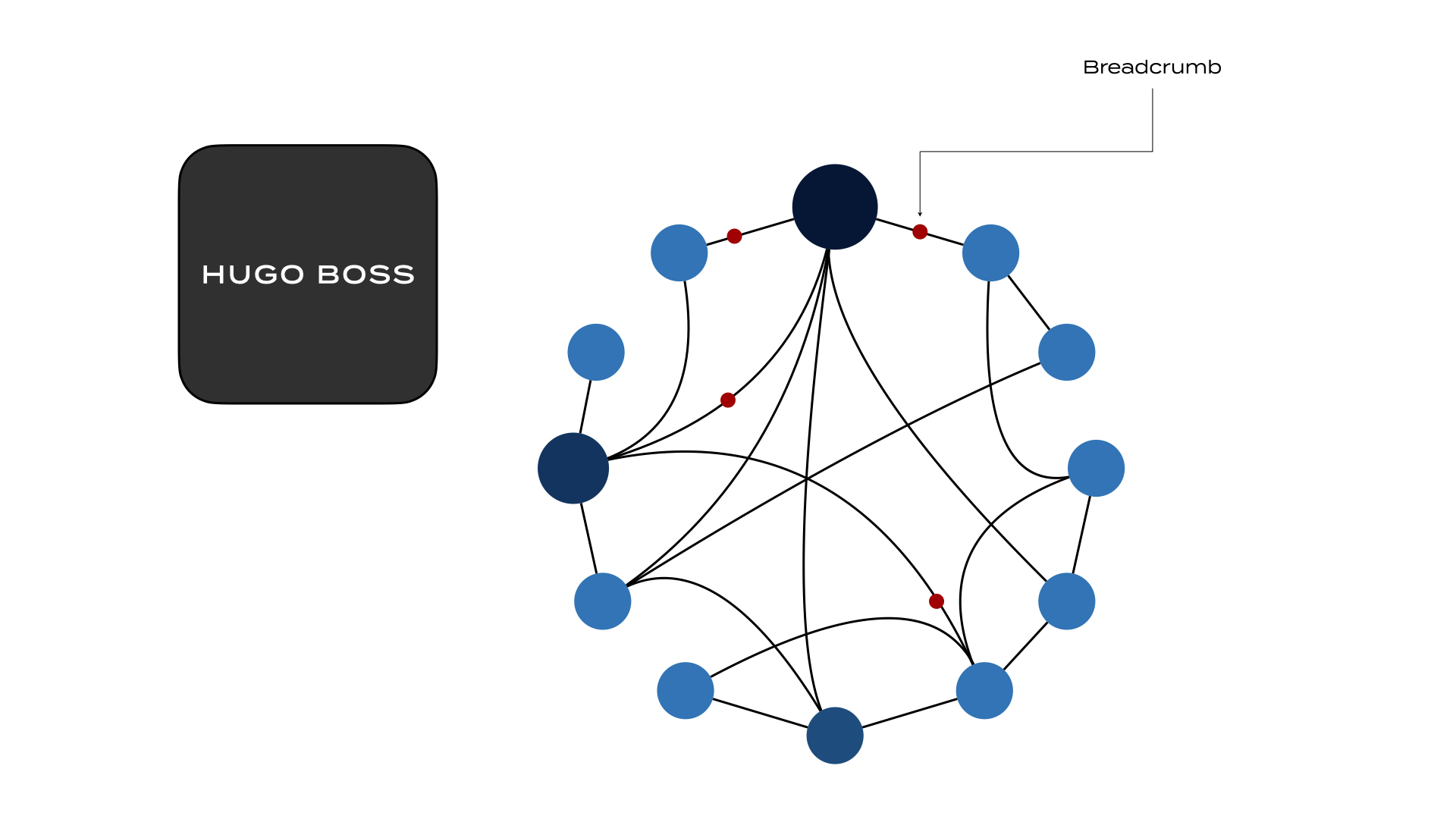
Our forensic analysis of the report’s digital footprint revealed that the “injection” occurred immediately. Within weeks of publication, nearly 2% of the report’s readership consisted of Hugo Boss insiders—specifically, directors and VPs.
The idea didn’t need to go viral globally; it just needed to infect the decision-making nucleus. Through private channels—the “Dark Social” network of saves and forwards—the diagnostic bypassed the “I don’t believe it” filter and landed on the strategy deck.
The Lesson: New Rulers for Old Problems
The HUGO BOSS case is not unique. It is simply the most visible validation of a universal truth:
“To see the invisible, we simply need new rulers.”−Morten J. Sørensen
The “Old Rulers” (traditional KPIs) told HUGO BOSS that womenswear was a difficult market. The “New Rulers” (Diagnostic Alpha) revealed it was a billion-euro opportunity disguised as a problem.
The company has now turned its streetlight toward that billion-euro opportunity. They have moved from “I don’t believe it” to “Let’s build it.”
For the rest of the market, the question remains:
What billion-euro “Invisible Gorilla” is walking through your business and investment right now, waiting for someone brave enough to turn on the lights?
READY TO TURN ON THE LIGHTS?
If your organisation is ready to move beyond “Organisational Homeostasis” and identify its own billion-value blind spot, initiate an Alpha Key™ Forensic Audit.
We apply the same methodology used to diagnose HUGO BOSS, PRADA, VINTED, TIMBERLAND, and PAUL SMITH.
INITIATE DIAGNOSTIC BRIEFING.
Root Cause Contagion: How Small Failures Drive Systemic Decay Within Organisations
A €1.7B loss began with a single €0.02 failure. Follow the breadcrumbs to how this "Root Cause Contagion" impacts every group revenue, margins, and market cap in the billions. It reveals the core principle: organisations miss unseen value by mistaking massive financial symptoms for a single, tiny, broken customer promise.

Following the €0.02 breadcrumb impacting group revenue, margins, market cap and enterprise value by billions
In our pursuit of understanding the grand and complex systems that govern our lives—economies, corporations, societies—we are trained to look for grand and complex causes.
We seek the macro-event, the dramatic failure, the singular catastrophic decision that explains a collapse. We scrutinise the financial statements, executive strategies, and market trends, believing that a €1.7 billion loss must have an equally enormous and visible cause. We are looking for the earthquake.
And in doing so, we miss the truth. We dismiss the humble, everyday clues, such as the €0.20 tea light, which had a successful €0.02 operational efficiency makeover. One that caused a silent earthquake. This is just such a true story.
This is the philosophical decay at the heart of our system. The proposition that a "Root Cause Contagion" begins with such an infinitesimal failure isn't just a "diagnostic"—it's the unbelievable, horrifying truth. It is a deep, ethereal, and epistemological challenge. I know; I followed that trail past and deep into the shadows.
The organisations we build are not the monolithic, top-down empires we imagine. Instead, they are a living, breathing network. The real strength of a brand is not its logo or its assets, but how it is built to live in people's minds—a fortress of memory, emotion, and meaning cultivated over time.
This is the true "small-world" constellation of customer perceptions, trust, and feelings. It's a reality that cannot be defined or shown from a balance sheet; it is the millions of different versions of the same brand. Each version lives in the mind of an individual customer, and collectively, this is what defines every brand and organisation.
The Breadcrumb and the Shadow: An Epistemological Crisis
The fairy tale of Hansel and Gretel is a fitting analogy here. Each failure, no matter how small, leaves an “invisible piece of thread”: a breadcrumb. It's the toothpick lying on the carpet outside the CEO's office in Subir Chowdhury's book The Difference: When Good Enough Isn't Enough. Why did no one who that day walked into the CEO's office stop, pick it up and put it in a bin? That tells you everything you need to know about that company. This presents an epistemological problem: how did we learn not to see what is visible?
The €1.7 billion loss in turnover from the €0.02 cost-saving program was the long symptom shadow that was cast—not the problem; the problem is the terrifying, large-scale projection of a much smaller, more tangible reality. We mistake the shadow for the object itself. That is wrong. The diagnostician is the one who dares to turn away from the flickering financial reports and trace the “invisible thread” back to its source—unravelling the truth behind the root causes. It's that one person who actually notices the toothpick. Stops. And picks it up to dispose of it in a bin.
What is the effect of that one person picking up the toothpick? It is the physical cure for the “gut feeling” contagion.
This single act is, first and foremost, one of prevention. By removing the "breadcrumb", the “invisible thread” is cut. Future visitors are never exposed to this tiny "broken promise". Their “gut feeling” of distrust is never triggered. The contagion is neutralised at its source.
More profoundly, it is an act of cultural reversal. The real problem is the culture of indifference that allows the toothpick to remain. The person who stops and picks it up provides a visible antidote: a micro-act of ownership and care. They don't just prevent decay; they actively mend the relational fabric, creating a positive “gut feeling” that this is a place where details matter.
This act of following the thread is the key. The diagnostician, in effect, employs a phenomenological method. This is the formal term for what they are doing: rejecting the abstract symptom (the €1.7 billion loss) and seeking the concrete, lived experience (the tea light that, in failing to burn, betrays a customer's simple trust).
This method, in turn, reveals the underlying structure of the contagion, which operates as a "Small-World Network". This network provides the map to understand exactly how a €0.02 cost-cutting strategy...drives a €1.7 billion loss in revenue. It demonstrates that financial decay is not the problem; it is merely the evidence of the problem. The fault itself is the millions of broken promises that remain unseen and unaddressed. In terms of the humble tea light, it is the failure of the operational efficiency (resulting in reduced quality) that becomes the brand's failure of trust.
The Iceberg of Ignorance: A Fortress of Hubris
Why does this happen? Why is the breadcrumb trail missed? Why is there a breadcrumb trail in the first place?
Because the leadership mindset is wrong. But this is not a simple blind spot. It is an active, self-reinforcing fortress: a "Hubris-Shield" built from the very people and processes meant to ensure success. It is the CEO Bubble, which takes two forms.
"People telling you what they think you want to hear, and people being fearful to tell you things they believe you don’t want to hear.”
—Walter Bettinger, Chief Executive Officer | Charles Schwab (2017).
It is a system built on two foundations:
The Trusted "Experts": This is the human echo chamber. They are the "experts" who are "fixated on fixing the visible and what appeared to work in the past". Because they are trusted, their entire purpose becomes to "convince you they are right", reinforcing the CEO's existing worldview. They are masters at fixing the "intangible shadows", which feels like progress.
The Leader's Ego: The leader's self-belief is tied to abstractions—the financial reports, the market cap, the "successful" cost-cutting program, the awards. To admit the €0.02 tea light matters is to admit their entire model of the world is wrong, which feels like a personal, catastrophic failure.
This shield creates the true "Iceberg of Ignorance”. The leadership team doesn't just miss the breadcrumb; their entire support structure and sense of self are conspiring to make it invisible.
This is a failure of deep knowledge; "they never ask to understand the why". Why do the shadows exist in the first place? It is a fixed mindset that only seeks to "improve this quarter's valuation metrics" or some other arbitrary, irrelevant number.
The misunderstood real problem? It’s the unseen broken promises—the unintended failures of operational improvements and ill-conceived strategies—that are the root causes. A tea light, which leaves 70% of its wax behind... becomes a tiny visible monument to a failed paradox: a 'successful' cost-cutting operational 'efficiency' program. The organisation celebrates the €0.02 saved...The paradox? The customers' “gut feelings” start leaving “invisible threads”...trace directly to €1.7 billion in quantified revenue collapse.
The Hidden Realm: A Small-World Network
Here is the methodical, step-by-step path from the €0.02 cost saving to the €1.7 billion loss. It is this hidden realm that the "experts" cannot see.
That first "breadcrumb"—a single customer comment, “See this, I can't believe the tea light left all that wax behind. What a waste!”—is not an isolated event. It is a node in a small-world network. This isn't a metaphor; it's a structural reality, a model, defined by Watts and Strogatz. These networks...have two specific, quantifiable properties that serve as the source of the contagion.
1. High Clustering Coefficient (The Local Fire):
In network science, this means that two friends of one person are highly likely to be friends themselves. This is the mathematical basis for Strong Ties. When our customer with the failed tea light feels that “personal betrayal”, the sentiment doesn't just go to one friend. It instantly saturates her entire local cluster of family and friends—a dense, high-trust clique. This is the mechanism that rots the core, high-value customer base from within.
2. Low Average Path Length (The Global Shortcut):
This is the "six degrees of separation" phenomenon (book authored by Duncan J. Watts, “Six Degrees: The Science of a Connected Age”). In the small-world network, any two nodes are connected by a shockingly short chain of human connections. The path length L doesn't grow linearly, but logarithmically with the number of nodes N (L ∝ log N). This is the mathematical basis for Weak Ties, and it connects that one customer to virtually the entire world.
That single, local comment—“70% of the wax is left”—doesn't stay local. It hits a "hub"...and instantly jumps the fence, broadcasting the failure globally. The contagion scales exponentially faster than the organisation's size or ability to prevent it.
This "Small-World Network" charted graph isn't some academic theory. It is the quantifiable financial impact of every unseen, unresolved customer issue... It is the “invisible thread” left behind by a system...that it has forgotten how to create lasting customer emotions. And when operational value creation is no longer possible, destruction is the only remaining option.
The Two Paths of Contagion: A Social Philosopher's Graph of Trust
Now that we can see and model the structure of the customers' “gut feeling” network, we can understand the two paths of contagion it enables. This "contagion" of distrust isn't abstract. It is a visceral, emotional force. ...It operates on two distinct philosophical planes...
First is the path of "Strong Ties". These are the high-trust, intimate bonds of loyalty... This is the realm of the personal. When a long-standing, loyal customer experiences a failure...it is a direct attack on the memory, emotion, and meaning that was the brand living in their mind.
The reaction is not one of mere inconvenience. It is a feeling of personal betrayal. This is not a transaction; it is an emotional relationship—a fact often invisible to leadership lacking emotional intelligence. But that personal betrayal, the customer's “gut feeling,” is very quantifiable. The resulting contagion is potent and hot.
It spreads not as a “bad review” but as a warning to loved ones, a lament... This is the erosion of the core brand's values, an ethical breach that rots the system from within. ...It is the ethical dry rot that silently compromises the core structural beams...
Second is the path of "Weak Ties." These are the long-range, abstract "shortcuts"... This is the realm of the public. Here, the failure of the tea light is no longer a personal story but a broadcasted "fact". It is instantly abstracted from a single experience into a global "brand issue". Sound familiar?
This contagion is cold, fast, and viral. ...It touches virtually the entire global population of eight billion. For what? A €0.02 cost-saving strategy. When the verified and quantified unintended consequences are traced to a €1.7 billion revenue loss.
The Relational Organisation
The ultimate philosophical lesson of the "Root Cause Contagion" is a brutal, metaphysical one. It forces us to ask: What is an organisation?
It is not its assets. It is not its market cap. It's not its executive team or its logo. These are merely attributes.
An organisation is the way it lives in people's minds. It is its network. It is its customers' collective perception; it is the sum total of its strong and weak ties—a complex web of promises, memories, and emotions held together by the fragile, invisible, and essential thread of trust.
To lead this requires true social intelligence—the ability to see and value this human web.
We are not suffering from thousands of disconnected problems. We are suffering from the amplification of a few core customer disconnects—a few broken threads, processes, and betrayed promises. Systemic decay...is the progressive dissolution of these relational and emotional customer bonds.
But how does a leader, insulated by the Hubris-Shield, find the "invisible thread"? They must adopt the diagnostician's method. They must have the courage to bypass their own "experts" and seek the "concrete, lived experience" themselves. This requires a new kind of tool—not just a spreadsheet, but a method of seeing that acts as a diagnostic scan of the entire relational network. A method that seeks the faint human signal—the “I feel let down”—and translates that “gut feeling” into the one language the "experts" and their spreadsheets cannot ignore: its quantifiable, billion euro impact on enterprise value.
The path to healing the €1.7 billion loss is not through more abstraction. Its simplicity lies in finding the breadcrumbs and having the humility to quantify the actual value of the innocent €0.02 tea light optimisation strategy, and mend the first broken promises because of it.
It's how leaders, innovators, and investors—those who cultivate deep knowledge, emotional intelligence, and social intelligence—can achieve untouchable growth... Follow the breadcrumbs beyond the Streetlight Effect, and have the unpretentiousness to follow the €0.20 tea light's optimisation path to €1.7 billion in verifiable value creation, mending the millions of invisible broken promises along the way.
A Precision Playbook for an Age of Diagnostic Alpha
Private Equity faces a crisis of methodology where financial engineering masks a dangerous "Illusion of Health". This precision playbook offers a surgical upgrade, using a diagnostic approach to move beyond the "Streetlight Effect" and unlock verifiable alpha.

A Surgical Upgrade for PRIVATE EQUITY Unlocking Verifiable Alpha Beyond the Streetlight Effect
A Note on Perspective
This playbook, like my book, was born from a personal journey driven by a single question: Why? For years, I received expert advice that produced results lacking verifiable answers, which led me to step beyond the comfort of the conventional Streetlight Effect and search for a truth grounded in evidence, not opinion.
I was told my path was dangerous by the same experts, reckless even. I chose to trust my own curiosity and evidence trail. For ten years, I questioned conventional wisdom, seeking a diagnostic truth. The answer came from a Coronary Artery Calcium (CAC) scan—a non-invasive CT scan designed to assess risk long before symptoms appear. The scan produced a score of 2.5%, a verifiable truth that provides a near-guarantee against a heart attack for the next decade, proving that the consensus is not always the truth. This was a result I could build upon.
This was my Rubicon. It taught me that the most valuable breakthroughs are found not by reinforcing consensus, but by having the courage to dare to look beyond the edges of the Streetlight Effect. Like the innovators and rebels celebrated for thinking differently, the greatest opportunities lie waiting just outside the established field of view, in the shadows of the unquestioned. It is a lesson in the profound power of an independent, critical-thinking perspective.
This playbook is for those leaders. It is for the innovators, investors, and visionaries across the Private Equity ecosystem who understand that true alpha is generated by seeing what others miss. It is a tool for those who are ready to embrace their own curiosity, to dare to look where others don't, and to find the profound unseen value that awaits them beyond the streetlight.
For years, I applied this diagnostic to brands worldwide. My path converged with Private Equity after a series of insights—from Professor Ludovic Phalippou's analysis in Private Equity Laid Bare to a rising chorus of insider critiques—all revealed a common theme: the industry is grappling with the very crisis of methodology I had been treating at the brand level all along—a crisis where its very perception of value has become detached from the reality of creating it.
This playbook is my answer.
Morten J. Sørensen
Managing Director and Author of Who Moved My Customers?
01 | The Executive Summary
A Crisis of Methodology
The principles of foundational diagnostics teach that any complex system—whether biological or corporate—can appear healthy while masking a deep, internal decay. Private Equity is now facing its own version of this challenge, where a reliance on malleable metrics and financial engineering has created a dangerous "Illusion of Health”.
This has fuelled a significant reputational challenge, resulting in a playbook that has reached the limits of its effectiveness. A perception of opacity now creates a gap between a firm's perceived success and the trust it commands from investors. The toolkit they have operated with, while once profitable, now creates predictable challenges:
The Debt Dilemma: The leveraged buyout (LBO) model saddles assets with debt, increasing bankruptcy risk by an estimated 18% and prioritising financial engineering over foundational strength.
The Perception of Extraction: Practices like dividend recapitalisations are often perceived as 'value extraction schemes’, impacting the 'gut feeling' of Limited Partners.
The Transparency Gap: The reliance on malleable metrics like IRR makes it impossible to differentiate genuine, skill-based alpha from simple market luck, leading to a crisis of credibility.
These are not separate issues. They are symptoms of a single, core challenge: searching for value only where the light of conventional metrics shines brightest. This reality has left the industry at a crossroads.
In this new era where diagnostic alpha is the only thing that matters, this playbook is the tool that unlocks the prize of verifiable alpha. It offers a return to the first principles of value creation, designed to solve Private Equity's own demarcation problem: to draw a clear line between skill and luck, unlocking the profound value hidden in the shadows.
02 | The Paradigm Shift
Introducing the Organisational CT Scan
The challenges outlined in the Executive Summary are not the result of a failed model, but of a flawed perspective. For too long, the industry has operated under the cognitive bias known as the “Streetlight Effect”—searching for value only where financial data is easy to see, while the real, untapped potential remains hidden in the shadows.
This approach treats every company as an “Opaque Black Box”, leaving firms to make high-stakes decisions based on an incomplete picture. This perspective comes not from within an industry that can be hesitant to question itself, but from an independent, diagnostic viewpoint focused solely on one metric: documented, quantified value creation that benefits the asset directly.
To generate true, sustainable alpha requires a fundamental paradigm shift: moving from superficial observation to deep diagnosis. This new approach is built on a single, guiding principle:
“VIRTUALLY ANYTHING THAT HAS AN EFFECT CAN BE OBSERVED, AND ITS IMPACT UNDERSTOOD, EVEN IF NOT WITH OLD RULERS.”
To act on this principle, a new kind of ruler is required. The Organisational CT Scan is a proprietary diagnostic methodology designed to illuminate an asset’s Opaque Black Box. It provides a non-invasive, evidence-based way to see inside virtually any asset, measure its true operational health, and quantify the financial impact of its customer disconnects.
This diagnostic approach forms the foundation of a new, high-precision playbook designed for the modern economy. This is not a single snapshot, but a multi-layered diagnostic capable of revealing different truths—from customer base synergies in an M&A scenario to hidden operational frictions within a single asset—depending on the challenge at hand.
03 | The 5-Step Precision Playbook
The following five steps provide a clear, actionable roadmap for PE firms to navigate today's challenges. This playbook moves beyond generic financial engineering to a surgical approach focused on diagnosing issues, unlocking hidden value, and proving verifiable alpha.
Step 1: De-Risk the Debt-Fuelled Acquisition
The Challenge
The leveraged buyout (LBO) model, a cornerstone of the PE industry, is creaking under its own weight. In a typical buyout, loans are put in the name of the purchased company, saddling the asset with hefty debt from day one. This practice contributes to a significantly higher bankruptcy risk, with studies indicating it is 18% higher after a leveraged buyout. Conventional due diligence, which focuses on visible financial data, often overlooks the hidden operational dysfunctions that could jeopardise the investment.
The Upgrade: Deploy the Organisational CT Scan Before You Sign
Instead of buying a problem, you acquire a solution. A pre-acquisition scan provides a deep, proprietary diagnostic of an asset's true operational health and integrity. This allows you to:
De-Risk the Debt: The scan meticulously exposes hidden risks and quantifies previously unseen inefficiencies before you commit capital. This ensures your debt load is based on a robust valuation of the asset's true potential, not just its visible shell.
Build an Evidence-Based Roadmap: Armed with a verifiable understanding of the asset's health, you transform operational risk into a de-risked, actionable plan for value creation from day one.
Step 2: Uncover Value BEYOND THE SATURATED MARKET
THE PERCEIVED CHALLENGE
The days of finding undervalued companies with obvious "fat to trim" are largely over. Intense competition has led to a situation where there are record amounts of uninvested cash ("dry powder") because it's getting "harder and harder to find those companies" with clear potential for improvement. Many sectors have already received the "PE treatment", leaving traditional playbooks with few levers to pull beyond further financial engineering.
THE HIDDEN OPPORTUNITY
The challenge isn't a lack of opportunity, but a lack of precision tools to see it in a competitive market. A firm that can look beyond the streetlight doesn't just compete—it dominates. This is how you gain the upper hand:
Find Obscured Value: The Organisational CT Scan is designed to uncover the profound potential that traditional due diligence is blind to. My case files prove that over €30 billion in untapped revenue can be hidden in plain sight—concealed by a single linguistic word on a product label or an efficient internal keystroke.
Transform Your Deal Flow: Instead of fighting over the same obvious assets, you gain the ability to see a landscape rich with undervalued opportunities. This transforms your role from a market participant subject to intense competition to a precision architect of value with a distinct, reputational, and sustainable advantage.
Step 3: SHIFT FROM VALUE EXTRACTION TO SUSTAINABLE VALUE CREATION
The Challenge
High fees are often generated not just from successful exits, but from practices that, while designed to generate returns, can be perceived as 'value extraction schemes' that risk a company's long-term health. The consequences of a purely financial focus can be severe, particularly in sensitive sectors like healthcare, where studies have noted negative patient outcomes in some PE-owned facilities.
The Upgrade
Move from emergency surgery to a preventative stent that builds organisational health. A broad-stroke financial approach can be like waiting for a patient to show acute symptoms before intervening with high-risk surgery. A modern, high-precision playbook focuses on diagnosing issues and restoring Organisational Health before a crisis. This approach is more efficient and effective, as it targets specific needs. It is achieved by:
Diagnosing Before You Cut: The Organisational CT Scan acts as a cardiac CT scan, non-invasively finding the specific "plaque"—the customer disconnects and hidden inefficiencies—that are silently clogging the arteries of the business.
Applying Surgical Precision: By pinpointing the precise nature and location of the problem, you can apply a targeted "stent"—a minimally invasive operational fix that restores healthy value flow. This approach builds a stronger, more resilient company by protecting its culture of innovation and strengthening customer loyalty—the very assets that drive long-term enterprise value.
Step 4: Shatter the "Illusion of Health" with Verifiable Metrics
The Challenge
The Private Equity industry's reputation for opacity is well-earned. For decades, firms have used performance charts that experts now suggest can be "phoney" and based on "highly convenient benchmarks". The key metric, the Internal Rate of Return (IRR), is susceptible to manipulation, which can create a reassuring but misleading Illusion of Health while the value of unsold assets is overly optimistic. This lack of transparency makes it impossible to differentiate genuine skill from simple market luck.
THE UPGRADE: WEAPONISE YOUR TRANSPARENCY
Instead of hiding behind opaque, easily manipulated numbers, a high-precision playbook leads with verifiable proof of genuine value creation. This is achieved through two proprietary metrics derived directly from the Organisational CT Scan:
Quantify the Unseen: The Asset Efficiency Score (AES) is a proprietary metric that provides a true measure of an asset's operational health. It moves beyond sentiment and opinion to quantify unrealised potential in concrete monetary terms, representing the value being lost due to internal frictions and causal customer disconnects. It provides a verifiable, data-driven baseline for performance that cannot be easily manipulated.
Certify Your Success: The Asset Efficiency Certification (AEC) is the ultimate proof of performance. It provides transparent, third-party validation that tracks an asset's AES improvement over the investment lifecycle (3-7 years). By documenting long-term, quantified improvements in operational effectiveness, the AEC empowers General Partners to demonstrate genuine, skill-based alpha over simple market luck irrefutably to their Limited Partners (LPs) and other stakeholders.
Step 5: Engineer a Credible Exit Strategy
The Challenge
The traditional exit often relies on pure market mechanics. A common goal is to take a company public via an IPO and secure its inclusion in a major index like the S&P 500. This is a powerful strategy because it can create a pool of "forced buyers" (like index funds and pension funds) who must purchase the stock, which can boost a valuation based on market mechanics, sometimes independent of the company's underlying operational health. This dynamic can reinforce a narrative that PE prioritises financial engineering over building fundamentally sound companies.
THE UPGRADE: BUILD A LEGACY OF INDISPUTABLE VALUE
A high-precision playbook doesn't just rely on market timing; it engineers a narrative of genuine strength that builds long-term credibility and maximises value based on verifiable proof. This is accomplished by:
Exiting with Proof: Instead of just bringing a good story to the market, you bring a certified, healthy asset. The Asset Efficiency Certification (AEC) provides profound, verifiable assurance to future buyers, LPs, and the public market that they are acquiring a resilient, high-performing company with a proven track record of operational excellence.
Controlling the Narrative: Armed with a certified asset and data-backed success stories, your conversation with the market is no longer defensive. It's a proactive demonstration of excellence that allows you to build a powerful reputation as a credible architect of genuine market growth, transforming your firm's image from a financier to a proven builder of resilient companies.
04 | The Diagnostic Alpha Framework
A 3-Phase Framework
While the 5-Step Playbook outlines when and why to apply a diagnostic mindset across the investment lifecycle, this chapter details the operational engine that powers the entire process. This 3-phase framework is the systematic methodology for moving any asset from an "Opaque Black Box" to a source of verifiable, skill-based alpha. It is the engine that drives the shift from superficial observation to deep diagnosis, unlocking profound value hidden beyond the Streetlight Effect.
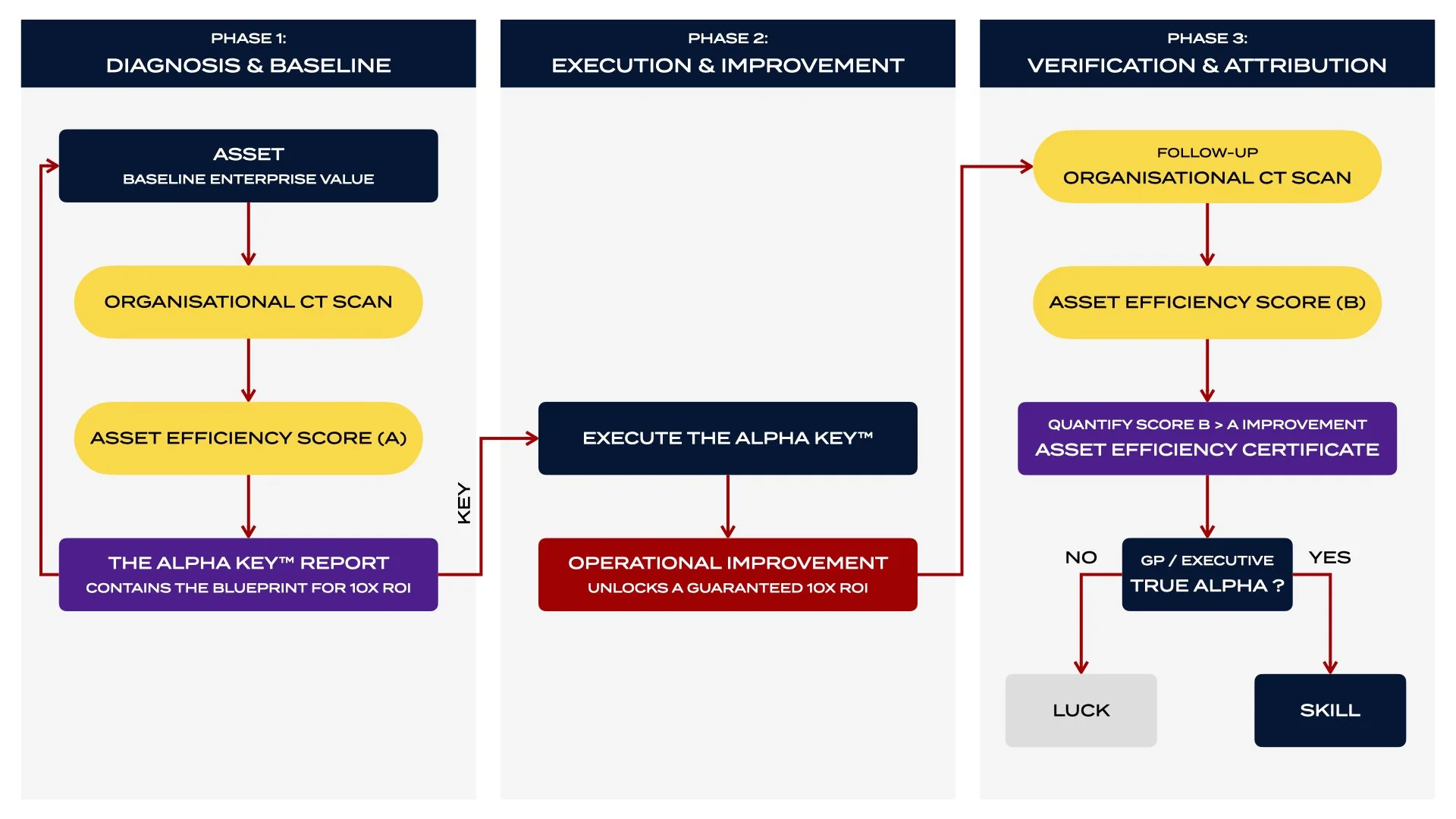
Phase 1: Diagnosis & Baseline
The first phase is a non-invasive, evidence-based process designed to establish a verifiable truth about an asset's current operational health.
Organisational CT Scan: This proprietary diagnostic moves beyond surface-level metrics to see inside an asset's true operational state. It synthesises a wide array of inputs—from financial data and internal processes to qualitative customer sentiment—to illuminate the hidden frictions and disconnects that erode value.
Asset Efficiency Score (AES): From the scan, we derive the Asset Efficiency Score (AES), a proprietary metric that quantifies the value being lost due to these disconnects. It provides a single, data-driven baseline (Score A) of the asset's health. A lower score signifies a larger, untapped opportunity for improvement.
The Alpha Key™ Report: The findings are delivered in this report, which contains the blueprint for achieving a minimum 10X ROI. It provides a single, high-impact, and evidence-based Alpha Key™ that targets the root cause of the asset's inefficiency.
Phase 2: Execution & Improvement
This phase is about surgical action. It translates the diagnostic insight from Phase 1 into a targeted, high-impact operational intervention.
Execute the Alpha Key™: This step involves the precise implementation of the single, transformative insight delivered in the report. It is the catalyst for moving the asset from its organisational homeostasis baseline toward a state of optimal performance.
Operational Improvement: The result is a targeted operational improvement that directly addresses the identified customer disconnect. This is the phase where the guaranteed 10X ROI is unlocked, transforming the diagnostic blueprint into realised, tangible value.
Phase 3: Verification & Attribution
The final phase provides irrefutable proof that the intervention was successful and that the value created was the result of skill, not luck.
Follow-up Scan & Score (B): A second Organisational CT Scan is conducted post-implementation to produce a new, updated Asset Efficiency Score (B).
Quantify Improvement (B > A): Verifiable improvement is demonstrated when the new score (B) is greater than the baseline score (A). This quantified, positive change is memorialised in the Asset Efficiency Certificate, providing transparent, third-party validation of the improvement.
GP / Executive True Alpha: By documenting a direct, causal link between the targeted intervention (Phase 2) and the data-driven improvement in operational effectiveness (Phase 3), the framework provides definitive proof of performance. It empowers General Partners and Executives to irrefutably demonstrate genuine, skill-based alpha over simple market luck to LPs and all other stakeholders.
05 | A Case Study in Precision
The principles in this playbook are not theoretical. The following case study demonstrates one powerful application of this diagnostic process, designed to uncover profound, quantifiable value where others see nothing.
Unlocking €1.375 Billion in the Shadows
HUGO BOSS
1. Following the Scent Beyond the Streetlight
My investigation did not begin with a financial statement, but with a human signal—a faint scent of customer disconnect that traditional analysis always misses. Dr. Kerstin Brehm, a former cardiac surgeon and the brand's ideal customer, posted publicly about her lifelong loyalty, yet current feeling of being a "stylish afterthought." Her question was profound and one I wanted to answer:
“Why was a brand she loved making her feel invisible?”
This is the starting point for the Strategic Bloodhound: a signal from the shadows that demands investigation.
2. The Visual Diagnosis of the Problem
The first step was to determine if Dr. Brehm's “feeling” was an emotion or a quantifiable reality. The Organisational CT Scan began by analysing two decades of HUGO BOSS's own financial data. The result was unequivocal.
The chart below visualises the problem. After peaking at over 13% of group revenue, the Womenswear division collapsed, falling to an average of just 6.8% over the last four years. This gap between the 20-year historical average and current performance represents €137 million in missed annual revenue. I call this The Cost of Decay—the annual price a company pays for simply failing to maintain its own established baseline. While this data provided the verifiable truth of what was happening, it could not answer the most important question: Why?
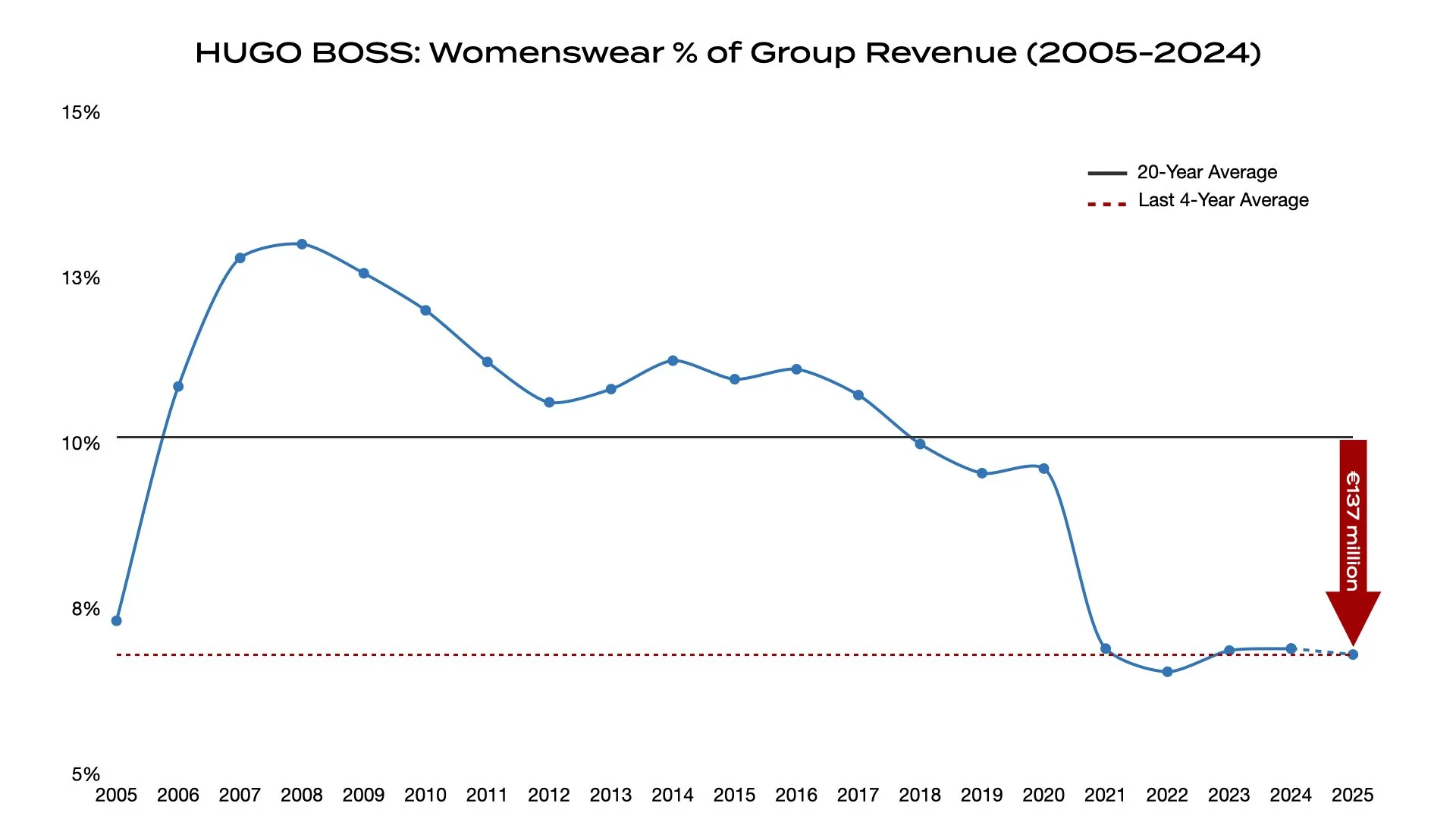
Diagnosis vs. Disbelief: Quantifying the Prize for Vision
While the problem was clear, HUGO BOSS was operating under its own Streetlight Effect. The company's focus was on the bright light of its 'CLAIM 5' strategy, which had driven record top-line revenue. However, sophisticated investors were sceptical, noting a depressed share price that contradicted the celebratory narrative.
They sensed what my Organisational CT Scan would prove: the Illusion of Health was masking a massive, unaddressed vulnerability.
3. Unlocking the Opaque Black Box
The diagnostician in me revealed the disease: a systemic failure to see, value, and serve its female customers. This was the same verifiable truth I had presented to the company myself in reports from 2017, 2019, and 2021. My follow-up conversations with Dr. Brehm confirmed that HUGO BOSS leadership had been presented with these conclusions from multiple sources. The response was consistently a variation of "I don't believe it"—a classic symptom of a leadership team insulated from reality by their own success.
The core disconnects weren't about hemlines or handbags; they were about a fundamental lack of visibility and invitation. As two customers outside the Stuttgart store told me, "How can we buy what we cannot see?”
4. The Verifiable Alpha Opportunity
The true power of this playbook is not just in diagnosing problems, but in quantifying the prize for solving them. A 2025 re-analysis confirmed that a 60/40 gender revenue split is a realistic potential for HUGO BOSS. Closing this gap would add over €1,375 billion in annual top-line revenue.

This is The Prize for Vision—the verifiable alpha waiting in the shadows. But for a Private Equity owner, the ultimate prize is how this top-line opportunity translates into the language of their world: EBITDA margin.
5. THE EBITDA PAYOFF: THE PRIVATE EQUITY PERSPECTIVE
For a PE owner, the true prize isn't just top-line revenue; it's the explosive impact on the bottom line. In 2024, HUGO BOSS delivered an EBITDA margin of 18.8%.
A hypothetical analysis shows that by capturing the €1.375 billion opportunity in womenswear, that margin would have catapulted to a world-class 27.3%. That nearly 900-basis-point improvement—a 1.5x multiple on the asset's core profitability—is the definitive proof of value creation: the high-octane fuel required to comfortably service LBO debt and dramatically increase enterprise value at exit.
This case study is the high-precision playbook in action. It demonstrates how starting with a faint human signal leads to a deep diagnosis that unlocks a multi-billion-euro opportunity—one that was always there, waiting patiently to be seen. The key to unlocking this value is now in their hands, but as this investigation proves, you cannot give billions in revenue to a leadership team that refuses to believe it exists just beyond their own Streetlight Effect.
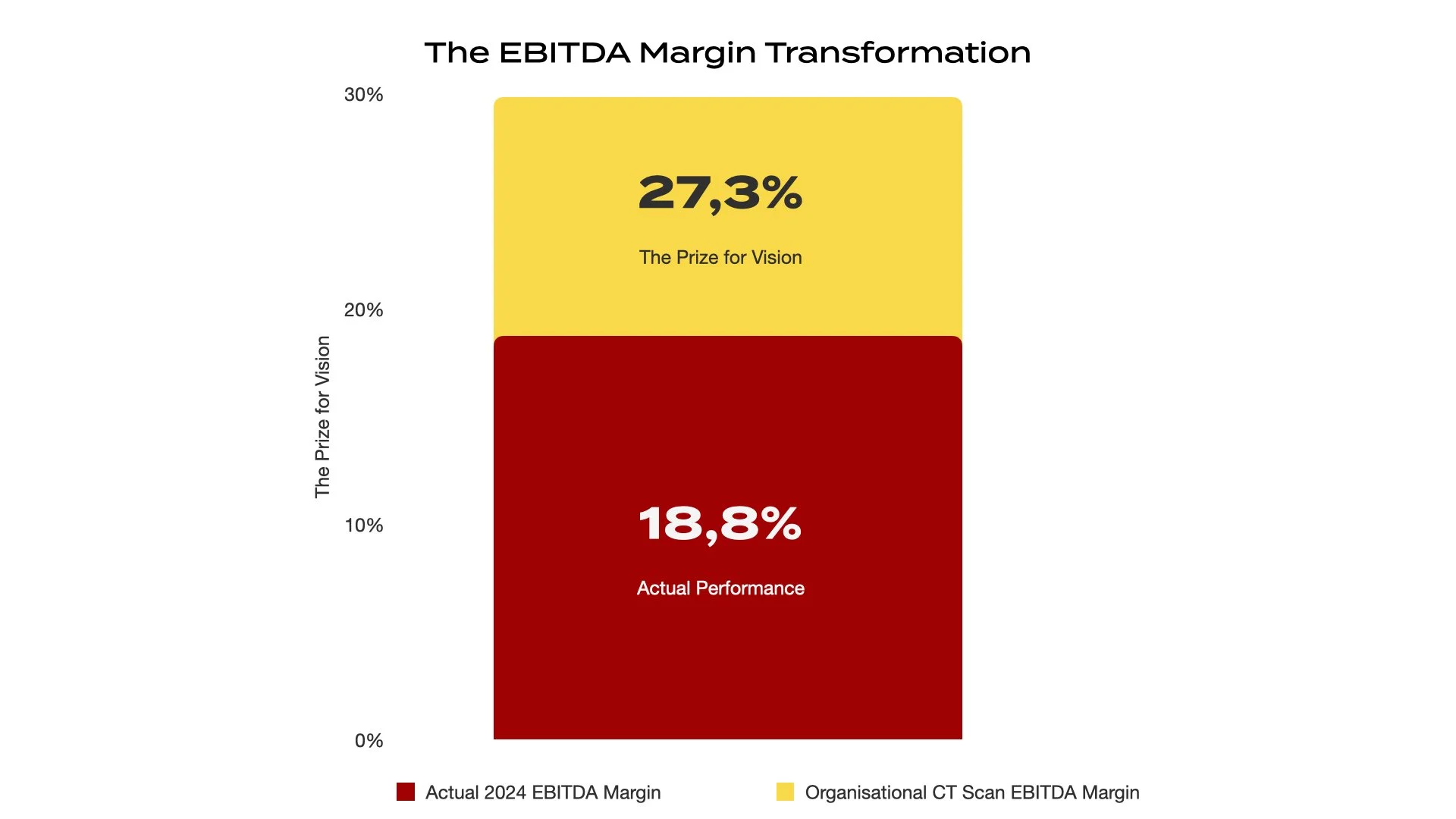
The Enterprise Value Transformation
Translated into the ultimate PE metric, this margin improvement would increase HUGO BOSS’s Enterprise Value from approximately €4,0 billion to €5,3 billion. That 30% uplift—a 1.3x increase in Enterprise Value derived purely from a diagnostic insight—is the definitive, verifiable prize of Diagnostic Alpha.
06 | Putting the Precision Playbook to Work
The playbook provides a verifiable, data-driven standard for the Private Equity ecosystem, replacing opacity with clarity and market luck with provable skill.
1. For General Partners (GPs) & PE Firms
Source Smarter: Uncover immense value in assets that competitors, blinded by conventional metrics, will overlook.
De-Risk Acquisitions: Justify valuations and make investment decisions based on a deep, diagnostic understanding of an asset’s true operational health.
Accelerate Fundraising: Provide LPs with certified, verifiable proof of skill-based alpha, moving beyond opaque and malleable metrics.
2. For Limited Partners (LPs) & Investors
Look Inside the Black Box: Ask sharper, more insightful questions about how a GP truly plans to generate returns beyond financial engineering.
Verify the Alpha: Request verifiable proof of operational effectiveness, like an Asset Efficiency Certification (AEC), to identify elite managers who can deliver genuine alpha.
Drive Sustainable Growth: Champion a model that builds healthier, more resilient companies, better aligning financial returns with long-term performance.
3. For Consultants & Service Providers
Deliver Unique Insight: Provide your PE industry clients with a unique, data-driven diagnostic that uncovers profound new opportunities for value creation.
Differentiate Your Practice: Set your firm apart by offering a proprietary, verifiable methodology that elevates your strategic recommendations, builds undeniable credibility, and justifies premium fees.
Speak the Language of Verifiable Alpha: Align your services directly with your clients’ ultimate goal: delivering provable, skill-based returns to their investors.
In this new era where Diagnostic Alpha is the only thing that matters, this playbook is the tool that unlocks the prize of Verifiable Alpha.
Continue the Journey Beyond the Streetlight
This playbook was created for the innovators, investors, and visionaries ready to find value where others don't. For those prepared to apply these principles, here are the resources to guide your next steps.
Your Resources
For Deeper Insight: To explore the allegorical story and philosophy behind the "Streetlight Effect," the book Who Moved My Customers? provides the foundational mindset for this new diagnostic approach is available on Amazon or here.
For Actionable Application: For a confidential discussion on applying the Organisational CT Scan to a specific portfolio asset or pre-acquisition target, you can connect with Morten directly. This is the path from theory to verifiable alpha.
For Ongoing Dialogue: To engage with current analysis, case studies, and join the conversation with other leaders, follow the latest insights on LinkedIn.
The €1.375 Billion Irony: Following the Scent of a Billion-Euro Blind Spot
Why would a brand its customer loves make her feel invisible? This investigation follows the human scent of disconnect at HUGO BOSS, revealing a two-decade-long decline, activist pressures, and a staggering €1.375 billion blind spot hidden in plain sight.
THE SCENT: A SEARCH FOR A TANGIBLE WHY

This investigation began not with a financial report, but with a human signal: a powerful public post from Dr. Kerstin Brehm, a former cardiac surgeon and the brand’s ideal customer. She described a lifelong loyalty to HUGO BOSS, yet a current reality of feeling like a “stylish afterthought”.
Dr. Brehm's question was simple and profound:
Why was a brand she loved making her feel invisible?
As The Strategic Bloodhound, my work is to follow signals in the shadows—these are the faintest of scents of customer disconnect that often lead to the heart of a company's greatest challenges. They are, as is so often the case, the clues hiding in plain sight, especially when a company fails to stay curious and look where others don't.
My first step was to determine if Dr. Brehm's sentiment was an isolated feeling or a quantifiable reality. A review of two decades of HUGO BOSS's own financial statements provided the unequivocal answer: her experience was the archetype of a womenswear division in a long and costly freefall.
But this data only showed what was happening, not;
Why?
This report follows that scent into the shadows to help answer Dr. Brehm's question. It details the investigation into the complex manoeuvres behind the decline and reveals the staggering, multi-billion-euro opportunity that remains hidden in the dark.
QUANTIFYING THE SCENT
Dr. Brehm's feeling of being a "stylish afterthought" was not an isolated sentiment. It was a precise reflection of a quantifiable, two-decade-long reality visible in HUGO BOSS's own financial statements.The data trail is unequivocal. After peaking at over 13% of group revenue, the womenswear division entered a long decline, ultimately collapsing to an average of just 6.8% over the past four years.
The Streetlight Effect
To understand how a €137 million opportunity can remain invisible to a world-class company, this investigation applies the central principle from my book, Who Moved My Customers? The book is an organisational parable that reveals the fundamental why behind why companies falter: they consistently overlook the subtle, unseen shifts in customer loyalty and disconnects because they are not looking in the right places.
My approach is built on the principle that this challenge has been solved:
“VIRTUALLY ANYTHING THAT HAS AN EFFECT CAN BE OBSERVED, AND ITS IMPACT UNDERSTOOD, EVEN IF NOT WITH OLD RULERS.”
The core of this blindness is a cognitive bias known as the “Streetlight Effect”.
The story is simple:
A policeman on his nightly patrol finds a man on his hands and knees under a streetlight. "What are you doing?" the policeman asks.
"I'm looking for my keys”, the man says.
The policeman helps him search, but after finding nothing, he asks, "Are you absolutely sure you lost them right here?"
"No," the man replies, "I lost them in the park.”
"Then why on earth are you looking here?" the baffled policeman asks.
"Because," the man says, "this is where the light is.”
This parable perfectly illustrates the gravitational pull to focus only on visible, readily available data while ignoring the truths lurking in the shadows. The false “Illusion of Health” it fosters can be dangerously misleading, leading to misinformed decisions and value destruction.
The “Organisational CT Scan”—the diagnostic mindset taught in the book—is the key to seeing beyond this illusion. It’s the framework designed to help decision makers look past the bright light of familiar metrics to expose their organisation’s true operational health and make the invisible visible.
Applying this lens to HUGO BOSS allows us to understand its paradox. The following section will reveal what the company sees under its own bright streetlight—the official story of success that helps explain its billion-euro womenswear blind spot.
Under the Streetlight
Under the bright light of its official narrative, HUGO BOSS is a resounding success. The 'CLAIM 5' strategy, implemented by CEO Daniel Grieder, has driven top-line revenue from €2.8 billion to a record-breaking €4.2 billion since 2021. The leadership is celebrated and has since set an ambitious new target of €5 billion in sales for 2025, accompanied by a 12% EBIT target.
In isolation, this top-line growth is impressive. This is the bright light where the company focuses its attention.
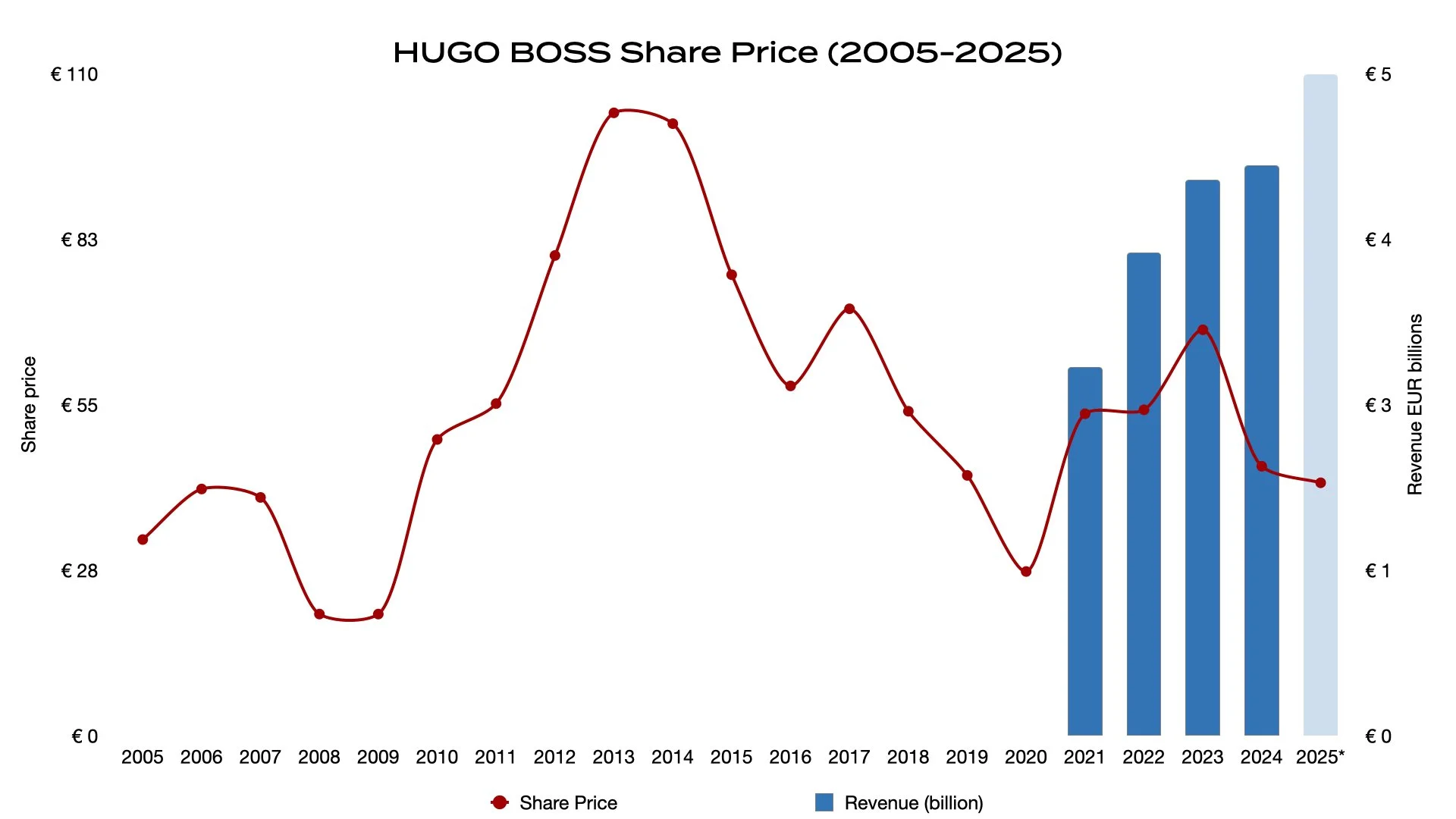
However, even within this bright light, anomalies appear in the periphery. Despite record-breaking revenue, the company's share price is depressed, and it has lost over €315 million in market capitalisation since Grieder took charge.
Furthermore, the most sophisticated analysts in the financial market are unconvinced. Following the June 2023 investor day, financial giants including Goldman Sachs, Deutsche Bank, and JP Morgan maintained "neutral" ratings.
This scepticism illuminates a classic financial dynamic... While leadership communicates success through the bright light of a profitability metric like EBIT, sophisticated investors are searching for truth in the shadows of the cash flow statement. This is the kind of thinking employed by legendary investors like Warren Buffett and Charlie Munger, who look beyond EBITDA for a simple reason: “Ignore working capital and capex, and you’re not looking at reality.” The market is signalling that it is looking at this deeper reality, not just the optics.
This disconnect between celebrated performance and market scepticism is the second clue that the whole story is not being told in the light. It is the central paradox that prompted this investigation into the shadows.
THE HUNT IN THE SHADOWS
Finding 1: The Cold Case of Wilful Blindness
The clues to the decline in womenswear and the market’s scepticism are not new discoveries. They are cold cases—a series of unheeded warnings presented directly to the company’s leadership over many years, long before the current ‘CLAIM 5’ strategy was conceived.
The following three findings are not presented as the sole causes of the decline, but as irrefutable symptoms of a deeper, systemic issue: a corporate culture that has consistently failed to see, value, and prioritise its female customer.
Sidebar: The Cold Case Files
2017—The Gender Gap:
An analysis presented to HUGO BOSS executives identified a potential 60/40 gender revenue split, representing a missed opportunity of over €750 million annually at the time.
2019—The Customer Disconnect:
A detailed customer report quantified a growing disconnect. It revealed that “sticky pathways” and other internal frictions—the “bad flora” in the company’s ecosystem—were actively eroding brand value to an estimated €834 million shortfall in womenswear revenue for that year alone.
2021—The Loyalty Collapse:
A follow-up analysis cautioned the company about an estimated €2.5 billion dilution in loyalty value stemming from these persistent blind spots.

Together, these previously ignored findings represent The Cost of Inaction—the price of being aware of massive, specific opportunities but failing to act.
The corporate reaction to this data... was consistently the same: disbelief. This is a classic symptom of “Organisational Homeostasis”—the state where a company becomes comfortable in an unhealthy but familiar equilibrium.
This history reveals the root of the problem. The issue has never been a lack of information, but a consistent failure to act on what was happening right outside the streetlight’s glow. These historical warnings were early-warning signals of the same systemic blind spot that the €1.375 billion opportunity quantifies today.
THE HUNT IN THE SHADOWS
Finding 2: 'Project Tango' and Executive Distraction
The historical neglect detailed in the "Cold Case" files was recently compounded by a significant and controversial executive distraction. In 2023, the "Project Tango" affair erupted, providing a compelling theory for why the womenswear division continued to languish, even amidst the celebrated ‘CLAIM 5’ turnaround.
Sidebar: What was 'Project Tango’?
The Plan:
An alleged secret plan orchestrated by CEO Daniel Grieder and the now-disgraced tycoon René Benko to create a new, independent "Fashion Investment Group".
The Goal:
Grieder would eventually leave HUGO BOSS to lead this new empire after acquiring controlling stakes in major brands like Adidas, Bally, and Bogner.
The 'Smoking Gun’:
Evidence stems from a confidential email in which Grieder allegedly linked his new HUGO BOSS strategy announcement (the €5 billion target) directly to a potential share price increase, reportedly writing to Benko, "I believe this will drive the share price to very high levels".
The Fallout:
Grieder’s alleged partner, René Benko, now faces criminal charges for insolvency-related fraud following the collapse of his Signa Group empire.
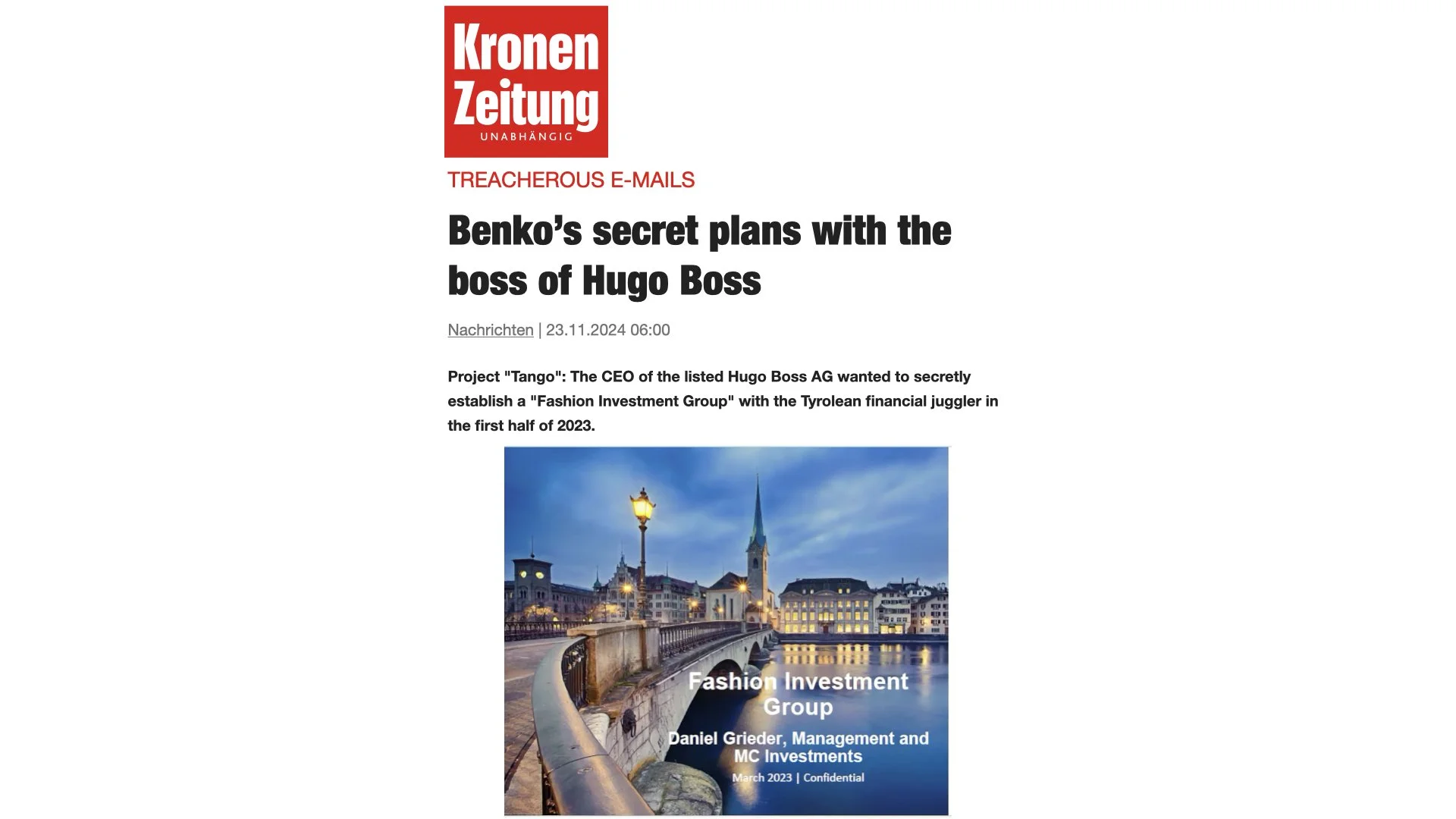
While the full details of “Project Tango” remain in the shadows, the allegations alone paint a picture of a leadership team whose focus may have been on a speculative, external venture rather than on fixing long-standing, core business problems. This distraction, which allegedly focused on creating a new multi-billion-euro external empire, provides a powerful explanation for why a known, internal €137 million problem like womenswear remained off the radar.
Sources: Kronen Zeitung: https://www.krone.at/3602449
Financial Times: https://www.ft.com/content/a2200443-e920-45d4-a14c-37b89b9d1594
THE HUNT IN THE SHADOWS
Finding 3: The Activist at the Gates
The combination of long-term neglect and executive distraction creates a predictable vulnerability. When a company is perceived to be underperforming and leaving billions in value on the table, activist investors see an opportunity. The arrival of Mike Ashley’s Frasers Group is the inevitable consequence of HUGO BOSS’s multi-billion-euro blind spots.
From 2020, the same time as HUGO BOSS announced Daniel Grieder’s arrival, through to today, Frasers Group has quietly amassed a colossal 28.20% of the company's voting rights, culminating in the 2025 election of its CEO, Michael Murray, to the Supervisory Board.
Their influence is already being exerted
Frasers Group has publicly stated it will vote against dividend payments, demanding that the board instead reinvest the capital to improve the quality of its growth. This activist stance, which also includes calls to redeem treasury shares, is a clear signal of their intent to force a shift in the company's capital allocation strategy. In addition, recent developments inside Frasers Group itself add a new layer of urgency to this situation. Their own CEO, Michael Murray, is expected to miss a personal £100 million bonus due to Frasers' underperforming share price. This internal pressure makes their investment in HUGO BOSS critical. Their demand for HUGO BOSS to scrap dividends and reinvest for growth is not just a strategic preference; it is a vital necessity to generate the returns they desperately need.
Sidebar: Who is Frasers Group?
Frasers Group, led by founder Mike Ashley, is a retail conglomerate known for its assertive and often-controversial business approach.
Aggressive Acquisitions:
They have a well-known history of acquiring struggling retailers at bargain prices. The question for HUGO BOSS is why they would be a target.
Activist Style:
They are famous for a hands-on management style and a willingness to engage in public corporate battles to unlock shareholder value.
'Elevation Strategy’:
Their recent expansion into the premium and luxury markets makes a brand like HUGO BOSS a prime target for their ecosystem.
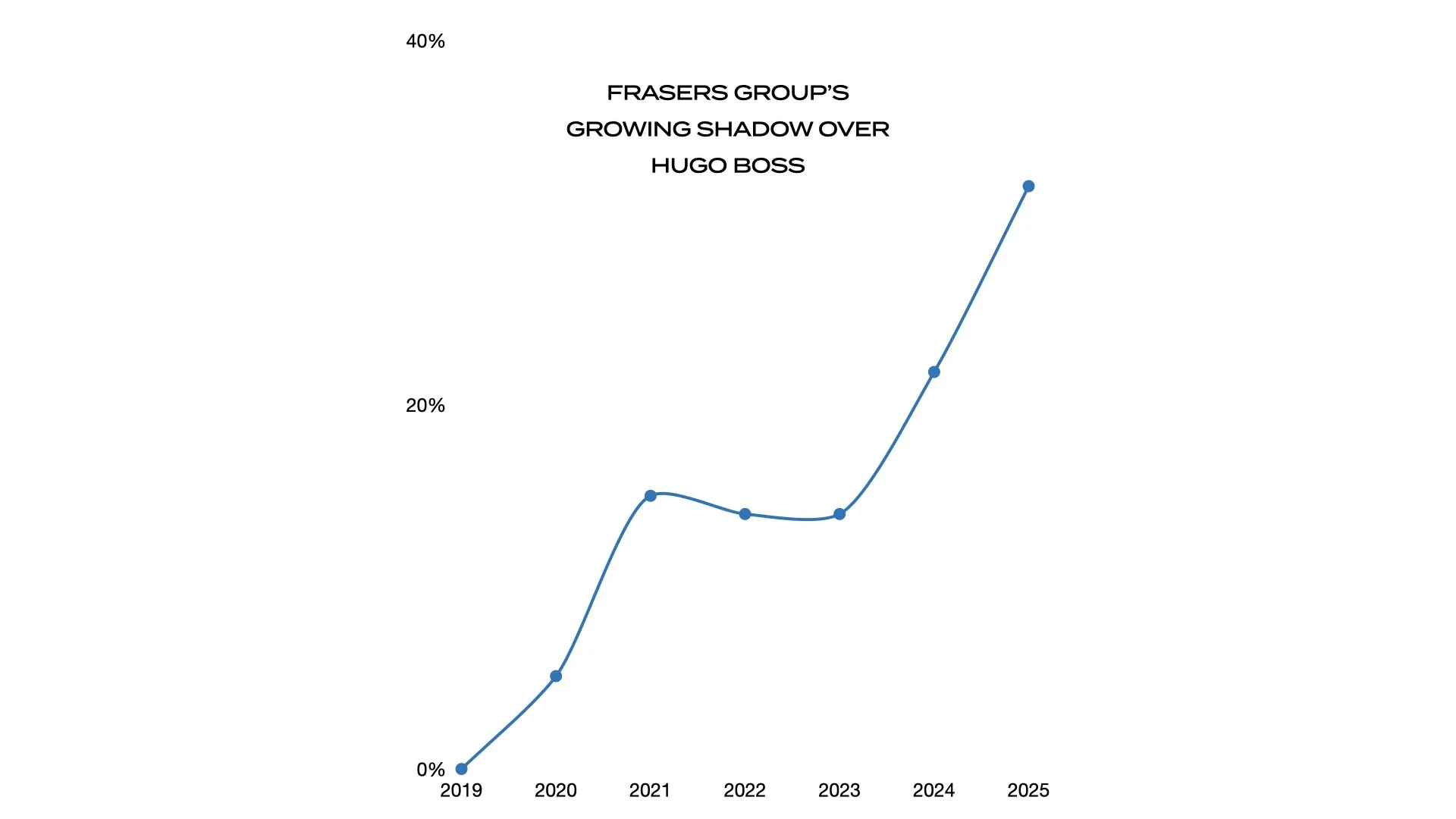
Frasers Group's presence is not the cause of HUGO BOSS's problems, but rather their ultimate effect.
WHAT THE STREETLIGHT MISSED
The €1.375 Billion Irony
With the evidence of historical neglect, executive distraction, and the resulting activist pressure now established, the final step is to quantify the true value that remains hidden in the shadows.
This investigation started with a customer asking why the brand was making her feel invisible. The data confirms her feeling: the womenswear division has collapsed from a peak of over 13% of group revenue to an average of just 6.8% today.
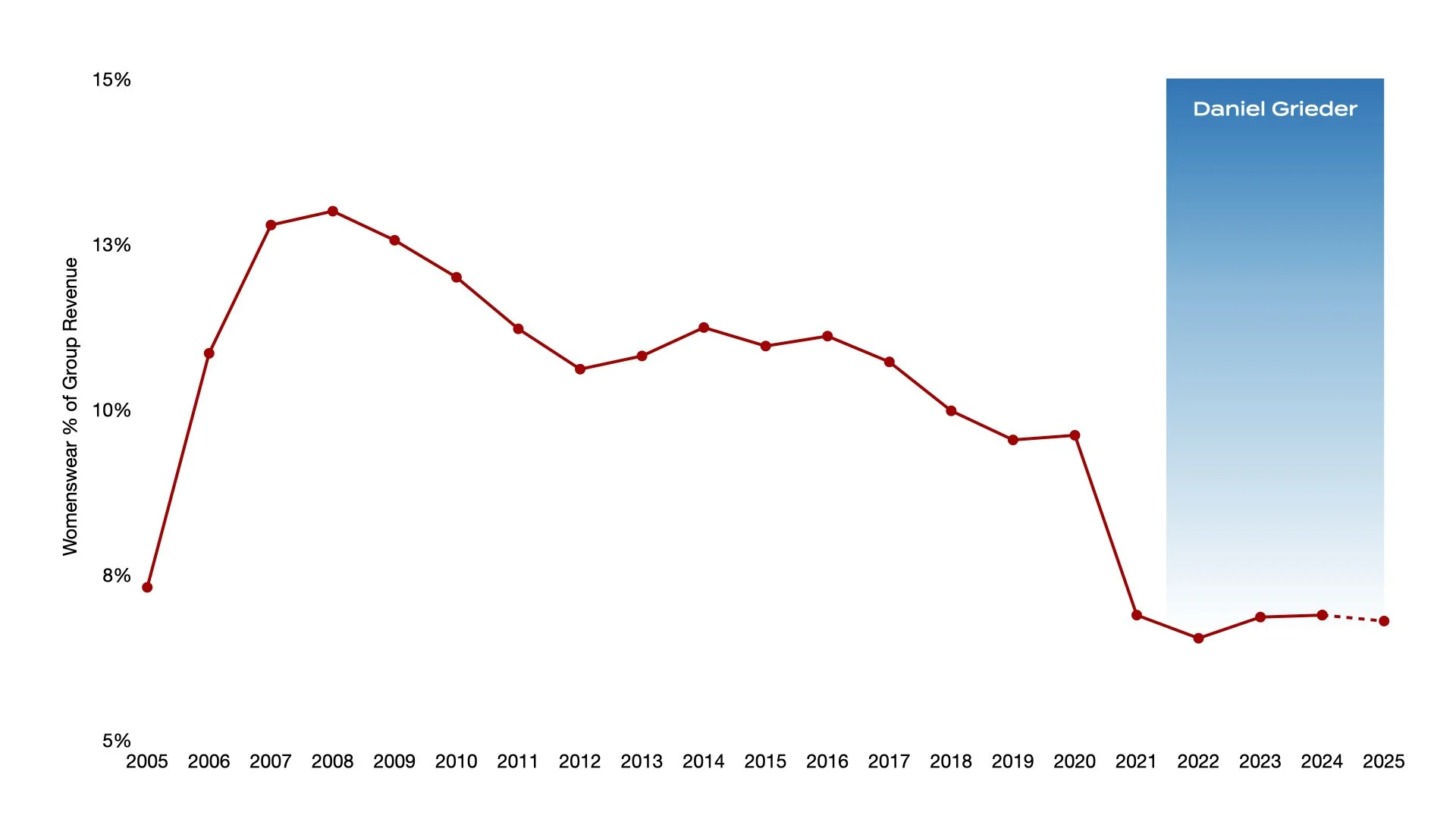
The question is no longer “Why can’t they build it?”—they already have. The real mystery now is:
Why did they let it collapse?
A 2025 analysis reconfirms the findings from 2017: a 60/40 gender revenue split potential continues to exist for a brand with HUGO BOSS’s market position. Closing this gap—simply by serving the customers the HUGO BOSS Streetlight is not equipped to see— would add over €1.375 billion in annual top-line revenue. This is The Prize for Vision. It is not about reclaiming a lost average but about seizing the full, forward-looking potential of the brand.
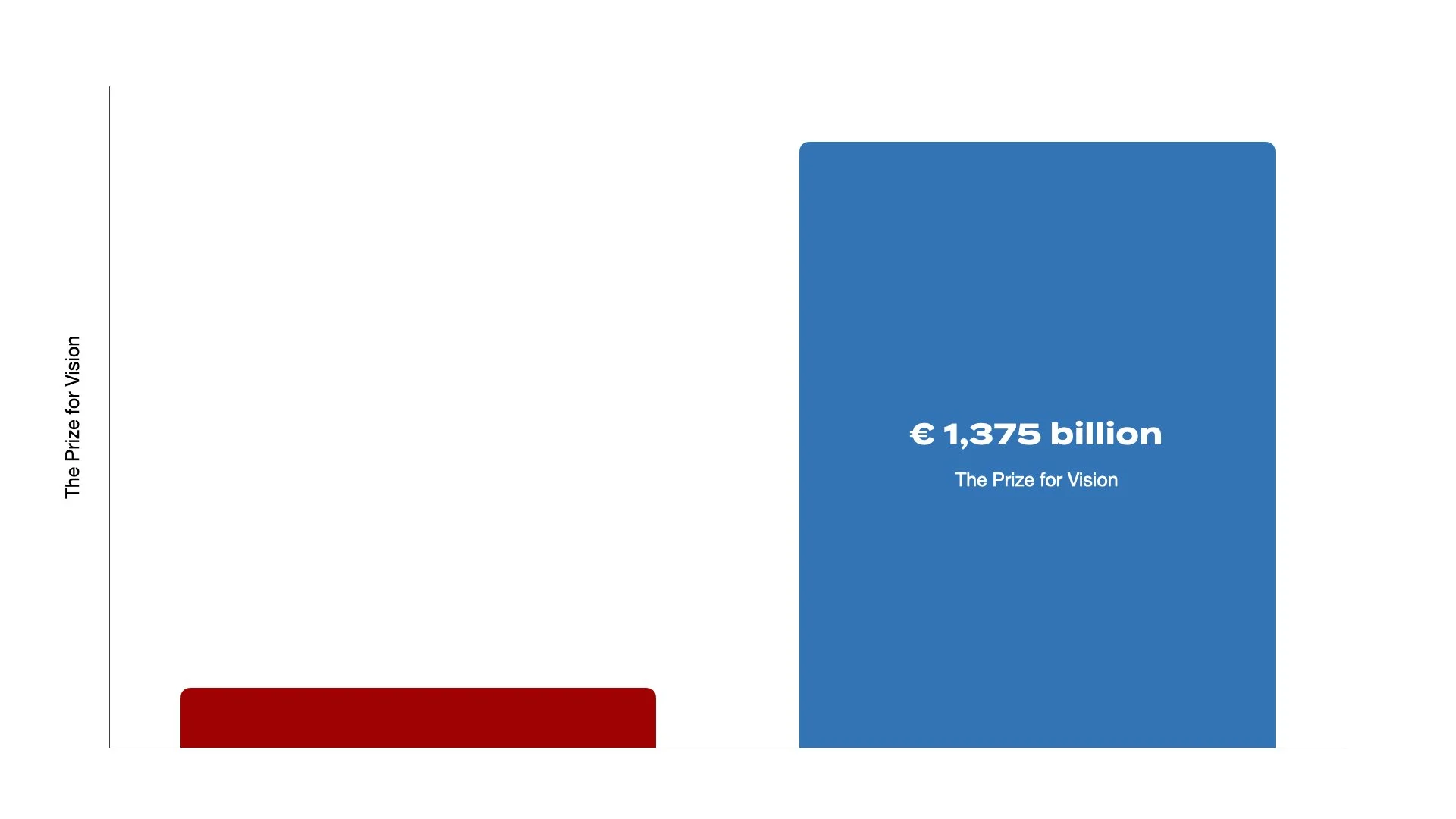
This is the ultimate irony of the Streetlight Effect. The key to smashing the €5 billion sales target and creating unassailable shareholder value was never in the bright light of the ‘CLAIM 5’ strategy playbook. It was always waiting patiently to be seen in the dark.

The €1.3 Billion Enterprise Value Prize
This dramatic improvement in profitability has a direct and profound impact on the company's total valuation. Based on the current enterprise value of approximately €4.0 billion, the operational improvements that unlock the €1.375 billion in revenue would translate directly into a potential Enterprise Value of €5.3 billion.
That €1.3 billion uplift is the ultimate prize of Diagnostic Alpha. It represents the verifiable, skill-based alpha that is created not through financial engineering, but through a surgical understanding of an asset's true operational health.
The unseen billions in revenue and margin remain in the shadows, a testament to the millions of customers who remain unseen, even after the initial signal from Dr. Kerstin Brehm was finally heard. This isn’t just about lost sales; it’s about a failure to nurture the entire ‘Customer Grove’—the allegorical term from my book for a brand’s customer ecosystem. It is a failure to tend to both the loyal ‘Fruitful Trees,’ who represent core customers, and the neglected ‘New Saplings’—the new customer segments that represent HUGO BOSS’s future.
CONCLUSION: THE KEY Is BEYOND “I DON'T BELIEVE IT”
The key to unlocking €1.375 billion in womenswear revenue for HUGO BOSS is so deceptively simple it often evokes the very disbelief that has been HUGO BOSS's response for years. The answer lies not in a complex new strategy, or even in the existing 'CLAIM 5', but in a simple, human-centric shift, once seen.
That key was revealed to me in 2017 by two fabulous ladies outside the Stuttgart store. They didn't critique the clothes they couldn't find; their question was more fundamental and profound. "Of course, we know HUGO BOSS, we know them as the masters of menswear," one said, looking toward the entrance, "but how can we buy what we cannot see?"
They were not asking for a new collection, ambassador, or icon; they were simply asking for an invitation to enter. That has always been the core and the key to reshaping the customer's gut feeling about HUGO BOSS. It is not found in expensive new marketing campaigns, new collections, or the use of ambassadors and icons. But in the profound act of a simple "invitation"—one that extends from the front window of the store to the front of the strategic agenda. That's the "I don't believe it" billion-euro key, visibility. It's about greeting the millions of customers who are already at the door, simply waiting to be seen.
The billions in hidden value wait only for a leadership team with the courage to believe that the most profound answers are often the simplest.
Unlocking this opportunity is not just a key to smashing sales targets; it is the most direct path to elevating the company's EBITDA margin to a world-class 27.3%, adding over a billion euros to its enterprise value, and closing the credibility gap with the financial markets—all while finally making Dr. Kerstin Brehm feel incredibly visible.
It’s your move, HUGO BOSS AG.
A personal sidenote
This corporate paradox, an organisation projecting health while masking critical, unseen vulnerabilities, resonates on a deeply personal level. This investigation began with a signal from Dr. Kerstin Brehm, a former cardiac surgeon. It is a fitting coincidence, as my own journey beyond the streetlight was validated by a diagnostic tool she knows well: a CT Scan.
My own "Illusion of Health" as a long-time diabetic was shattered over a decade ago when I first stepped beyond conventional wisdom's Streetlight Effect. A recent, near-perfect CAC scan result has provided the clinical objective validation for the power of that first step. I dared to look where others didn't, and that single step transformed my life.
“Always stay curious and dare to look where others don’t.”
BEYOND THE STREETLIGHT: Illuminating True Value in Private Equity’s Shadows
In Private Equity, are you looking where the light is easiest? Learn from the Icahn case why the Strategic Bloodhound illuminates true value & risk beyond conventional due diligence.

“TO SEE WHAT OTHERS DO NOT, THAT IS TRUE GENIUS.”
— Morten J. Sørensen
It’s a familiar story: a man is frantically searching for his keys under a streetlight. A policeman asks if he’s sure he lost them there. “No,” the man replies, “I lost them in the park.” The bewildered policeman asks, “Then why are you looking here?” “Because,” the man says, “this is where the light is.”
In the complex, high-stakes world of Private Equity, are we too often found searching for the answers, for alpha, for assurance, only under the most convenient lights? Are we drawn to the readily available data, the polished pitch decks, and the compelling narratives, while the real keys to value creation—or critical risk—lie waiting silently in the shadows? The truth is that virtually anything and everything is measurable and, therefore, can be verified. It simply comes down to how and where you look and possessing the right mindset to illuminate what’s hidden. This is the core of the Strategic Bloodhound approach—a relentless pursuit of ground truth by bringing light to those dark, hard-to-see areas.
The Seductive Glow: Narratives, Opacity, and the Streetlight Effect in PE
Even for sophisticated investors, the lure of the streetlight is incredibly strong because the alternative requires challenging, compelling stories and navigating deliberate or unintentional obscurity. The Private Equity industry, at times, can reward masterful storytelling. General Partners (GPs) craft powerful narratives of value creation, unique “playbooks,” and future success. But how often do these narratives withstand rigorous, independent verification of the underlying operational health or sustainable performance drivers? Narrative can, and often does, triumph over ground truth.
Complex financial structures, instruments, and leverage can also create an illusion of alpha that might not be purely derived from operational improvement. Are we verifying the source of returns, or are we mesmerised by the engineered outcome under the easy light of headline numbers? Furthermore, the ‘Opaque Black Box’ nature inherent in many fund structures can make it incredibly difficult for Limited Partners (LPs) to verify Net Asset Value (NAV) drivers or distinguish skill from luck until it’s too late. This isn’t always nefarious, but complexity can serve to obscure. Reported NAVs and Internal Rates of Return (IRRs) can sometimes be gamed or selectively presented. Fee structures and the pressure to deploy capital can also lead to decisions prioritising GPs’ timelines over the long-term health of assets or LP interests. The core message is clear: compelling narratives and complex structures can make the ‘easy light’ seem sufficient, discouraging deeper, more arduous verification in the ‘dark’.
When the Darkness is Illuminated: A Case Study – Hindenburg vs. Icahn Enterprises
This isn’t mere theory. The consequences of superficial analysis—of staying under the streetlight—play out dramatically in the public markets, offering stark lessons for private equity. A prime example is the Hindenburg Research versus Carl Icahn’s Icahn Enterprises (IEP) reports from May 2023.
Here was IEP, linked to an “American icon” of investing, Carl Icahn, boasting a dividend yield of over 15%. The ‘streetlight’ shone brightly on these facts: invest with a legend, get a fantastic payout. This was the readily available story. But Hindenburg Research ventured beyond that easy light, publishing detailed reports that alleged a very different reality in the less illuminated corners:
An Unsustainable Dividend: Hindenburg argued the eye-watering dividend was “unsupported by IEP’s cash flow and investment performance,” citing that IEP’s portfolio had lost approximately 53% since 2014. The company had cumulatively burned through roughly $4.9 billion in free cash flow. They alleged the dividend was funded by “regular open market sales of IEP units, totalling $1.7 billion since 2019,” describing it as a “‘Ponzi-like’ economic structure.” Lesson for PE: Always verify returns’ true source and sustainability, not just the headline number. Is it generated from actual earnings or financial engineering?
Questionable Valuations (NAV): IEP traded at a hefty premium to its NAV. Hindenburg didn’t just question the premium; they estimated IEP’s reported year-end NAV of $5.6 billion was inflated by at least 22%. They cited “questionable value marking practices,” including IEP reportedly valuing a meatpacking company stake at $243 million when its public market capitalisation was only $89 million and marking an “Automotive Parts” division at $381 million, only for a key subsidiary to declare bankruptcy a month later. Lesson for PE: Rigorously verify asset marks, especially for illiquids and controlled companies. Are valuations reflecting verifiable market realities or optimistic internal assessments?
Conflicts of Interest & Facilitators: Hindenburg highlighted that Jefferies was the “only large investment bank with research coverage on IEP,” continuously placing a “buy” rating while reportedly running all of IEP’s $1.7 billion in ATM offerings. Lesson for PE: Verify independence and scrutinise relationships between companies, their advisors, and research providers. Whose interests are truly being served?
Debt & Key Man Risk: Hindenburg pointed to Carl Icahn pledging approximately 60% of his substantial IEP holdings (181.4 million units) for personal margin loans, with a lack of disclosed basic metrics around these loans. Lesson for PE: In PE, verifying the financial health and potential personal leverage of key principals is crucial, as it can create unseen risks for the entire enterprise.
These red flags were often overlooked due to the halo effect of Icahn’s reputation, the allure of the high dividend, and the acknowledged complexity of analysing holding companies. Many stayed under the existing streetlight, looking where it was easiest, not necessarily where the fuller truth might lie.
The Strategic Bloodhound in Action: Illuminating Value in Private Equity
The Icahn case starkly underscores the critical need for a Strategic Bloodhound investigative approach in private equity due diligence and portfolio oversight. It’s about proactively seeking out the information that isn’t readily presented. It means venturing into the perceived darkness where the real work of verification lies.
This demands a desire to ‘look inside’ the PE’s Opaque Black Boxes. Applying independent forensics and diagnostics—an Organisational CT Scan, if you will (like the Private Equity Asset Efficiency Score (PEAES) diagnostic)—to show the truths as they truly are. It’s about moving beyond trusting the narrative to rigorously testing it against quantifiable, evidence-based operational health metrics. This approach uncovers the hidden risks, identifies operational friction, and challenges the conventional ‘playbooks’.
This isn’t just about avoiding the next IEP-like situation. It’s about fostering and reaching for genuine transparency and accountability. More importantly, by illuminating these less-scrutinised areas, we can uncover sources of extraordinary, sustainable value creation invisible to those who only operate under the familiar glow of standard reporting or persuasive pitches.
The Immunity Dividend and a Path to Shared Success
For LPs, GPs, and investors alike, cultivating this deep verification mindset yields an ‘immunity dividend’, building resilience against seductive but unsubstantiated narratives and allowing for decisions based on verifiable substance, not just compelling stories that glitter under the lamppost. This journey into the ‘dark’ doesn’t mean there has to be only one winner. True transparency and a focus on genuine, verifiable value creation benefit everyone: investors, LPs, skilled GPs, and portfolio companies. It elevates the entire ecosystem and industry by moving beyond perception to provable, unquestioned performance.
Your Call to Action: Stepping Beyond the Lamppost
Look at your current pipeline, your portfolio, and your trusted relationships. Where are the ‘streetlights’ shining brightest? And more importantly, what crucial aspects might lie beyond their reach in the unexamined shadows? What’s one core assumption, one key claim, that you haven’t seen independently and rigorously verified recently? Could a commitment to deeper inquiry—to becoming your own ‘Strategic Bloodhound’—change your perspective or outcomes? The most significant opportunities and critical risks often lie not where the light is easiest but where the truth is the fullest. It’s time to start looking there. I still find it profound after all the years; once you learn to see something, it is incredibly difficult to unsee it again. Yet, it is virtually impossible to share that same vision. But I try every day.
Can You See Who Is Healthy? Diagnosing Your Organisation Beyond the Surface
Organisations often project health while masking unseen vulnerabilities. Discover the Organisational CT Scan: a diagnostic framework to reveal true health, quantify hidden risks, and unlock unrealised value.

Look around you. Can you reliably tell who is genuinely healthy and who might be harbouring a critical, unseen ailment simply by looking at them? Age, physique, and even surface-level indicators are not foolproof predictors of underlying well-being. Someone seemingly fit could have hidden high blood pressure or inflammation, while someone appearing less robust might possess surprisingly healthy biomarkers.
These same rules apply precisely to the corporate world. Organisations, like individuals, often project robust health—a gleaming headquarters, impressive press coverage, strong quarterly earnings—while masking critical, unseen vulnerabilities. These are the very surface metrics often presented to leaders (CEOs, Boards, CSOs, PEs, CIOs), creating a dangerous Illusion of Health under the narrow beam of the Streetlight Effect. These conventional metrics often overlook hidden friction or customer disconnects—factors silently paving the way towards financial collapse. History confirms that relying on surface indicators is dangerously unreliable when assessing the true state of an organisation’s Opaque Black Box.
“Virtually anything that has an effect can be observed, and its impact understood, even if not with old rulers.” — Morten J. Sørensen
The Peril of Symptom-Based Management
When something feels wrong in our bodies, our first instinct might be to treat the symptoms. Organisations frequently fall into the same costly and ineffective trap: treating visible symptoms like high employee turnover with hiring bonuses or declining sales with aggressive discounts. This symptom-based management is reactive, costly, and unsustainable. It fails to address the underlying pathology—the “bad flora” that creates an unhealthy Organisational Homeostasis. This approach ultimately risks deeper dysfunction and significant, often unbudgeted, expenditure, posing a key concern for executives accountable for financial and operational health (CFOs, COOs, PE Investors). The fundamental underlying challenge persists: what is not measured cannot be seen, managed, or fixed.
The Solution: Adopting a Diagnostic Mindset – The Organisational CT Scan
How do we move beyond reactive, symptom-based management to accurately measure and proactively manage true organisational health? Leaders need reliable diagnostic tools that can look “beyond the surface”, much like medical science uses advanced imaging technology.
Imagine trying to predict someone’s ten-year heart attack risk based only on appearance. Even adding a standard blood work panel makes this unreliable. However, a specific tool like a Coronary CT calcium scan can detect hidden plaque buildup, providing a strong statistical indicator of future risk and enabling preventative action.
Similarly, a deep diagnostic tool akin to an Organisational CT Scan is essential for informed leadership. Its purpose extends beyond spotting immediate problems. It meticulously assesses the health of the organisation’s internal ecosystem—the balance of productive versus counterproductive norms, information flow, inter-departmental relationships, and the overall cultural microbiome influencing resilience and efficiency. It helps answer the critical strategic question: Is the organisation simply maintaining a flawed status quo, or is it operating from a truly healthy, efficient baseline? Identifying this is the first step towards defining the missing reset required for sustainable health and preventing collapse.
Unlocking Foresight and Preventing Collapse
Adopting this pragmatic diagnostic view provides critical advantages for the entire leadership team and investors. It cultivates the foresight needed to prevent financial collapse before surface symptoms become critical. It empowers informed strategic decision-making, including M&A validation, due diligence, and sustained organic growth strategies. It also mitigates catastrophic threats by addressing missed and unseen root causes. It unlocks untapped value by pinpointing specific areas for improvement. For those managing brand and customer relationships (CMOs, CCOs, CSOs), it offers clear insight into the drivers of loyalty and why customer disconnect occurs (emotionally driven), directly impacting the bottom line.
This revolutionary Organisational CT Scan moves beyond surface appearances to cultivate deep organisational well-being and ensure sustainable success by addressing the unseen factors that truly determine long-term performance and survival.
For a comprehensive understanding of this critical framework, including detailed case studies and its practical application, download the full white paper below:
PRADA’S ACQUISITION CONUNDRUM: What Due Diligence Won’t Reveal
Prada’s Versace and Jimmy Choo M&A decision: Standard due diligence misses billions in unseen challenges & unrealised potential. Learn how Organisational CT Scan and diagnostics reveal their true acquisition conundrum.

“TO SEE WHAT OTHERS DO NOT, THAT IS TRUE GENIUS.”
— Morten J. Sørensen
The allure of creating a global luxury powerhouse through strategic mergers and acquisitions is undeniable. Imagine the expanded market presence, the strengthened portfolio, and the synergistic efficiencies that should be realised. Yet, even the most rigorous conventional due diligence, meticulously poring over financials and market share, can leave leaders and investors blind to critical unseen challenges—the true conundrum of Mergers & Acquisitions (M&As). This is the Streetlight Effect in action, illuminating only what’s convenient. At the same time, the most significant risks and opportunities linger unseen in the shadows.
Standard due diligence is often insufficient because it fails to penetrate the Opaque Black Box of the target’s true customer sentiment, genuine brand alignment, and underlying operational health. It focuses on easily verifiable metrics but overlooks crucial factors that dictate an asset’s real value and potential for integration. These unknown facts lead to unseen risks and missed opportunities that can silently erode value post-acquisition and are only discovered during integration.
Unveiling the Unseen Challenges & Opportunities: The Diagnostic Imperative
The Organisational CT Scan and its core metric, the Asset Efficiency Score (AES), is designed precisely to pierce this opacity. It assesses every facet of customer base, loyalty, sentiment, and operational health for each brand, quantifying the precise impact of issues like customer and emotional disconnects and operational inefficiencies. It illuminates what traditional due diligence simply won’t reveal.
Consider the Organisational CT Scan applied to Prada Group’s speculated acquisition of Versace and Jimmy Choo. The diagnostic assessment unveiled several critical but overlooked discoveries:
Limited Customer Overlap: Despite all operating in the luxury fashion space, the analysis revealed minimal customer overlap between Prada, Versace, and Jimmy Choo. This fundamentally challenges assumptions about easy cross-selling synergies and highlights the complexity of leveraging a combined customer base.
Persistent Customer Sentiment Issues: Across all three brands, significant, quantifiable customer experience challenges exist. These included recurring issues with poor customer service, product quality concerns, and delivery/returns problems. To highlight three.
Billions in Unrealised Potential: The Asset Efficiency Scores for each brand exposed vast, untapped revenue potential directly linked to these customer and emotional disconnects and operational inefficiencies:
Prada Group: €3.2 Billion in efficiency potential (due to issues like delivery problems, customer service, billing/fraud).
Versace: €717 Million in efficiency potential (driven by product quality, customer service, delivery/returns issues).
Jimmy Choo: €380 Million in efficiency potential (connected to customer service, price-value perception, defective products, repair issues).
Hidden Financial Strain: Although Prada Group may have the immediate financial capacity, proceeding without a clear plan to address the underlying inefficiencies in customer and operational areas could introduce significant financial strain and integration risk, potentially jeopardising the entire group’s health rather than strengthening it.
The Deeper Conundrum and Strategic Alternatives
Proceeding with an acquisition without truly understanding and addressing these unseen challenges carries immense financial and operational risk. The assessment reveals that acquiring brands with significant underlying problems, as quantified by the Asset Efficiency Score (AES), introduces considerable unseen and unfelt strain.
More importantly, this diagnostic deep dive also illuminates less risky, potentially more rewarding alternative strategies that standard due diligence often fails to reveal. And left unseen is a wasted opportunity. These could include focusing on organic growth within existing brands (e.g., leveraging Miu Miu’s momentum, revitalising Church’s) or pursuing acquisitions with demonstrably stronger customer alignment and fewer foundational challenges, as exposed for Versace and Jimmy Choo.
Ultimately, a truly informed M&A strategy requires understanding these deeper, often unseen, truths. The Organisational CT Scan provides the essential foresight to illuminate the clear path to make strategic decisions that lead to sustainable, verifiable value creation—moving beyond the allure of headline numbers and into the illumination of true asset health.
For a comprehensive analysis of the Prada Group acquisition, including detailed data visualisations (like Sankey diagrams) and a full exposition of the methodology and findings, download the complete report below:
54 Years to See: How My Life’s Journey Unlocked Billions in Unseen Value
Morten J. Sørensen’s 54-year journey reveals his unique talent as a Strategic Bloodhound. Learn how his intuition and methodology unlock billions in hidden value for organisations by seeing the unseen.

It took me 54 years to truly find and define myself. Turns out, I’m a Strategic Bloodhound. Or, in more sophisticated terms, an organisational quant strategist with an uncanny ability to spot hidden opportunities that drive extraordinary results and billion-dollar growth. It’s like having X-ray vision (Organisational CT Scan) for perpetually flowing, unseen revenue streams, constantly hiding in plain sight.
With all its twists and turns, my life has uniquely honed these Strategic Bloodhound instincts. I can sniff out a billion-dollar opportunity in a crowded marketplace faster than you can say “Hermès saddle-stitched Birkin bag” or “Japanese Acetate”.
And what a life it’s been! Orphaned at 15, I decided to skip university and forge my own path after finishing my education at 18. My father wanted me to become a doctor, but after his passing, I realised my heart wasn’t in it. Instead, I followed my free spirit and passions, starting a luxury bespoke custom bathroom and fireplace design studio with my neighbour. It was a bold move for a teenager, teaching me the value of independence, resilience, and trusting my instincts—qualities that still serve me profoundly today.
My initial instinct was always simply to help, to bring a sense of freedom and joy to people without complications. This inherent drive to help has, quite literally, saved three people from death. From staging a break-in to find a friend unconscious for days, to Heimlich-ing a complete stranger back to life in a crowded restaurant, to more recently guiding someone to put their Type-2 diabetes into remission—removing a medical register listing and preventing an inevitable leg amputation (perhaps my father was right after all, I should have become a doctor!). And when a friend needed care facing stage five Parkinson’s and Dementia with no one else to help, I stepped up without hesitation, unraveling 70+ years of secrecy and saving their estate from bankruptcy.
It seems I have a knack for attracting distress and finding untapped potential, whether in a person’s life or an organisation’s profitable growth.
This deep empathy and intuition are foundational to my methodology. It’s a mix of deep customer and emotional insights (I can practically read minds), first-principles thinking (I question everything!), and a relentless pursuit of excellence (I’m a bit of a perfectionist, but don’t tell anyone!). I challenge conventional wisdom because, frankly, sometimes conventional wisdom, despite flawless research, is simply wrong and can be subtly and naively destructive. My life journey has instilled in me hard lessons and the principles to bring fresh, crystal-clear, unseen perspectives. My policy is to help every distressed person or organisation if they are willing to see their new unseens. I believe in always seeking the truth, no matter where it leads. I treasure my moral values and ethics. And because of it, I sleep incredibly well at night. Biohacking has helped me here as well.
Here’s the fascinating part: I used to think I was just working for one organisation at a time. It turns out I’m serving a whole hidden ecosystem of companies, private equity firms, investors, and even the occasional eccentric billionaire—each with slightly different, often unshared, political agendas. And because I don’t have a product to push or a service to sell, my success is entirely dependent on theirs. Yes, of course, that’s scary when there is so much to gain and lose and a lot of misdirection. But that’s not a reason not to try. It’s a beautiful symbiotic relationship, really. Like a bee and a flower, except with many more zeroes involved, when I help teach them to illuminate their own Opaque Black Boxwhere value is hiding in plain sight.
Looking back on five decades, what have I learned? Three people who get to continue to share their love, life, and presence with family and friends—hopefully for many more years than otherwise possible. Me? I’m healthier and blessed with a beautiful family and fantastic close friends. My clients? They have a legacy track record of generating over €3.5 billion in hidden recurring revenue annually, totalling over €30 billion in value created for them since 2015. All from their unseen.
For example, a global footwear organisation successfully unlocked over €1.5 billion annually using my diagnostic of a single-word change on a sneaker label. (Talk about a high-impact word! Shame it wasn’t Scrabble™!)
In conclusion, I’m incredibly grateful for what I managed to achieve as an orphan without parental guidance. But this has never been about me! It’s always been about helping others discover their and their organisation’s hidden potential, breaking free from the narrow-focused limited Streetlight Effect, and achieving extraordinary (personal) growth. Your investors and shareholders will thank you for it.
PRIVATE EQUITY FIRMS: Is Your LBO Model a Ticking Time Bomb Trapping You in Quicksand?
Is your PE LBO model a ticking time bomb? Discover how the Organisational CT Scan diagnostic uncovers hidden asset value and underperformance, unlocking billions in AUM returns and serving as a lifeline against debt.

The alarming reality facing Private Equity firms today echoes a stark warning from Moody’s, as highlighted in the Financial Times: LBO models are under increasing pressure from the “hefty debt loads” of their leveraged portfolio companies. Rising interest rates deepen the debt servicing burden, putting additional strain on financial health and significantly increasing the likelihood of bankruptcy. The numbers are grim: approximately 20% of large companies acquired through LBOs typically go bankrupt within ten years. With current rate increases, it’s easy to foresee bankruptcy rates moving towards one in three in the coming years. That’s the problem—a veritable ticking time bomb threatening to pull valuable assets into quicksand.
But why, even with sophisticated LBO models and rigorous initial due diligence, does this happen? The issue often lies beyond the visible numbers, in the Opaque Black Box of unseen operational inefficiencies and deep-seated customer emotions and disconnects that erode value from within, making assets profoundly vulnerable to external pressures. This is the Streetlight Effect in play: focusing intently on the financial structure while overlooking the critical truths lurking in the operational shadows.
Yes, the situation may seem critical, but a powerful lifeline is available. Leveraging the Organisational CT Scan helps Private Equity firms and their portfolio companies stave off bankruptcy and generate significantly higher returns for their investors and shareholders.
My business model is as transparent as my insights. No win, no fee. It operates alongside a familiar “two and twenty” fee structure: a 2% hidden value finders fee with a 20% performance fee paid on the revenue pathways illuminated that generates a quantified metric. Your unseen success is also mine.
The proprietary Organisational CT Scan diagnostic assessment maximises your NAVs and assets’ profits, increasing management fees and carried interest. It strengthens your asset(s)/fund(s) performances to become industry-leading and dominant. The Organisational CT Scan’s proven accuracy has successfully unlocked over €3.5 billion in incremental annual systematic revenue, generating over €30 billion in total client value since 2015.
Like legendary designer Paula Scher at NYC design agency Pentagram, who famously sketched the iconic Citi logo on a napkin, earning $1.5 million in five minutes from a $2.3 trillion asset. My Strategic Bloodhound instincts have been honed over five decades, born from a life-changing journey of seeing what others miss.
Today, I instinctively see organisations’ hidden billions, and importantly, I can also illuminate the unseen pathways to higher returns for your Assets Under Management (AUMs). That is the power of the Organisational CT Scan, providing Asset Efficiency Score (AES) insights in due diligence and ongoing portfolio oversight, tracked over an asset’s lifecycle to reveal your Asset Efficiency Certificate (AEC). Revealing your team’s Value Creation Plan (VCP) as a skill or a matter of luck.
Let’s get together. I work and teach leaders, executives, and private equity professionals to unlock true alpha by illuminating unseen forces and transforming overlooked details into verifiable results. Sometimes, the best way to trigger change is to dare to see what others don’t.
THE FIVE STAGES OF BRAND GRIEF: Why Vans Left Me Barefoot (and What It Means for Your Brand)
Morten J. Sørensen’s Vans experience reveals the “Five Stages of Brand Grief”. Discover how the Organisational CT Scan illuminates emotional customer disconnect to unlock billions in unseen revenue for organisations and VP Corp..

I wanted to give Vans my money, but they wouldn’t let me.
As someone whose instincts and policy have been to help every organisation unlock its hidden billions and thrive, I’m acutely aware of the forces that connect and disconnect brands from their customers and alter the emotional connection one has to a particular brand.
A few weeks ago, while packing light for a London trip with only a pair of Converse Chuck 70s, I ended up with blisters after walking over 30 miles (50 km) along the River Thames. Mental note to self: Vans Old Skool low tops (suede/canvas) are more comfortable for long walks than Converse Chuck 70s. At that moment, I had a single desire: I wanted desperately to buy a new pair of Vans canvas. Staying in Central London, I was confident I could easily find a Vans store, so I set out to make a purchase. The Vans website listed four stores. I embarked on an unintentional odyssey, visiting three locations and finding no directly operated stores. Zero. Nada. This was disappointing in so many different ways.
The flagship store on Oxford Street was closed for renovations (unannounced on their website), another was mysteriously absent from Neal Street, and the third was nowhere to be found within Westfield Shopping Centre. I even searched the big touch screens present to guide you to your brand. “No Results.” was all the display informed me.
This frustrating and now personal inconvenience was more than just a bad customer experience; it was a stark, tangible reminder of the invisible, powerful emotional forces that disconnect brands from their customers fast—It just happens to be a core specialism of mine.
It also sparked a realisation: this customer journey, marred by unmet expectations, mirrors the emotional stages of grief outlined by Dr. Elisabeth Kübler-Ross. And, as Rory Sutherland of Ogilvy UK often highlights, context matters powerfully.
Let’s explore the Five Stages of Brand Grief looking through the lens of Vans:
Denial: Brands, much like individuals, often enter denial about their problems. In Vans’ case, this might manifest as underestimating the impact that inaccurate website information and unannounced store closures have on customer’s emotional experience and Van’s revenue model. “It’s just a website glitch,” they might say, operating under the Streetlight Effect, blinded by inaccurate assumptions. When “Absolutely abysmal, I ordered hi-tops for my son over a week ago...after a week, I checked Vans website, and my order was still processing...” you know something more is going on. For a customer eager to purchase, it’s a significant, preventable obstacle, creating real pain. So, I did a quick breakdown analysis, and it shows a staggering 74% of Vans’ online customer reviews are 1-star, with an average rating of just 1.6 stars. To me, that was unsurprising and almost anticipated. To me, this points to a significant organisational customer disconnect and a brand in denial (context matters).
Anger: My own frustration with the situation and my mental mind-map of that odyssey reflect the anger customers may also feel when a brand fails to meet expectations. “They totally cheated me. Ordered shoes several weeks ago but have not received anything yet. Have emailed but received no answer.” This unnecessary and preventable customer anger, born from wasted time and unfulfilled desires, quantifiably leads to lost sales and damage to brand loyalty. As Sutherland might say, Vans is failing to understand the “why” behind my behaviour. Why was I frustrated? Because the context of my experience—inaccurate information, closed stores, wasted time—created a negative emotional response. The result is billions of dollars wiped from VF Corporation’s share price valuation.
Bargaining: At this stage, a brand might try to rationalise the issues, downplaying their significance or seeking quick fixes instead of addressing the root causes. “We’re working on it,” they might say, perhaps selling off corporate aircraft and aircraft hangars to please shareholders. “After being told to take them to a store for exchange and a 50-mile round trip, the store refused and diverted me back to customer services. After going around in circles with their customer service, I gave up. £65 wasted.” This outcome may appear to please shareholders in the short term, but it’s just misdirection. Bargaining with themselves, hoping to avoid the real work of transformation. The organisation is failing to ask the fundamental why this happened.
Depression: This stage represents the realisation of missed opportunities and the potential consequences of inaction. “Will never purchase from them again. 3 months later I still didn’t receive my order, only thing I received was ignorance from this company.” It’s a critical point where brands must acknowledge the need for change and seek genuine solutions or risk falling further behind. This is where a brand’s plan might not be a truestrategy but rather “solving problems with plasters for wounds that do not exist,” as Roger Martin might observe.
Acceptance: Finally, acceptance involves embracing the need for true transformation and committing to a new (untrodden) path, even if it challenges existing playbooks and ventures deep into the dark unknown. It’s not accepting the first answer, such as blaming “Yodel delivery.” This is where true growth and revitalisation occur. As someone with decades of experience in investigating customer disconnects, I’ve helped organisations illuminate their unseen revenue streams and successfully taught them to unlock billions.
My proprietary Organisation CT Scan, combines quantitative analysis, behavioural science, and a deep understanding of customer psychology to illuminate the untrodden pathways to extraordinary growth. It’s unthinkable to turn back once you truly see the unseen.
This is the area where brands can truly “behavioralize” their approach, as Sutherland suggests, by understanding and monetising their customers’ psychological and emotional drivers.
My experience with the Vans brand highlights a critical need for VF Corporation to move through and beyond these stages of grief to unlock its unseen, hidden internal revenue destruction.
My background, investigative drive and ethics revolve around teaching organisations like VF Corporation to be unpretentious and examine their portfolio’s naked truth. Taking that first step can be difficult; I know, I’ve been there myself. But remember, every journey begins with a single question. Your comfort is knowing I’ll share what I’ve learned and help you and your portfolio brands quickly unlock their unseen potential.
The new pathway plotted beats any strategy plan or plane. My humble offer is simple: I will help VF and Vans find, locate and reveal the keys to your missed revenue. I’ve publicly shared two lost keys. One with a US$0.10 solution and the other with a US$0.00 solution. Each key holds billions in locked revenue for Vans. The Organisational CT Scant may enable you to also see Vans’ invisible revenue, drive customer experiences, and, in the process, transform your broader portfolio of brands faster and much more efficiently.
The only question that remains is, how much growth do you desire VF Corp.?
THE NAKED TRUTH: Advising Clients Ethically in the Pursuit of Unseen Value
Discover the “naked truth” of ethical advising. Morten J. Sørensen explores the vulnerability of truth-telling, how to overcome client resistance, and unlock unseen value for organisations.

“YOU’RE ALMOST STANDING NAKED IN FRONT OF THEM METAPHORICALLY AND TRYING TO GET THEM TO THINK DIFFERENTLY.”
— David C. Baker Author and Founder of Punctuation
This powerful quote perfectly captures the vulnerability inherent in my work. As someone whose instincts and policy have been to help every organisation unlock their hidden billions and thrive, I’m acutely aware of the forces that emotionally connect and disconnect brands from their customers and critically alter the emotional connection one has to a particular brand. My ethical compass, honed through a life-changing journey and over a decade of helping clients to see, illuminate, and transform their organisations, teaches me that bringing light to an organisation’s unseen is often met with strong internal resistance. Clients, comfortable within the confines of their Streetlight Effect biases, can find the new pathways and perspectives unsettling.
Ethical advising, therefore, is not merely about expertise; it’s about the unwavering pursuit of truth. As David C. Baker also emphasises:
“YOUR OUTLOOK SHOULD ALWAYS BE, ‘HEY, LISTEN, IN THIS ENGAGEMENT, LET’S ALWAYS LOOK FOR THE TRUTH, WHEREVER IT COMES FROM.’”
I encourage my clients to challenge my perspectives. For me, it’s never been about winning the conversation. I accept my views are non-conformist. Sometimes, they may even seem unbelievable, especially when sharing the scan of their Opaque Black Box of unseen inefficiencies. But that is precisely how we find better solutions to the unseen challenges together. Our shared goal should always be to deliver flawless customer excellence; when organisations fall short, they erode trust. And that, I feel. It can be measured and is quantifiable.
Let’s share a real-world case story example of a quantifiably validated strategy beating years of conventional planning: It’s about rekindling growth from the ashes. I had the privilege of reigniting a stagnant category of a couple of hundred million to over one billion annually by identifying the missing customer emotional keys that had prevented this growth. After a decade of trying, following an Organisational CT Scan and with only minor changes stemming from the deep dive diagnostic, the organisation could finally unlock and drive significant value. In the process, it improved revenue and loyalty, refining brand elegance, reducing customer support and returns, and increasing traffic across all retail channels. The internal resistance? It touched and illuminated the many interconnected livelihoods that relied on their norms, highlighting the importance of open communication and courage when seeking the truth.
Even a decade in, my journey continues to teach me the importance of empathy, especially when clients struggle to see their organisation’s hidden, locked potential—something I see quantifiably. As David C. Baker wisely states: “Be empathetic about the courage they will require to make these changes... You’re giving them the courage to act on it and maybe some support and some clarity.” Seeing new insights awaken in clients who initially resisted new perspectives is exhilarating. That is the reward I strive for.
Ethical advising moves beyond providing expert consultation; it’s about encouraging clients to look with humility, make new, educated decisions, and take what may feel like courageous actions. It’s exhilarating when these two twines—truth and courage—meet.
It’s how brands truly achieve the “naked truth” of their potential.