
SYSTEMIC DIAGNOSTICS // FIDUCIARY ARCHIVE
THE FIDUCIARY REGISTRY
Independent, non-smoothable intelligence logs and systemic diagnostics compiled over more than a decade of tracing transaction metadata. This archive operates as a sovereign database built to strip away narrative seduction, exposing where portfolio assets are weaponised as pawns within private equity's opaque black box. It equips Level 1 allocators with the precise metrics required to enforce baseline accountability and cleanly separate authentic operational execution from debt-engineered luck.
How to see an “invisible” something that does not exist
The "O" in SØRENSEN is a purposeful creative gap, yet your brain instinctively completes the stroke. This is the essence of Diagnostic Alpha: using new rulers to see the “invisible” value already present in your white space. Once you see your organisation’s true potential, you can never unsee it. That is the “Invisible Gorilla.”

Consider the “Ø” in SØRENSEN.
From a physical perspective, it is merely a broken circle; a gap; a purposeful creative “mistake”. (My gratitude to the genius creative duo, ROGUE Bros., who understood my vision and crafted a masterpiece: elegant, simple, and incredibly effective.)
Yet your brain—wired for Gestalt Closure, a mechanism playing a crucial role in visual perception—refuses to perceive the gap. Instead, it instinctively projects a diagonal stroke through the white space. It completes the pattern. It transforms a broken “O” into a perfect Ø, fundamentally altering what you see.
I did not draw that line. You did.
Here is the remarkable part: now that you have seen the Ø, you can never “unsee” it. You can no longer look at this image and perceive a broken circle. You see only the complete reality.
This is the core of my work.
My philosophy is simple:
“To see the invisible, we simply need new rulers.”
Most organisations gaze at their problems—their broken circles—and see only gaps, lost revenue, or operational friction. They see a “broken O”. They fixate on the Relative, simply because they cannot yet see the Absolute.
I work with the willing: the leaders who aspire to understand, and who possess the courage to look closer. To see reality.
When we apply the right “new ruler”—whether it is an Organisational CT Scan or the Alpha Key™—we do not create new things out of thin air. We simply illuminate the path that allows you to see the value that was already there, hidden in the white space. We illuminate your “Invisible Gorillas”.
At Vinted, that “invisible line” is a €4.92 billion bridge to a new valuation.
At HUGO BOSS, it was the €1.75 billion “invisible females”.
At Your Organisation, it is the difference between a decline (Russell & Bromley) and a legacy.
Once that line is drawn, the invisible becomes absolute reality. And you will never be able to unsee your organisation’s true potential again.
I drop a pebble into an ocean, and we observe the ripples. That, even after a decade, is still exhilarating to me.
Are you willing to step beyond the “I don’t believe it” and see what others miss?
The invisible is only invisible until you choose to measure it.
Vinted sits on €4.92bn. Hugo Boss found €1.75bn. What is currently hiding in your white space?
Initiate Diagnostic Briefing
The €1.375 Billion Validation: How a PDF jumped the “Small-World Network” to change Hugo Boss
On January 8, 2026, HUGO BOSS validated a €1.375 billion diagnosis. This is the forensic timeline of how a single Diagnostic Alpha report traversed the "Small-World Network" to bypass the boardroom's immune system, overcome the "I Don’t Believe It" filter, and transform a womenswear blind spot into corporate strategy.

Date: January 2026
Case: HUGO BOSS AG
Asset Class: Diagnostic Alpha
The Most Expensive Sentence in Business
There is a parable I often share about a policeman finding a man searching for his keys under a streetlight. When asked if he lost them there, the man says, “No, I lost them in the park, but this is where the light is.”
This is the Streetlight Effect. In the corporate world, there is a gravitational pull to focus only on visible, comfortable metrics—Gross Margin, Sell-Through, Wholesale Volume—while ignoring the massive value leaks hidden in the operational shadows.
For the last decade, I have observed a recurring pattern. When I present a CEO with forensic evidence of a billion-euro opportunity hiding in those shadows, the initial reaction is rarely joy. It is denial.
“I don’t believe it.”
That sentence is the most expensive liability on any balance sheet. It is the sound of Organisational Homeostasis—the immune system of a company fighting to keep things the same, even when “the same” is slowly eroding its foundation.
But occasionally, the logic of the shadow becomes too powerful to ignore.
The €1.375 Billion Mirror
On September 1, 2025, I published a forensic diagnostic titled The €1.375 Billion Irony and shared it publicly.
The report wasn’t a critique of fashion; it was an audit of value. It diagnosed HUGO BOSS with a structural blindness: the company was treating its womenswear division as a “stylish afterthought”. The data was unequivocal—the division had collapsed from a peak of over 13% of group revenue to a four-year average of just 6.8%.
My prescription was surgical: To capture the €1.375 billion in annual revenue that was missing, the company needed to stop treating womenswear as an adjunct to the men’s business. It required a “surgical separation”—a standalone business unit with the autonomy and expertise to see the female customer who had been waiting in the dark.
Four months later, the diagnosis became strategy.
In January 2026, HUGO BOSS announced a radical restructuring: the creation of an independent Womenswear Business Unit and the appointment of Kerstin Dorst to lead it.
The alignment between the Diagnostic Alpha prescription and the corporate execution is a near-perfect mirror:
The Diagnosis (Sept 2025): I argued the brand failed to “see” the female customer, citing Dr. Kerstin Brehm’s feeling of being invisible.
The Execution (Jan 2026): The company appointed a specialist leader explicitly to “address gender-specific preferences even better.”
The Irony: In a poetic twist of validation, the company hired a Kerstin (Dorst) to answer the question posed by a Kerstin (Brehm).
The Physics of the Pivot
How does a PDF report from an external consultant migrate to the boardroom agenda of a DAX-listed giant in four months?
It is the physics of the Small-World Network.
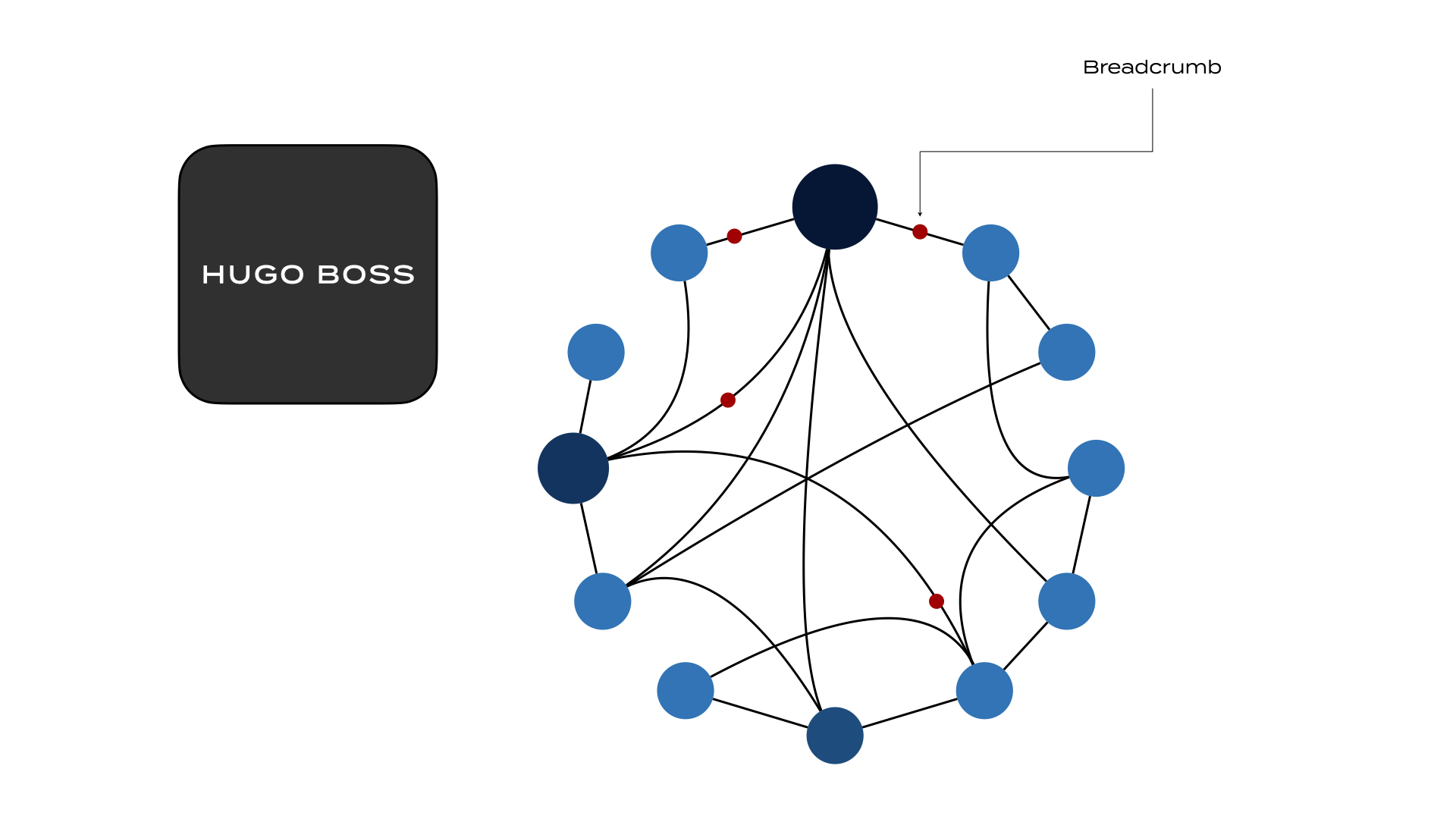
Our forensic analysis of the report’s digital footprint revealed that the “injection” occurred immediately. Within weeks of publication, nearly 2% of the report’s readership consisted of Hugo Boss insiders—specifically, directors and VPs.
The idea didn’t need to go viral globally; it just needed to infect the decision-making nucleus. Through private channels—the “Dark Social” network of saves and forwards—the diagnostic bypassed the “I don’t believe it” filter and landed on the strategy deck.
The Lesson: New Rulers for Old Problems
The HUGO BOSS case is not unique. It is simply the most visible validation of a universal truth:
“To see the invisible, we simply need new rulers.”−Morten J. Sørensen
The “Old Rulers” (traditional KPIs) told HUGO BOSS that womenswear was a difficult market. The “New Rulers” (Diagnostic Alpha) revealed it was a billion-euro opportunity disguised as a problem.
The company has now turned its streetlight toward that billion-euro opportunity. They have moved from “I don’t believe it” to “Let’s build it.”
For the rest of the market, the question remains:
What billion-euro “Invisible Gorilla” is walking through your business and investment right now, waiting for someone brave enough to turn on the lights?
READY TO TURN ON THE LIGHTS?
If your organisation is ready to move beyond “Organisational Homeostasis” and identify its own billion-value blind spot, initiate an Alpha Key™ Forensic Audit.
We apply the same methodology used to diagnose HUGO BOSS, PRADA, VINTED, TIMBERLAND, and PAUL SMITH.
INITIATE DIAGNOSTIC BRIEFING.
A Precision Playbook for an Age of Diagnostic Alpha
Private Equity faces a crisis of methodology where financial engineering masks a dangerous "Illusion of Health". This precision playbook offers a surgical upgrade, using a diagnostic approach to move beyond the "Streetlight Effect" and unlock verifiable alpha.

A Surgical Upgrade for PRIVATE EQUITY Unlocking Verifiable Alpha Beyond the Streetlight Effect
A Note on Perspective
This playbook, like my book, was born from a personal journey driven by a single question: Why? For years, I received expert advice that produced results lacking verifiable answers, which led me to step beyond the comfort of the conventional Streetlight Effect and search for a truth grounded in evidence, not opinion.
I was told my path was dangerous by the same experts, reckless even. I chose to trust my own curiosity and evidence trail. For ten years, I questioned conventional wisdom, seeking a diagnostic truth. The answer came from a Coronary Artery Calcium (CAC) scan—a non-invasive CT scan designed to assess risk long before symptoms appear. The scan produced a score of 2.5%, a verifiable truth that provides a near-guarantee against a heart attack for the next decade, proving that the consensus is not always the truth. This was a result I could build upon.
This was my Rubicon. It taught me that the most valuable breakthroughs are found not by reinforcing consensus, but by having the courage to dare to look beyond the edges of the Streetlight Effect. Like the innovators and rebels celebrated for thinking differently, the greatest opportunities lie waiting just outside the established field of view, in the shadows of the unquestioned. It is a lesson in the profound power of an independent, critical-thinking perspective.
This playbook is for those leaders. It is for the innovators, investors, and visionaries across the Private Equity ecosystem who understand that true alpha is generated by seeing what others miss. It is a tool for those who are ready to embrace their own curiosity, to dare to look where others don't, and to find the profound unseen value that awaits them beyond the streetlight.
For years, I applied this diagnostic to brands worldwide. My path converged with Private Equity after a series of insights—from Professor Ludovic Phalippou's analysis in Private Equity Laid Bare to a rising chorus of insider critiques—all revealed a common theme: the industry is grappling with the very crisis of methodology I had been treating at the brand level all along—a crisis where its very perception of value has become detached from the reality of creating it.
This playbook is my answer.
Morten J. Sørensen
Managing Director and Author of Who Moved My Customers?
01 | The Executive Summary
A Crisis of Methodology
The principles of foundational diagnostics teach that any complex system—whether biological or corporate—can appear healthy while masking a deep, internal decay. Private Equity is now facing its own version of this challenge, where a reliance on malleable metrics and financial engineering has created a dangerous "Illusion of Health”.
This has fuelled a significant reputational challenge, resulting in a playbook that has reached the limits of its effectiveness. A perception of opacity now creates a gap between a firm's perceived success and the trust it commands from investors. The toolkit they have operated with, while once profitable, now creates predictable challenges:
The Debt Dilemma: The leveraged buyout (LBO) model saddles assets with debt, increasing bankruptcy risk by an estimated 18% and prioritising financial engineering over foundational strength.
The Perception of Extraction: Practices like dividend recapitalisations are often perceived as 'value extraction schemes’, impacting the 'gut feeling' of Limited Partners.
The Transparency Gap: The reliance on malleable metrics like IRR makes it impossible to differentiate genuine, skill-based alpha from simple market luck, leading to a crisis of credibility.
These are not separate issues. They are symptoms of a single, core challenge: searching for value only where the light of conventional metrics shines brightest. This reality has left the industry at a crossroads.
In this new era where diagnostic alpha is the only thing that matters, this playbook is the tool that unlocks the prize of verifiable alpha. It offers a return to the first principles of value creation, designed to solve Private Equity's own demarcation problem: to draw a clear line between skill and luck, unlocking the profound value hidden in the shadows.
02 | The Paradigm Shift
Introducing the Organisational CT Scan
The challenges outlined in the Executive Summary are not the result of a failed model, but of a flawed perspective. For too long, the industry has operated under the cognitive bias known as the “Streetlight Effect”—searching for value only where financial data is easy to see, while the real, untapped potential remains hidden in the shadows.
This approach treats every company as an “Opaque Black Box”, leaving firms to make high-stakes decisions based on an incomplete picture. This perspective comes not from within an industry that can be hesitant to question itself, but from an independent, diagnostic viewpoint focused solely on one metric: documented, quantified value creation that benefits the asset directly.
To generate true, sustainable alpha requires a fundamental paradigm shift: moving from superficial observation to deep diagnosis. This new approach is built on a single, guiding principle:
“VIRTUALLY ANYTHING THAT HAS AN EFFECT CAN BE OBSERVED, AND ITS IMPACT UNDERSTOOD, EVEN IF NOT WITH OLD RULERS.”
To act on this principle, a new kind of ruler is required. The Organisational CT Scan is a proprietary diagnostic methodology designed to illuminate an asset’s Opaque Black Box. It provides a non-invasive, evidence-based way to see inside virtually any asset, measure its true operational health, and quantify the financial impact of its customer disconnects.
This diagnostic approach forms the foundation of a new, high-precision playbook designed for the modern economy. This is not a single snapshot, but a multi-layered diagnostic capable of revealing different truths—from customer base synergies in an M&A scenario to hidden operational frictions within a single asset—depending on the challenge at hand.
03 | The 5-Step Precision Playbook
The following five steps provide a clear, actionable roadmap for PE firms to navigate today's challenges. This playbook moves beyond generic financial engineering to a surgical approach focused on diagnosing issues, unlocking hidden value, and proving verifiable alpha.
Step 1: De-Risk the Debt-Fuelled Acquisition
The Challenge
The leveraged buyout (LBO) model, a cornerstone of the PE industry, is creaking under its own weight. In a typical buyout, loans are put in the name of the purchased company, saddling the asset with hefty debt from day one. This practice contributes to a significantly higher bankruptcy risk, with studies indicating it is 18% higher after a leveraged buyout. Conventional due diligence, which focuses on visible financial data, often overlooks the hidden operational dysfunctions that could jeopardise the investment.
The Upgrade: Deploy the Organisational CT Scan Before You Sign
Instead of buying a problem, you acquire a solution. A pre-acquisition scan provides a deep, proprietary diagnostic of an asset's true operational health and integrity. This allows you to:
De-Risk the Debt: The scan meticulously exposes hidden risks and quantifies previously unseen inefficiencies before you commit capital. This ensures your debt load is based on a robust valuation of the asset's true potential, not just its visible shell.
Build an Evidence-Based Roadmap: Armed with a verifiable understanding of the asset's health, you transform operational risk into a de-risked, actionable plan for value creation from day one.
Step 2: Uncover Value BEYOND THE SATURATED MARKET
THE PERCEIVED CHALLENGE
The days of finding undervalued companies with obvious "fat to trim" are largely over. Intense competition has led to a situation where there are record amounts of uninvested cash ("dry powder") because it's getting "harder and harder to find those companies" with clear potential for improvement. Many sectors have already received the "PE treatment", leaving traditional playbooks with few levers to pull beyond further financial engineering.
THE HIDDEN OPPORTUNITY
The challenge isn't a lack of opportunity, but a lack of precision tools to see it in a competitive market. A firm that can look beyond the streetlight doesn't just compete—it dominates. This is how you gain the upper hand:
Find Obscured Value: The Organisational CT Scan is designed to uncover the profound potential that traditional due diligence is blind to. My case files prove that over €30 billion in untapped revenue can be hidden in plain sight—concealed by a single linguistic word on a product label or an efficient internal keystroke.
Transform Your Deal Flow: Instead of fighting over the same obvious assets, you gain the ability to see a landscape rich with undervalued opportunities. This transforms your role from a market participant subject to intense competition to a precision architect of value with a distinct, reputational, and sustainable advantage.
Step 3: SHIFT FROM VALUE EXTRACTION TO SUSTAINABLE VALUE CREATION
The Challenge
High fees are often generated not just from successful exits, but from practices that, while designed to generate returns, can be perceived as 'value extraction schemes' that risk a company's long-term health. The consequences of a purely financial focus can be severe, particularly in sensitive sectors like healthcare, where studies have noted negative patient outcomes in some PE-owned facilities.
The Upgrade
Move from emergency surgery to a preventative stent that builds organisational health. A broad-stroke financial approach can be like waiting for a patient to show acute symptoms before intervening with high-risk surgery. A modern, high-precision playbook focuses on diagnosing issues and restoring Organisational Health before a crisis. This approach is more efficient and effective, as it targets specific needs. It is achieved by:
Diagnosing Before You Cut: The Organisational CT Scan acts as a cardiac CT scan, non-invasively finding the specific "plaque"—the customer disconnects and hidden inefficiencies—that are silently clogging the arteries of the business.
Applying Surgical Precision: By pinpointing the precise nature and location of the problem, you can apply a targeted "stent"—a minimally invasive operational fix that restores healthy value flow. This approach builds a stronger, more resilient company by protecting its culture of innovation and strengthening customer loyalty—the very assets that drive long-term enterprise value.
Step 4: Shatter the "Illusion of Health" with Verifiable Metrics
The Challenge
The Private Equity industry's reputation for opacity is well-earned. For decades, firms have used performance charts that experts now suggest can be "phoney" and based on "highly convenient benchmarks". The key metric, the Internal Rate of Return (IRR), is susceptible to manipulation, which can create a reassuring but misleading Illusion of Health while the value of unsold assets is overly optimistic. This lack of transparency makes it impossible to differentiate genuine skill from simple market luck.
THE UPGRADE: WEAPONISE YOUR TRANSPARENCY
Instead of hiding behind opaque, easily manipulated numbers, a high-precision playbook leads with verifiable proof of genuine value creation. This is achieved through two proprietary metrics derived directly from the Organisational CT Scan:
Quantify the Unseen: The Asset Efficiency Score (AES) is a proprietary metric that provides a true measure of an asset's operational health. It moves beyond sentiment and opinion to quantify unrealised potential in concrete monetary terms, representing the value being lost due to internal frictions and causal customer disconnects. It provides a verifiable, data-driven baseline for performance that cannot be easily manipulated.
Certify Your Success: The Asset Efficiency Certification (AEC) is the ultimate proof of performance. It provides transparent, third-party validation that tracks an asset's AES improvement over the investment lifecycle (3-7 years). By documenting long-term, quantified improvements in operational effectiveness, the AEC empowers General Partners to demonstrate genuine, skill-based alpha over simple market luck irrefutably to their Limited Partners (LPs) and other stakeholders.
Step 5: Engineer a Credible Exit Strategy
The Challenge
The traditional exit often relies on pure market mechanics. A common goal is to take a company public via an IPO and secure its inclusion in a major index like the S&P 500. This is a powerful strategy because it can create a pool of "forced buyers" (like index funds and pension funds) who must purchase the stock, which can boost a valuation based on market mechanics, sometimes independent of the company's underlying operational health. This dynamic can reinforce a narrative that PE prioritises financial engineering over building fundamentally sound companies.
THE UPGRADE: BUILD A LEGACY OF INDISPUTABLE VALUE
A high-precision playbook doesn't just rely on market timing; it engineers a narrative of genuine strength that builds long-term credibility and maximises value based on verifiable proof. This is accomplished by:
Exiting with Proof: Instead of just bringing a good story to the market, you bring a certified, healthy asset. The Asset Efficiency Certification (AEC) provides profound, verifiable assurance to future buyers, LPs, and the public market that they are acquiring a resilient, high-performing company with a proven track record of operational excellence.
Controlling the Narrative: Armed with a certified asset and data-backed success stories, your conversation with the market is no longer defensive. It's a proactive demonstration of excellence that allows you to build a powerful reputation as a credible architect of genuine market growth, transforming your firm's image from a financier to a proven builder of resilient companies.
04 | The Diagnostic Alpha Framework
A 3-Phase Framework
While the 5-Step Playbook outlines when and why to apply a diagnostic mindset across the investment lifecycle, this chapter details the operational engine that powers the entire process. This 3-phase framework is the systematic methodology for moving any asset from an "Opaque Black Box" to a source of verifiable, skill-based alpha. It is the engine that drives the shift from superficial observation to deep diagnosis, unlocking profound value hidden beyond the Streetlight Effect.
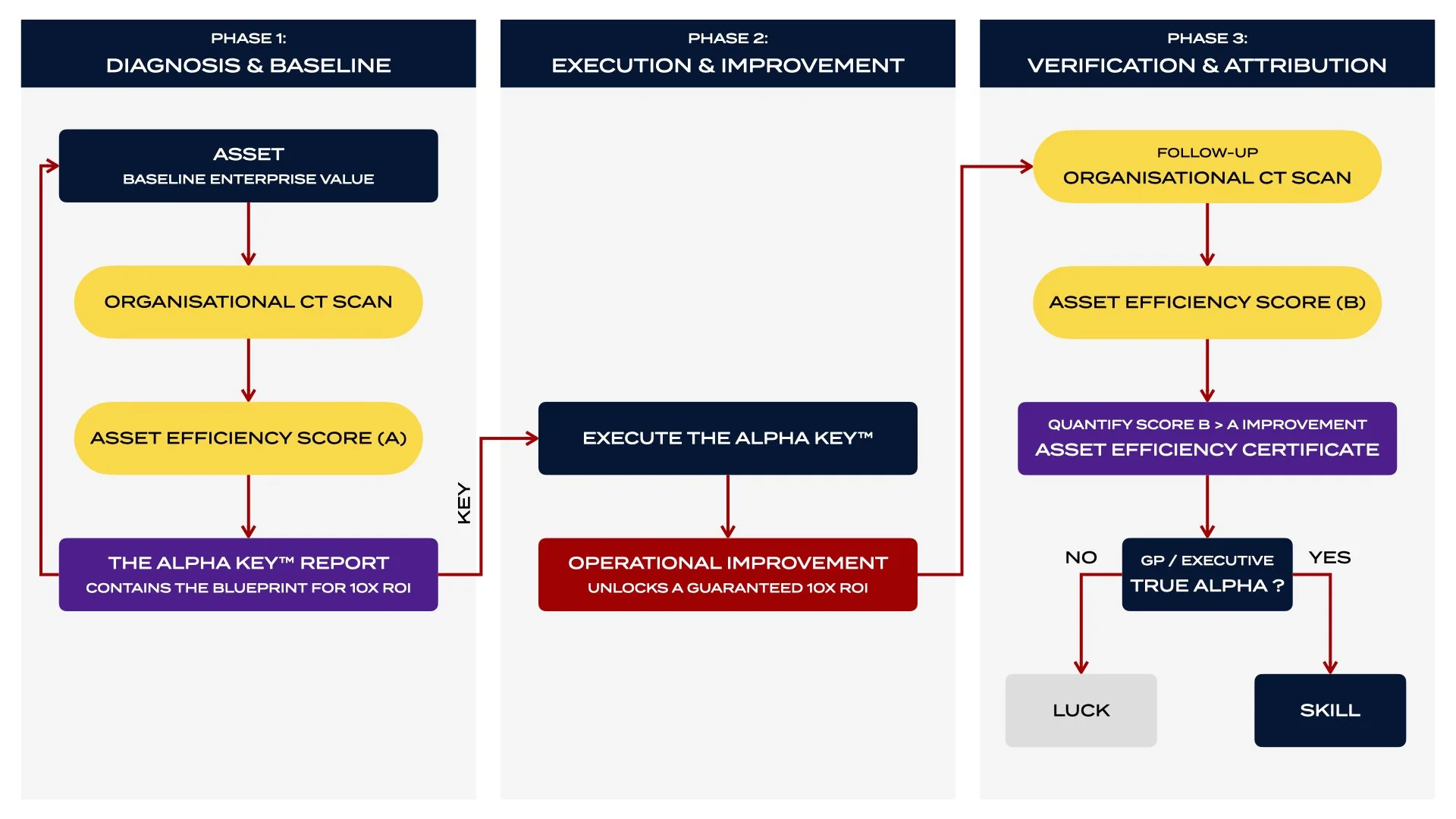
Phase 1: Diagnosis & Baseline
The first phase is a non-invasive, evidence-based process designed to establish a verifiable truth about an asset's current operational health.
Organisational CT Scan: This proprietary diagnostic moves beyond surface-level metrics to see inside an asset's true operational state. It synthesises a wide array of inputs—from financial data and internal processes to qualitative customer sentiment—to illuminate the hidden frictions and disconnects that erode value.
Asset Efficiency Score (AES): From the scan, we derive the Asset Efficiency Score (AES), a proprietary metric that quantifies the value being lost due to these disconnects. It provides a single, data-driven baseline (Score A) of the asset's health. A lower score signifies a larger, untapped opportunity for improvement.
The Alpha Key™ Report: The findings are delivered in this report, which contains the blueprint for achieving a minimum 10X ROI. It provides a single, high-impact, and evidence-based Alpha Key™ that targets the root cause of the asset's inefficiency.
Phase 2: Execution & Improvement
This phase is about surgical action. It translates the diagnostic insight from Phase 1 into a targeted, high-impact operational intervention.
Execute the Alpha Key™: This step involves the precise implementation of the single, transformative insight delivered in the report. It is the catalyst for moving the asset from its organisational homeostasis baseline toward a state of optimal performance.
Operational Improvement: The result is a targeted operational improvement that directly addresses the identified customer disconnect. This is the phase where the guaranteed 10X ROI is unlocked, transforming the diagnostic blueprint into realised, tangible value.
Phase 3: Verification & Attribution
The final phase provides irrefutable proof that the intervention was successful and that the value created was the result of skill, not luck.
Follow-up Scan & Score (B): A second Organisational CT Scan is conducted post-implementation to produce a new, updated Asset Efficiency Score (B).
Quantify Improvement (B > A): Verifiable improvement is demonstrated when the new score (B) is greater than the baseline score (A). This quantified, positive change is memorialised in the Asset Efficiency Certificate, providing transparent, third-party validation of the improvement.
GP / Executive True Alpha: By documenting a direct, causal link between the targeted intervention (Phase 2) and the data-driven improvement in operational effectiveness (Phase 3), the framework provides definitive proof of performance. It empowers General Partners and Executives to irrefutably demonstrate genuine, skill-based alpha over simple market luck to LPs and all other stakeholders.
05 | A Case Study in Precision
The principles in this playbook are not theoretical. The following case study demonstrates one powerful application of this diagnostic process, designed to uncover profound, quantifiable value where others see nothing.
Unlocking €1.375 Billion in the Shadows
HUGO BOSS
1. Following the Scent Beyond the Streetlight
My investigation did not begin with a financial statement, but with a human signal—a faint scent of customer disconnect that traditional analysis always misses. Dr. Kerstin Brehm, a former cardiac surgeon and the brand's ideal customer, posted publicly about her lifelong loyalty, yet current feeling of being a "stylish afterthought." Her question was profound and one I wanted to answer:
“Why was a brand she loved making her feel invisible?”
This is the starting point for the Strategic Bloodhound: a signal from the shadows that demands investigation.
2. The Visual Diagnosis of the Problem
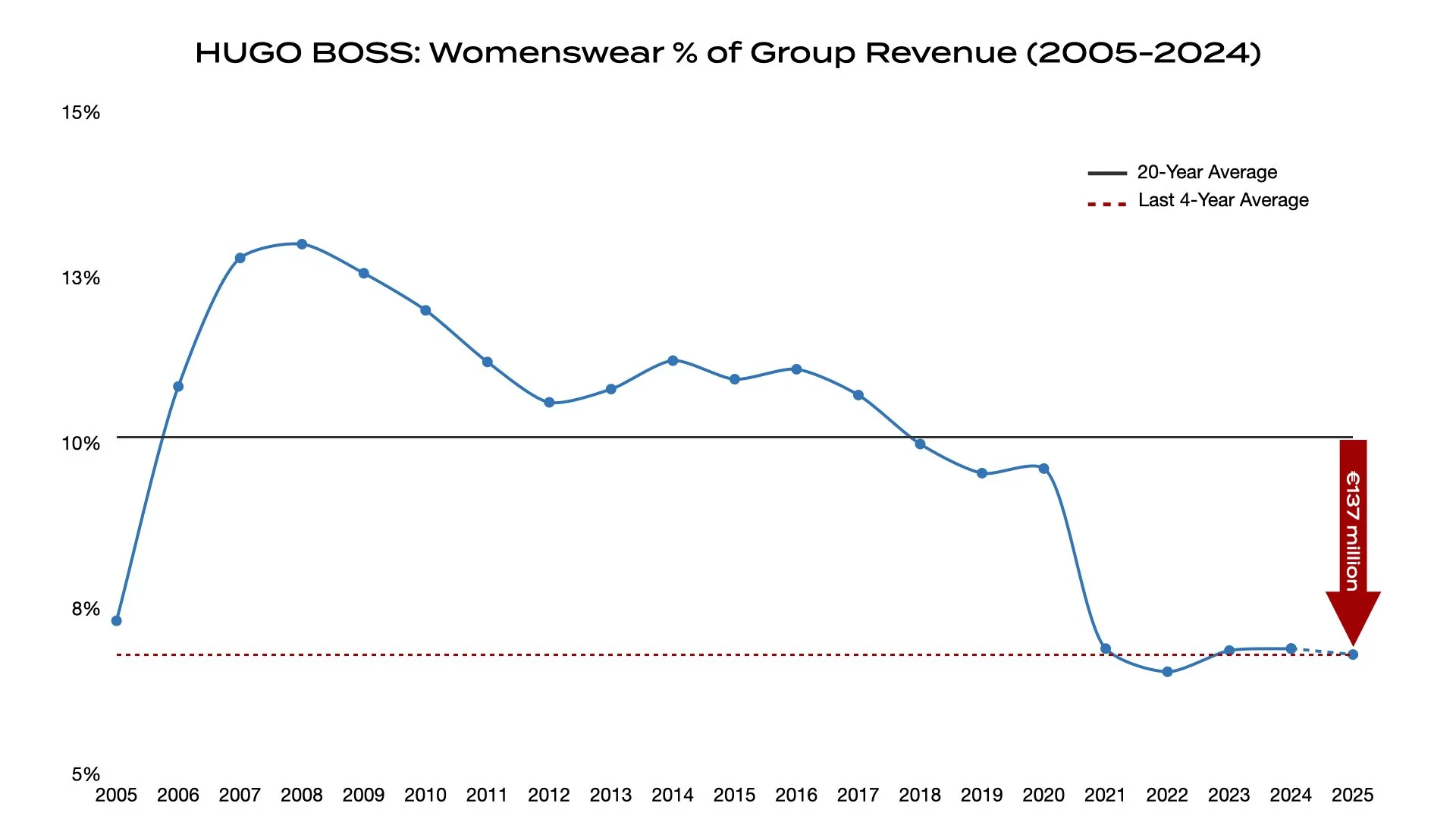
The first step was to determine if Dr. Brehm's “feeling” was an emotion or a quantifiable reality. The Organisational CT Scan began by analysing two decades of HUGO BOSS's own financial data. The result was unequivocal.
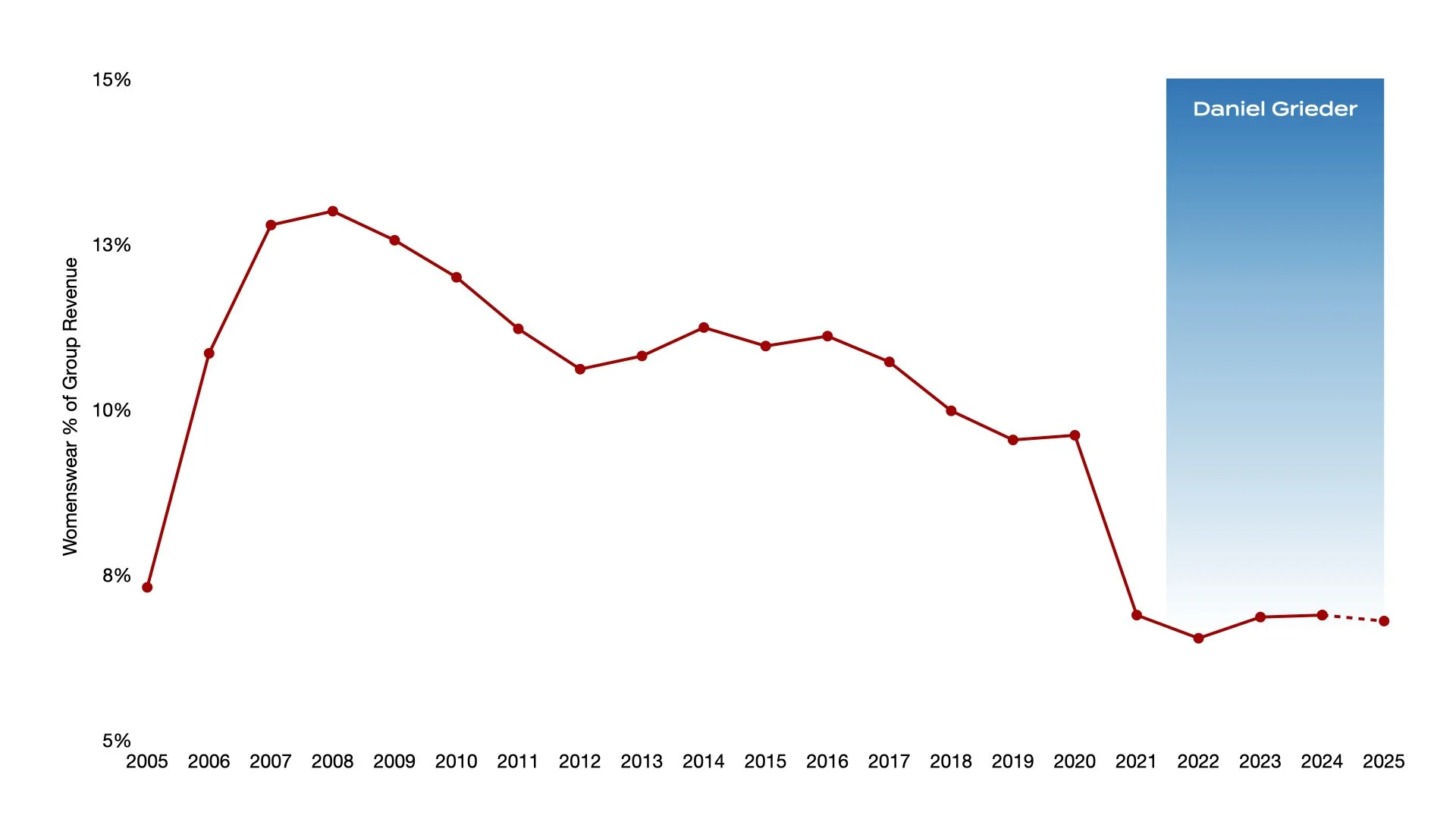
The chart below visualises the problem. After peaking at over 13% of group revenue, the Womenswear division collapsed, falling to an average of just 6.8% over the last four years. This gap between the 20-year historical average and current performance represents €137 million in missed annual revenue. I call this The Cost of Decay—the annual price a company pays for simply failing to maintain its own established baseline. While this data provided the verifiable truth of what was happening, it could not answer the most important question: Why?
Diagnosis vs. Disbelief: Quantifying the Prize for Vision
While the problem was clear, HUGO BOSS was operating under its own Streetlight Effect. The company's focus was on the bright light of its 'CLAIM 5' strategy, which had driven record top-line revenue. However, sophisticated investors were sceptical, noting a depressed share price that contradicted the celebratory narrative.
They sensed what my Organisational CT Scan would prove: the Illusion of Health was masking a massive, unaddressed vulnerability.
3. Unlocking the Opaque Black Box
The diagnostician in me revealed the disease: a systemic failure to see, value, and serve its female customers. This was the same verifiable truth I had presented to the company myself in reports from 2017, 2019, and 2021. My follow-up conversations with Dr. Brehm confirmed that HUGO BOSS leadership had been presented with these conclusions from multiple sources. The response was consistently a variation of "I don't believe it"—a classic symptom of a leadership team insulated from reality by their own success.
The core disconnects weren't about hemlines or handbags; they were about a fundamental lack of visibility and invitation. As two customers outside the Stuttgart store told me, "How can we buy what we cannot see?”
4. The Verifiable Alpha Opportunity
The true power of this playbook is not just in diagnosing problems, but in quantifying the prize for solving them. A 2025 re-analysis confirmed that a 60/40 gender revenue split is a realistic potential for HUGO BOSS. Closing this gap would add over €1,375 billion in annual top-line revenue.

This is The Prize for Vision—the verifiable alpha waiting in the shadows. But for a Private Equity owner, the ultimate prize is how this top-line opportunity translates into the language of their world: EBITDA margin.
5. THE EBITDA PAYOFF: THE PRIVATE EQUITY PERSPECTIVE
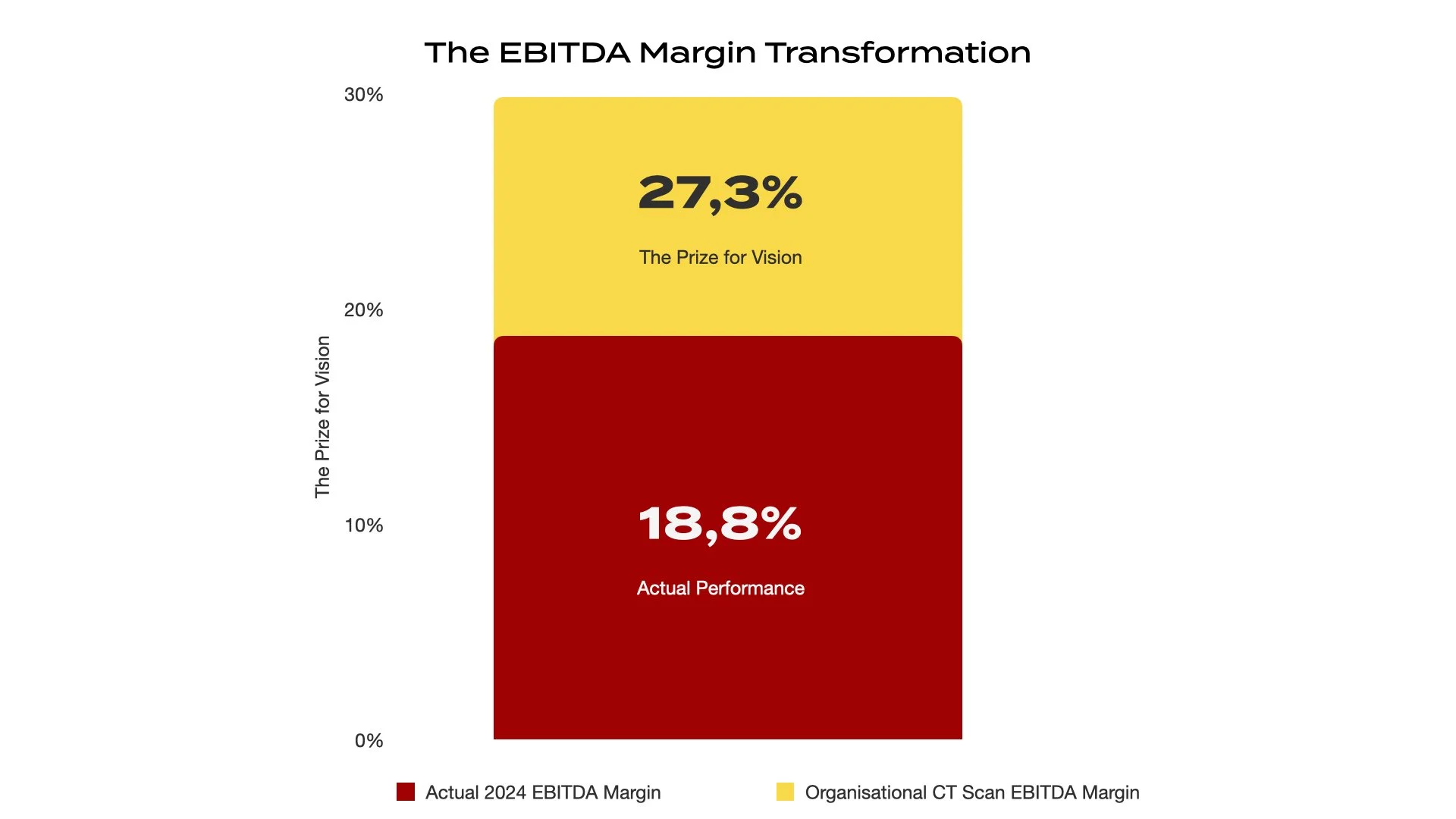
For a PE owner, the true prize isn't just top-line revenue; it's the explosive impact on the bottom line. In 2024, HUGO BOSS delivered an EBITDA margin of 18.8%.
A hypothetical analysis shows that by capturing the €1.375 billion opportunity in womenswear, that margin would have catapulted to a world-class 27.3%. That nearly 900-basis-point improvement—a 1.5x multiple on the asset's core profitability—is the definitive proof of value creation: the high-octane fuel required to comfortably service LBO debt and dramatically increase enterprise value at exit.
This case study is the high-precision playbook in action. It demonstrates how starting with a faint human signal leads to a deep diagnosis that unlocks a multi-billion-euro opportunity—one that was always there, waiting patiently to be seen. The key to unlocking this value is now in their hands, but as this investigation proves, you cannot give billions in revenue to a leadership team that refuses to believe it exists just beyond their own Streetlight Effect.
The Enterprise Value Transformation
Translated into the ultimate PE metric, this margin improvement would increase HUGO BOSS’s Enterprise Value from approximately €4,0 billion to €5,3 billion. That 30% uplift—a 1.3x increase in Enterprise Value derived purely from a diagnostic insight—is the definitive, verifiable prize of Diagnostic Alpha.
06 | Putting the Precision Playbook to Work
The playbook provides a verifiable, data-driven standard for the Private Equity ecosystem, replacing opacity with clarity and market luck with provable skill.
1. For General Partners (GPs) & PE Firms
Source Smarter: Uncover immense value in assets that competitors, blinded by conventional metrics, will overlook.
De-Risk Acquisitions: Justify valuations and make investment decisions based on a deep, diagnostic understanding of an asset’s true operational health.
Accelerate Fundraising: Provide LPs with certified, verifiable proof of skill-based alpha, moving beyond opaque and malleable metrics.
2. For Limited Partners (LPs) & Investors
Look Inside the Black Box: Ask sharper, more insightful questions about how a GP truly plans to generate returns beyond financial engineering.
Verify the Alpha: Request verifiable proof of operational effectiveness, like an Asset Efficiency Certification (AEC), to identify elite managers who can deliver genuine alpha.
Drive Sustainable Growth: Champion a model that builds healthier, more resilient companies, better aligning financial returns with long-term performance.
3. For Consultants & Service Providers
Deliver Unique Insight: Provide your PE industry clients with a unique, data-driven diagnostic that uncovers profound new opportunities for value creation.
Differentiate Your Practice: Set your firm apart by offering a proprietary, verifiable methodology that elevates your strategic recommendations, builds undeniable credibility, and justifies premium fees.
Speak the Language of Verifiable Alpha: Align your services directly with your clients’ ultimate goal: delivering provable, skill-based returns to their investors.
In this new era where Diagnostic Alpha is the only thing that matters, this playbook is the tool that unlocks the prize of Verifiable Alpha.
Continue the Journey Beyond the Streetlight
This playbook was created for the innovators, investors, and visionaries ready to find value where others don't. For those prepared to apply these principles, here are the resources to guide your next steps.
Your Resources
For Deeper Insight: To explore the allegorical story and philosophy behind the "Streetlight Effect," the book Who Moved My Customers? provides the foundational mindset for this new diagnostic approach is available on Amazon or here.
For Actionable Application: For a confidential discussion on applying the Organisational CT Scan to a specific portfolio asset or pre-acquisition target, you can connect with Morten directly. This is the path from theory to verifiable alpha.
For Ongoing Dialogue: To engage with current analysis, case studies, and join the conversation with other leaders, follow the latest insights on LinkedIn.
The €1.375 Billion Irony: Following the Scent of a Billion-Euro Blind Spot
Why would a brand its customer loves make her feel invisible? This investigation follows the human scent of disconnect at HUGO BOSS, revealing a two-decade-long decline, activist pressures, and a staggering €1.375 billion blind spot hidden in plain sight.
THE SCENT: A SEARCH FOR A TANGIBLE WHY

This investigation began not with a financial report, but with a human signal: a powerful public post from Dr. Kerstin Brehm, a former cardiac surgeon and the brand’s ideal customer. She described a lifelong loyalty to HUGO BOSS, yet a current reality of feeling like a “stylish afterthought”.
Dr. Brehm's question was simple and profound:
Why was a brand she loved making her feel invisible?
As The Strategic Bloodhound, my work is to follow signals in the shadows—these are the faintest of scents of customer disconnect that often lead to the heart of a company's greatest challenges. They are, as is so often the case, the clues hiding in plain sight, especially when a company fails to stay curious and look where others don't.
My first step was to determine if Dr. Brehm's sentiment was an isolated feeling or a quantifiable reality. A review of two decades of HUGO BOSS's own financial statements provided the unequivocal answer: her experience was the archetype of a womenswear division in a long and costly freefall.
But this data only showed what was happening, not;
Why?
This report follows that scent into the shadows to help answer Dr. Brehm's question. It details the investigation into the complex manoeuvres behind the decline and reveals the staggering, multi-billion-euro opportunity that remains hidden in the dark.
QUANTIFYING THE SCENT
Dr. Brehm's feeling of being a "stylish afterthought" was not an isolated sentiment. It was a precise reflection of a quantifiable, two-decade-long reality visible in HUGO BOSS's own financial statements.The data trail is unequivocal. After peaking at over 13% of group revenue, the womenswear division entered a long decline, ultimately collapsing to an average of just 6.8% over the past four years.
The Streetlight Effect
To understand how a €137 million opportunity can remain invisible to a world-class company, this investigation applies the central principle from my book, Who Moved My Customers? The book is an organisational parable that reveals the fundamental why behind why companies falter: they consistently overlook the subtle, unseen shifts in customer loyalty and disconnects because they are not looking in the right places.
My approach is built on the principle that this challenge has been solved:
“VIRTUALLY ANYTHING THAT HAS AN EFFECT CAN BE OBSERVED, AND ITS IMPACT UNDERSTOOD, EVEN IF NOT WITH OLD RULERS.”
The core of this blindness is a cognitive bias known as the “Streetlight Effect”.
The story is simple:
A policeman on his nightly patrol finds a man on his hands and knees under a streetlight. "What are you doing?" the policeman asks.
"I'm looking for my keys”, the man says.
The policeman helps him search, but after finding nothing, he asks, "Are you absolutely sure you lost them right here?"
"No," the man replies, "I lost them in the park.”
"Then why on earth are you looking here?" the baffled policeman asks.
"Because," the man says, "this is where the light is.”
This parable perfectly illustrates the gravitational pull to focus only on visible, readily available data while ignoring the truths lurking in the shadows. The false “Illusion of Health” it fosters can be dangerously misleading, leading to misinformed decisions and value destruction.
The “Organisational CT Scan”—the diagnostic mindset taught in the book—is the key to seeing beyond this illusion. It’s the framework designed to help decision makers look past the bright light of familiar metrics to expose their organisation’s true operational health and make the invisible visible.
Applying this lens to HUGO BOSS allows us to understand its paradox. The following section will reveal what the company sees under its own bright streetlight—the official story of success that helps explain its billion-euro womenswear blind spot.
Under the Streetlight
Under the bright light of its official narrative, HUGO BOSS is a resounding success. The 'CLAIM 5' strategy, implemented by CEO Daniel Grieder, has driven top-line revenue from €2.8 billion to a record-breaking €4.2 billion since 2021. The leadership is celebrated and has since set an ambitious new target of €5 billion in sales for 2025, accompanied by a 12% EBIT target.
In isolation, this top-line growth is impressive. This is the bright light where the company focuses its attention.
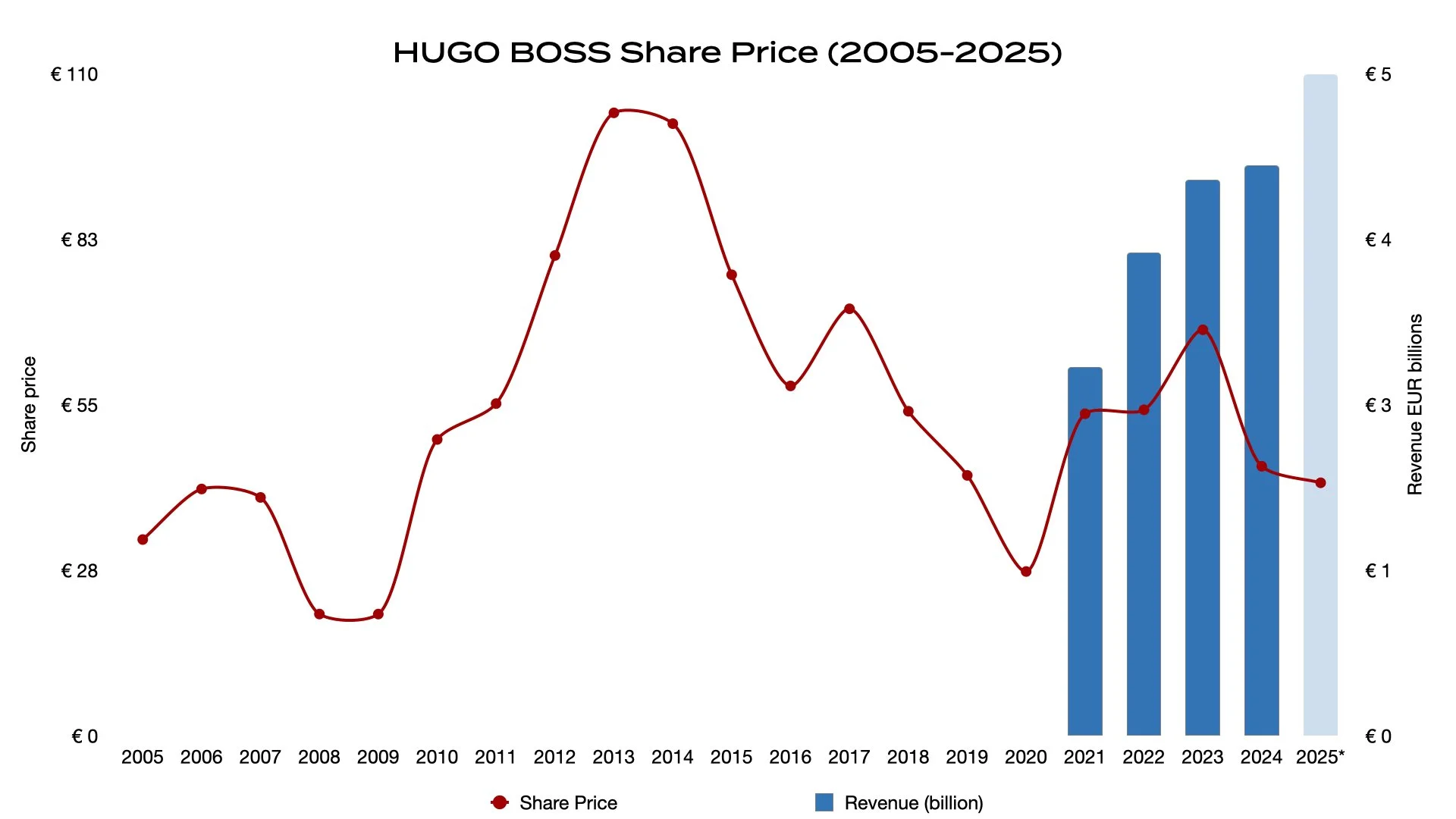
However, even within this bright light, anomalies appear in the periphery. Despite record-breaking revenue, the company's share price is depressed, and it has lost over €315 million in market capitalisation since Grieder took charge.
Furthermore, the most sophisticated analysts in the financial market are unconvinced. Following the June 2023 investor day, financial giants including Goldman Sachs, Deutsche Bank, and JP Morgan maintained "neutral" ratings.
This scepticism illuminates a classic financial dynamic... While leadership communicates success through the bright light of a profitability metric like EBIT, sophisticated investors are searching for truth in the shadows of the cash flow statement. This is the kind of thinking employed by legendary investors like Warren Buffett and Charlie Munger, who look beyond EBITDA for a simple reason: “Ignore working capital and capex, and you’re not looking at reality.” The market is signalling that it is looking at this deeper reality, not just the optics.
This disconnect between celebrated performance and market scepticism is the second clue that the whole story is not being told in the light. It is the central paradox that prompted this investigation into the shadows.
THE HUNT IN THE SHADOWS
Finding 1: The Cold Case of Wilful Blindness
The clues to the decline in womenswear and the market’s scepticism are not new discoveries. They are cold cases—a series of unheeded warnings presented directly to the company’s leadership over many years, long before the current ‘CLAIM 5’ strategy was conceived.
The following three findings are not presented as the sole causes of the decline, but as irrefutable symptoms of a deeper, systemic issue: a corporate culture that has consistently failed to see, value, and prioritise its female customer.
Sidebar: The Cold Case Files
2017—The Gender Gap:
An analysis presented to HUGO BOSS executives identified a potential 60/40 gender revenue split, representing a missed opportunity of over €750 million annually at the time.
2019—The Customer Disconnect:
A detailed customer report quantified a growing disconnect. It revealed that “sticky pathways” and other internal frictions—the “bad flora” in the company’s ecosystem—were actively eroding brand value to an estimated €834 million shortfall in womenswear revenue for that year alone.
2021—The Loyalty Collapse:
A follow-up analysis cautioned the company about an estimated €2.5 billion dilution in loyalty value stemming from these persistent blind spots.

Together, these previously ignored findings represent The Cost of Inaction—the price of being aware of massive, specific opportunities but failing to act.
The corporate reaction to this data... was consistently the same: disbelief. This is a classic symptom of “Organisational Homeostasis”—the state where a company becomes comfortable in an unhealthy but familiar equilibrium.
This history reveals the root of the problem. The issue has never been a lack of information, but a consistent failure to act on what was happening right outside the streetlight’s glow. These historical warnings were early-warning signals of the same systemic blind spot that the €1.375 billion opportunity quantifies today.
THE HUNT IN THE SHADOWS
Finding 2: 'Project Tango' and Executive Distraction
The historical neglect detailed in the "Cold Case" files was recently compounded by a significant and controversial executive distraction. In 2023, the "Project Tango" affair erupted, providing a compelling theory for why the womenswear division continued to languish, even amidst the celebrated ‘CLAIM 5’ turnaround.
Sidebar: What was 'Project Tango’?
The Plan:
An alleged secret plan orchestrated by CEO Daniel Grieder and the now-disgraced tycoon René Benko to create a new, independent "Fashion Investment Group".
The Goal:
Grieder would eventually leave HUGO BOSS to lead this new empire after acquiring controlling stakes in major brands like Adidas, Bally, and Bogner.
The 'Smoking Gun’:
Evidence stems from a confidential email in which Grieder allegedly linked his new HUGO BOSS strategy announcement (the €5 billion target) directly to a potential share price increase, reportedly writing to Benko, "I believe this will drive the share price to very high levels".
The Fallout:
Grieder’s alleged partner, René Benko, now faces criminal charges for insolvency-related fraud following the collapse of his Signa Group empire.
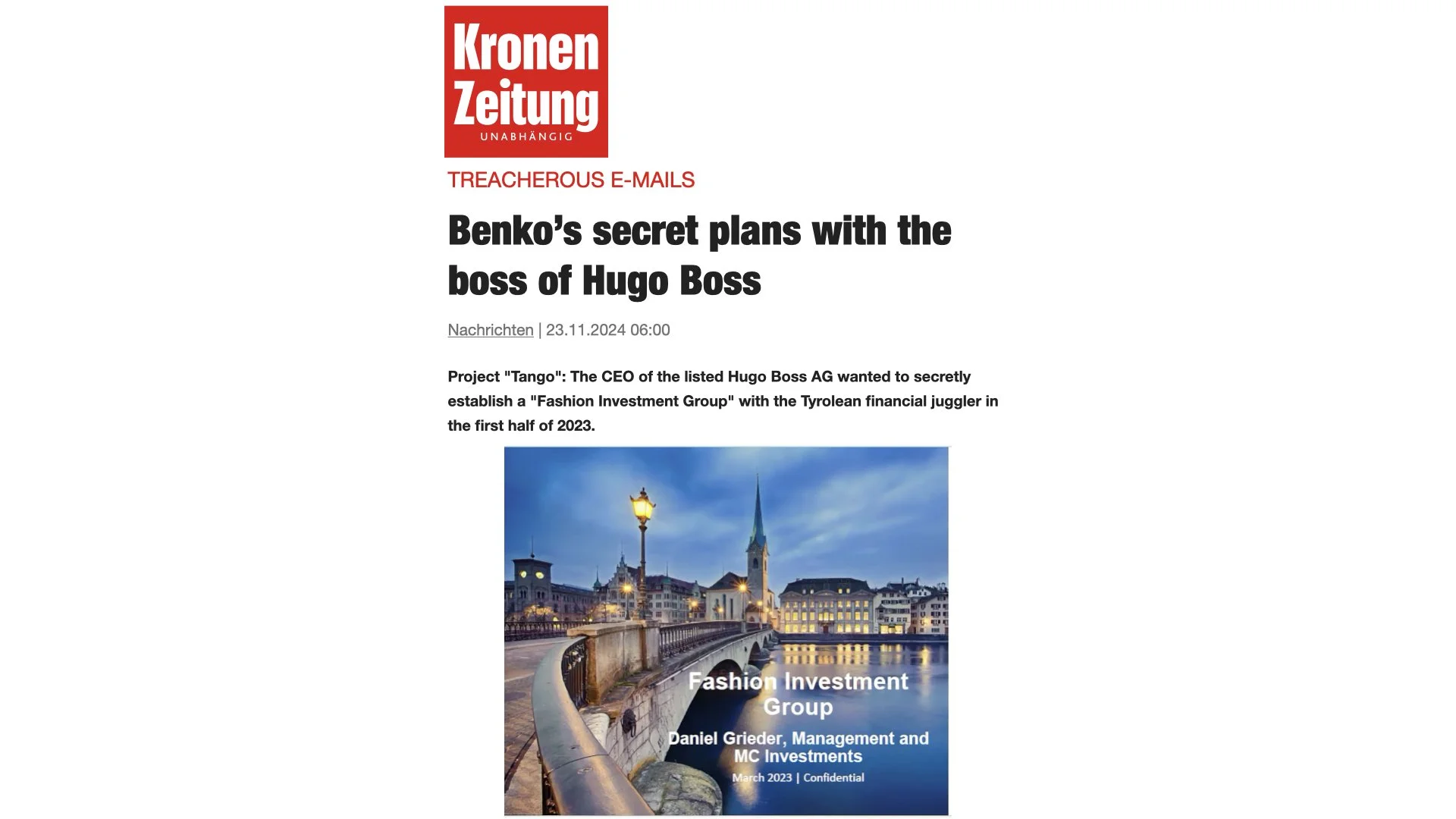
While the full details of “Project Tango” remain in the shadows, the allegations alone paint a picture of a leadership team whose focus may have been on a speculative, external venture rather than on fixing long-standing, core business problems. This distraction, which allegedly focused on creating a new multi-billion-euro external empire, provides a powerful explanation for why a known, internal €137 million problem like womenswear remained off the radar.
Sources: Kronen Zeitung: https://www.krone.at/3602449
Financial Times: https://www.ft.com/content/a2200443-e920-45d4-a14c-37b89b9d1594
THE HUNT IN THE SHADOWS
Finding 3: The Activist at the Gates
The combination of long-term neglect and executive distraction creates a predictable vulnerability. When a company is perceived to be underperforming and leaving billions in value on the table, activist investors see an opportunity. The arrival of Mike Ashley’s Frasers Group is the inevitable consequence of HUGO BOSS’s multi-billion-euro blind spots.
From 2020, the same time as HUGO BOSS announced Daniel Grieder’s arrival, through to today, Frasers Group has quietly amassed a colossal 28.20% of the company's voting rights, culminating in the 2025 election of its CEO, Michael Murray, to the Supervisory Board.
Their influence is already being exerted
Frasers Group has publicly stated it will vote against dividend payments, demanding that the board instead reinvest the capital to improve the quality of its growth. This activist stance, which also includes calls to redeem treasury shares, is a clear signal of their intent to force a shift in the company's capital allocation strategy. In addition, recent developments inside Frasers Group itself add a new layer of urgency to this situation. Their own CEO, Michael Murray, is expected to miss a personal £100 million bonus due to Frasers' underperforming share price. This internal pressure makes their investment in HUGO BOSS critical. Their demand for HUGO BOSS to scrap dividends and reinvest for growth is not just a strategic preference; it is a vital necessity to generate the returns they desperately need.
Sidebar: Who is Frasers Group?
Frasers Group, led by founder Mike Ashley, is a retail conglomerate known for its assertive and often-controversial business approach.
Aggressive Acquisitions:
They have a well-known history of acquiring struggling retailers at bargain prices. The question for HUGO BOSS is why they would be a target.
Activist Style:
They are famous for a hands-on management style and a willingness to engage in public corporate battles to unlock shareholder value.
'Elevation Strategy’:
Their recent expansion into the premium and luxury markets makes a brand like HUGO BOSS a prime target for their ecosystem.
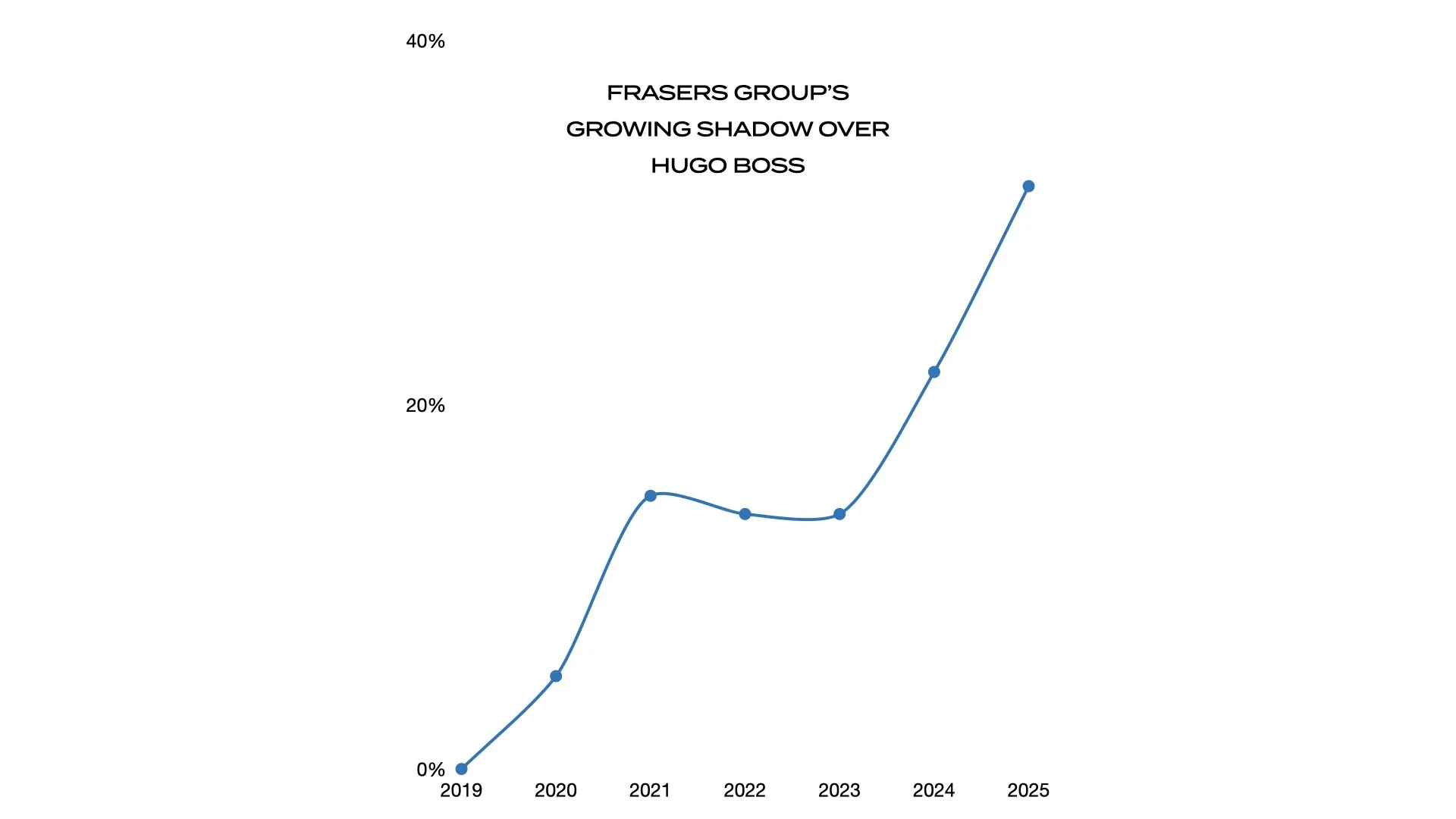
Frasers Group's presence is not the cause of HUGO BOSS's problems, but rather their ultimate effect.
WHAT THE STREETLIGHT MISSED
The €1.375 Billion Irony
With the evidence of historical neglect, executive distraction, and the resulting activist pressure now established, the final step is to quantify the true value that remains hidden in the shadows.
This investigation started with a customer asking why the brand was making her feel invisible. The data confirms her feeling: the womenswear division has collapsed from a peak of over 13% of group revenue to an average of just 6.8% today.
The question is no longer “Why can’t they build it?”—they already have. The real mystery now is:
Why did they let it collapse?
A 2025 analysis reconfirms the findings from 2017: a 60/40 gender revenue split potential continues to exist for a brand with HUGO BOSS’s market position. Closing this gap—simply by serving the customers the HUGO BOSS Streetlight is not equipped to see— would add over €1.375 billion in annual top-line revenue. This is The Prize for Vision. It is not about reclaiming a lost average but about seizing the full, forward-looking potential of the brand.
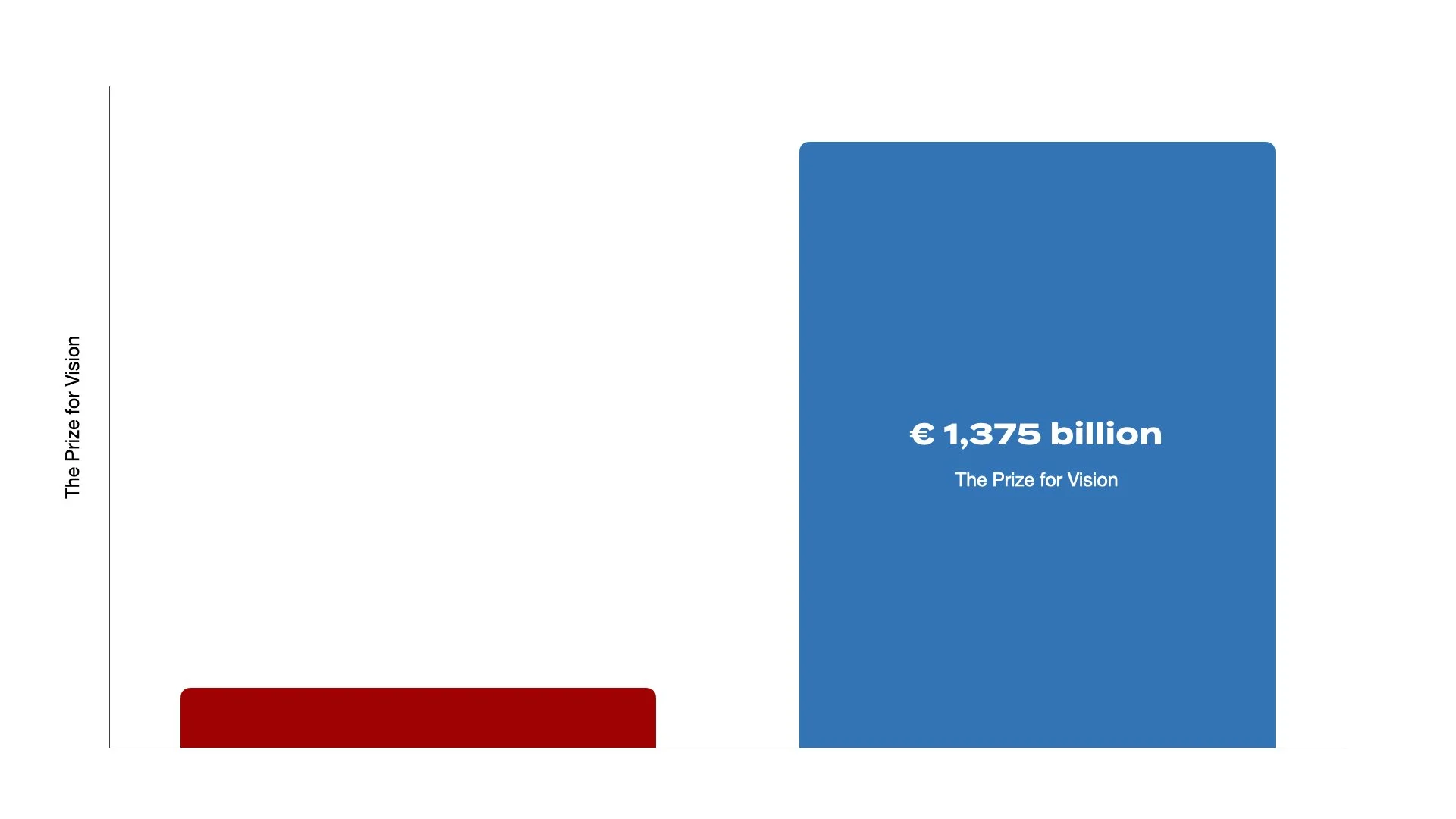
This is the ultimate irony of the Streetlight Effect. The key to smashing the €5 billion sales target and creating unassailable shareholder value was never in the bright light of the ‘CLAIM 5’ strategy playbook. It was always waiting patiently to be seen in the dark.

The €1.3 Billion Enterprise Value Prize
This dramatic improvement in profitability has a direct and profound impact on the company's total valuation. Based on the current enterprise value of approximately €4.0 billion, the operational improvements that unlock the €1.375 billion in revenue would translate directly into a potential Enterprise Value of €5.3 billion.
That €1.3 billion uplift is the ultimate prize of Diagnostic Alpha. It represents the verifiable, skill-based alpha that is created not through financial engineering, but through a surgical understanding of an asset's true operational health.
The unseen billions in revenue and margin remain in the shadows, a testament to the millions of customers who remain unseen, even after the initial signal from Dr. Kerstin Brehm was finally heard. This isn’t just about lost sales; it’s about a failure to nurture the entire ‘Customer Grove’—the allegorical term from my book for a brand’s customer ecosystem. It is a failure to tend to both the loyal ‘Fruitful Trees,’ who represent core customers, and the neglected ‘New Saplings’—the new customer segments that represent HUGO BOSS’s future.
CONCLUSION: THE KEY Is BEYOND “I DON'T BELIEVE IT”
The key to unlocking €1.375 billion in womenswear revenue for HUGO BOSS is so deceptively simple it often evokes the very disbelief that has been HUGO BOSS's response for years. The answer lies not in a complex new strategy, or even in the existing 'CLAIM 5', but in a simple, human-centric shift, once seen.
That key was revealed to me in 2017 by two fabulous ladies outside the Stuttgart store. They didn't critique the clothes they couldn't find; their question was more fundamental and profound. "Of course, we know HUGO BOSS, we know them as the masters of menswear," one said, looking toward the entrance, "but how can we buy what we cannot see?"
They were not asking for a new collection, ambassador, or icon; they were simply asking for an invitation to enter. That has always been the core and the key to reshaping the customer's gut feeling about HUGO BOSS. It is not found in expensive new marketing campaigns, new collections, or the use of ambassadors and icons. But in the profound act of a simple "invitation"—one that extends from the front window of the store to the front of the strategic agenda. That's the "I don't believe it" billion-euro key, visibility. It's about greeting the millions of customers who are already at the door, simply waiting to be seen.
The billions in hidden value wait only for a leadership team with the courage to believe that the most profound answers are often the simplest.
Unlocking this opportunity is not just a key to smashing sales targets; it is the most direct path to elevating the company's EBITDA margin to a world-class 27.3%, adding over a billion euros to its enterprise value, and closing the credibility gap with the financial markets—all while finally making Dr. Kerstin Brehm feel incredibly visible.
It’s your move, HUGO BOSS AG.
A personal sidenote
This corporate paradox, an organisation projecting health while masking critical, unseen vulnerabilities, resonates on a deeply personal level. This investigation began with a signal from Dr. Kerstin Brehm, a former cardiac surgeon. It is a fitting coincidence, as my own journey beyond the streetlight was validated by a diagnostic tool she knows well: a CT Scan.
My own "Illusion of Health" as a long-time diabetic was shattered over a decade ago when I first stepped beyond conventional wisdom's Streetlight Effect. A recent, near-perfect CAC scan result has provided the clinical objective validation for the power of that first step. I dared to look where others didn't, and that single step transformed my life.
“Always stay curious and dare to look where others don’t.”