
SYSTEMIC DIAGNOSTICS // FIDUCIARY ARCHIVE
THE FIDUCIARY REGISTRY
Independent, non-smoothable intelligence logs and systemic diagnostics compiled over more than a decade of tracing transaction metadata. This archive operates as a sovereign database built to strip away narrative seduction, exposing where portfolio assets are weaponised as pawns within private equity's opaque black box. It equips Level 1 allocators with the precise metrics required to enforce baseline accountability and cleanly separate authentic operational execution from debt-engineered luck.
In the Outer Space of Limited Partnership: MAPPING THE OPERATIONAL SKILL OF PRIVATE EQUITY’S GPS
In the ‘Outer Space’ of Private Equity, Limited Partners are left holding decaying assets while GPs manufacture unearned performance fees. By applying an Organisational CT Scan to 13 years of Golden Goose's telemetry, this diagnostic exposes the ‘NAV Squeezing’ illusion—proving it is entirely possible to separate true GP skill from financial engineering.

‘In the Outer Space of Limited Partnership, nobody can hear when anybody screams.’Recent industry discourse—spearheaded by financial risk experts like Victor Hong and Larry Mohs—has laid bare the mechanics of ‘NAV Squeezing’. This is the practice where General Partners (GPs) manufacture unearned performance fees through rapid accounting mark-ups, leaving the Limited Partners (LPs) footing the bill.
The financial diagnosis is bleak. But if you recalibrate the frequency to filter out the financial background noise, the void is not silent at all. Outer space is not empty; it is simply unmapped.When you bypass the financial façade and zero-beat the true operational waveform, the exact illusions described by Wall Street watchdogs play out in real time.
The 13-Year Telemetry of a Host Asset
Below is the 13-year operational telemetry of a single asset—Golden Goose. Across four GPs and five transfers, its distress beacon cuts right through the vacuum.

Figure 1: The 13-year operational telemetry of Golden Goose. Yellow markers indicate GP-engineered valuation spikes and debt syndication; red markers track the compounding structural friction and operational decay of the host asset.
This graph is an Organisational CT Scan. It provides the visual diagnostic proof that it is entirely possible to track GP skill versus luck over time and map any asset's operational reality accurately, irrespective of the financial narrative.
The X-ray reveals two distinct, conflicting realities:
The Illusion of Value (The Yellow Stars)
GPs engineer massive valuation spikes to extract performance fees and syndicate new debt. Currently, Golden Goose is being saddled with €880M in debt under the HSG buyout, extracting €57M in pure annual interest. (For a complete mathematical breakdown of how this specific debt burden cannibalises the host asset, refer to my real-time diagnosis of the Golden Goose Corporate Doom Loop). The financial engineering works perfectly: the exiting GPs and the investment banks extract their millions and successfully transfer the risk.
The Operational Decay (The Red Stars)
Look beneath the yellow stars. While the financial metrics spike, the host is being systematically hollowed out. This invariant 13-year CT Scan reveals that the asset's oxygen is bleeding out, albeit slowly. As of the latest telemetry, €469M of its 2025 revenue is transacted with customers carrying a 91% probability of churn due to unaddressed root-cause contagion and structural friction.
DIAGNOSTIC DEEP DIVE: > How does a 64% Asset Inefficiency Score collide with €57M in annual interest? Read the accompanying real-time diagnosis to see exactly who wins, who loses, and the mathematics behind the 20% bankruptcy trap: The €880M Golden Goose Bond Sale & The Corporate Doom Loop
The True Cost of 'Shadow Data'
The mechanics of the Private Equity machine are brutally efficient:
The GPs extract the management fees.
The banks extract the syndication fees.
The LPs are left holding debt against a decaying, dying asset in the cold vacuum of the vast, black Outer Space.
Human eyes are biologically limited to the visible spectrum, and standard LP due diligence is no different. It only sees the yellow stars.The operational screams—the red stars—are perfectly clear once you deploy the algorithm required to scan the invisible spectrum of 'Shadow Data’ and display the artefacts. To see the invisible, we simply need new rulers. The panopticon has been built; it is time for the LPs to step into the watchtower.
Measuring The Unmeasurable: Breaking the One-Way Mirror of Private Equity
Drawing a profound parallel between a flawed medical playbook and the Private Equity industry, this article exposes how standard financial metrics mask the hollowing out of enterprise value. Discover how the Asset Efficiency Score (AES) provides an independent, mathematically verifiable ruler to break PE's one-way mirror, empowering LPs to bypass rigged data and isolate true GP skill from mere market luck.
For the past decade, my work has been purely diagnostic—stepping beyond the standard 'Streetlight Effect' of financial reporting to quantify the unmodelled operational realities that silently hollow out enterprise value. I built the Organisational CT Scan to reverse-engineer these hidden mechanics, helping teams anchor due diligence in measurable friction recovery rather than just treating surface-level metrics.
It is the difference between handing a management team a financial painkiller to temporarily mask the symptoms, versus isolating the root-cause contagion that is actually hollowing out the host.
This relentless focus on exposing the 'unseen' didn't start in a boardroom. It is deeply personal.
For 40+ years, I have lived with Type 1 Diabetes. The established medical 'playbook' dictated I eat 360 grams of carbohydrates daily. This prescribed diet guarantees hyperglycaemic spikes, just as the massive insulin doses required to counteract them guarantee hypoglycaemic crashes. Both extremes silently hollow out the human body. This is the 'playbook' roller-coaster we are expected to endure—where losing a limb is considered an acceptable outcome. It is a playbook that literally prescribes the exact kryptonite that destroys the body. I had to know why.
Just over ten years ago, I rejected this 'normal'. I questioned the truth and reverse-engineered how the system evolved over a century to define the playbook they blindly follow today. When I finally pushed against the system and forced my doctors to give me a simple, fast, non-invasive CAC Scan—a Coronary Artery Calcium (CAC) scan is a non-invasive, low-dose CT scan that measures the amount of calcified plaque in the heart's arteries, providing a score that helps predict future heart attack risk—to prove my internal health, the results shattered their assumptions.
Yet, 99% of the medical ecosystem isn't interested because the truth sits outside their 'Streetlight Effect'—a truth that doesn’t make the industry money. They blindly follow the prescribed 'accepted' lie. The system is rigged in their favour, giving them plausible deniability and liability cover.
The Private Equity Playbook
At the exact same time I began applying my diagnostic lens to corporate assets, I saw the exact same rigged system.
I saw Private Equity’s vast, invisible spider’s web influencing and hollowing out the brands everyday people use—manipulating those assets to serve General Partner (GP) incentives rather than the asset's actual health. The Private Equity industry is structurally misaligned. Taking on a trillion-dollar industry means facing an establishment that desperately needs the current narrative to remain true.
GPs use debt, manipulate IRR, and ride market tailwinds to simulate 'Alpha'—charging astronomical ‘2 and 20’ fees for what is actually just market 'Beta'. Like my doctors over the years, they are following a global playbook that enriches the system while destroying the host, relying on opaque shadow data to hide the reality.
“To see the invisible, we simply need new rulers.” — Morten J. Sørensen
Because internal emotional and operational friction is hard to measure, GPs easily hide behind this shadow data. Without a new ruler for operational reality, Limited Partners (LPs)—the pension funds and sovereign wealth funds supplying the capital—cannot verify if a GP actually generated true value (Skill) or simply rode a wave of leverage and market tailwinds (Luck).
It is time to break the one-way mirror of Private Equity.
The Diagnostic Baseline (AES)
If we are to isolate GP skill, we must measure unseen operational reality, not just financial outputs. A personal cardiac CT scan—revealing internal homeostatic health long before external symptoms appear—sparked the Genesis breakthrough.
Using this concept, we can establish an independent, externally verifiable Asset Efficiency Score (AES). Its inverse, the Asset Inefficiency Score (AIS), quantifies the exact volume of unpriced value actively trapped within a company's human and operational friction, transforming it into a measurable metric:
This establishes an uninfluenced, true operational baseline of the asset—completely independent of its financial market valuation and, crucially, agnostic of the GP's self-reported data.
The Hypothesis: The Variance of Skill
Since we can measure an independent operational baseline friction, we can isolate the GP's actual impact without relying on their data room.
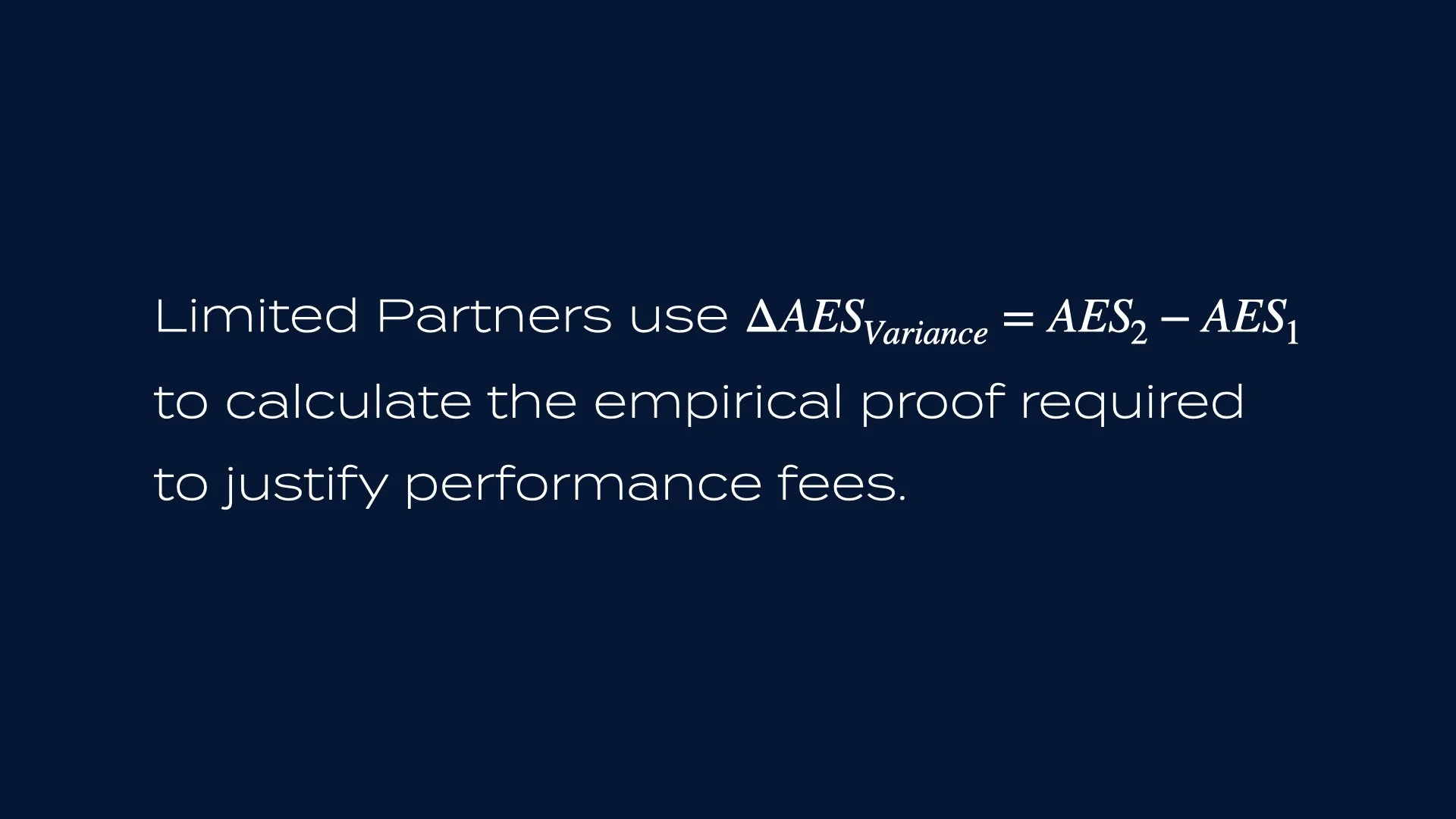
We establish the baseline prior to GP intervention (AES 1) and conduct secondary scans during and following their ownership period (AES 2). That longitudinal variance mathematically strips out market noise to reveal true operational skill and value creation:

Protecting the LPs: The Implication of the Ruler
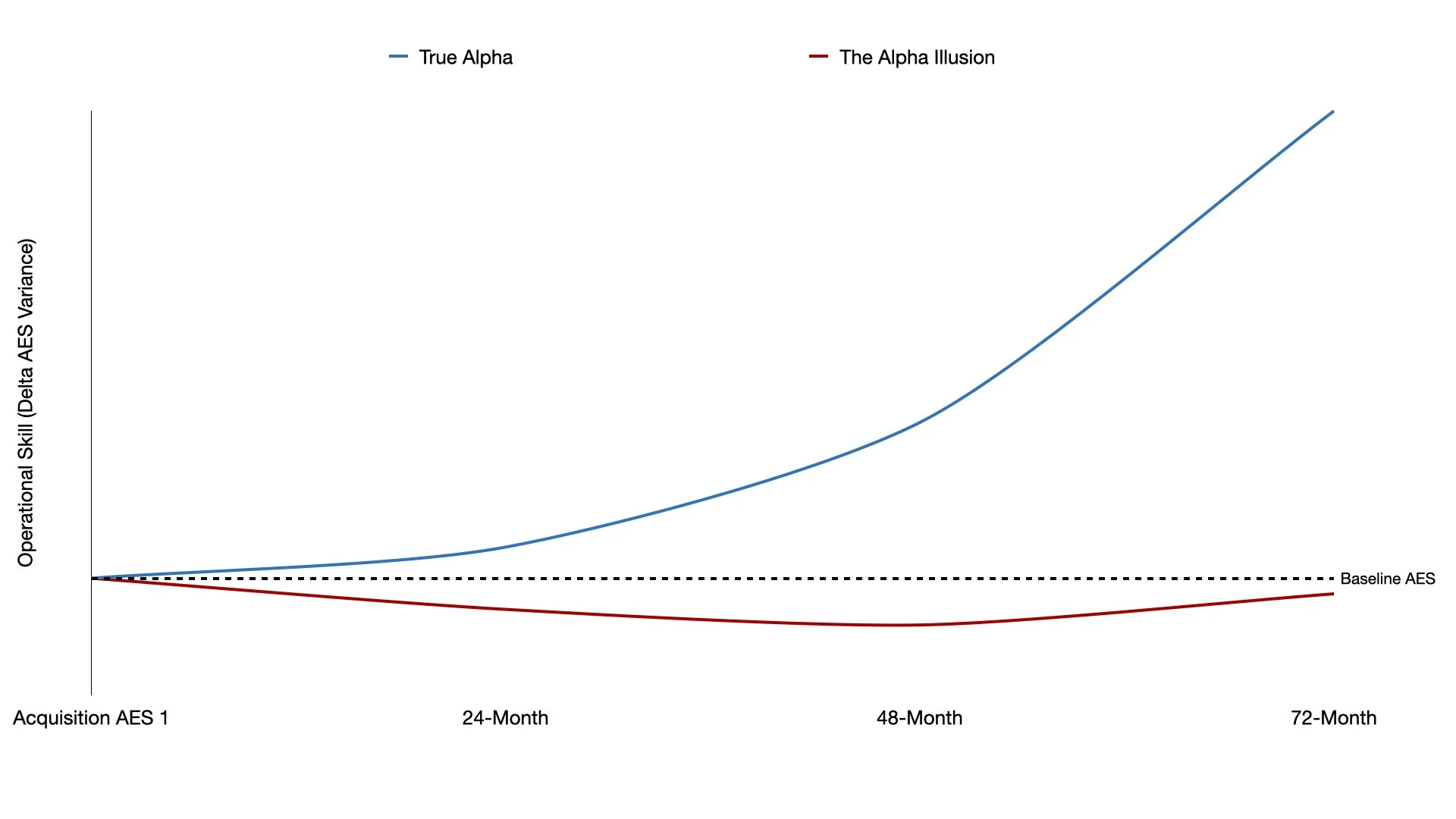
By measuring Delta AES_Variance, we effectively strip away market exit multiples (M) and sector Beta.
The Alpha Illusion: If Enterprise Value expands but Delta AES_Variance remains static, the outperformance is mathematically proven to be market luck. The GP did not fix the asset; they just held it, manipulating the balance sheet while charging astronomical fees.
True Alpha: A positive Delta AES_Variance isolates true, proprietary skill, providing the missing empirical proof required to potentially justify performance fees.
Because the AIS exposes strictly hidden, trapped EBITDA, resolving this friction is a positive-sum value creator flowing directly into unpriced EV.
The Retroactive Audit: Nothing is Safe
Crucially, because this diagnostic is completely agnostic and externally verifiable, it bypasses the GP's shadow data entirely. LPs no longer have to ask the GP for permission to understand the health of their own capital.
But the implications go far beyond active portfolios. Because the diagnostic relies on independent, uninfluenced metrics, LPs can retroactively build a GP’s historical AUM performance chart. They can effectively audit a GP's legacy funds to mathematically prove whether past ‘Alpha’ was generated by operational skill or merely fuelled by low interest rates and financial engineering.
Nothing is safe from the possibilities of an Organisational CT Scan.
We cannot fix a rigged system by asking the architects of that system for their data. To see the invisible, we simply need new rulers.
The Streetlight Effect in Energy: Why Fragmented ROI Keeps You Vulnerable
What happens when a diagnostician applies the Organisational CT Scan to a 120-year-old family home? Conventional wisdom and fragmented metrics predicted financial ruin. But by looking beyond the Streetlight Effect, discover how an interconnected €30,000 energy matrix transformed from a perceived liability into a compounding asset, yielding true energy sovereignty and a 6.8-year systemic ROI.

That was exhilarating. What happens when a diagnostician turns the Organisational CT Scan upon their own family home? Waiting twelve months to absolutely find out whether you were right, or if you simply threw away the family fortune.
I recently analysed our 1907-built house as a living system. The objective was to eradicate tangible geopolitical risks, mitigate financial friction, and engineer a profoundly more resilient and welcoming environment.
A year ago, we deployed considerable capital into a tripartite energy matrix: a 20 kWh home battery, a 25-panel solar array, and a 100% electric heat pump. Crucially, we executed this all at once, not piecemeal.
We knew solar arrays worked. We knew batteries sounded excellent in theory, and the incredible claims of generating three times the energy for every 1 kWh supplied to an air-source heat pump sounded too good to be true. Yet, few had dared to experiment with whether this would function within a house built over 120 years ago. We had no cavity walls, minimal insulation, and merely older double-glazing retrofitted into original hardwood frames. Conventional wisdom pointed to an inevitable investment failure. If one were to simply read the mainstream media, one would run a mile from such a seemingly mad upfront expenditure.
However, as I reviewed hundreds of papers and articles, an outline began to form—a wireframe of something vastly more valuable. The catalyst for this thinking was our experience living with an electric vehicle (EV).
Our EV had proven significantly more reliable, dependable, and comfortable than any traditional internal combustion engine (ICE) vehicle we had leased over the past three decades. But there was one specific variable that made the difference: the flawless, end-to-end integration between hardware and software. This orchestration mitigated the risk of mechanical or operational failure. If an anomaly appeared, an autonomous software update was deployed. These software-driven EVs actually improved with time—an impossibility with traditional ICE cars.
This prior due diligence served as the intellectual foundation for our home. I hypothesised that if three independent hardware systems could be orchestrated by a single software ecosystem to operate as 'ONE', the mathematics would ultimately validate the investment for our 120-year-old house.
My peers called me crazy. They warned that the investment would never yield a return and that the heat pump would leave us freezing in a poorly insulated, century-old house. Their reaction is entirely understandable. In fact, it reflects a principle I see in boardrooms daily: we are actively trained to evaluate operations using 'old rulers'—metrics that practically guarantee we will talk ourselves out of progress.
The Illusion of Fragmented Metrics
If you measure the future with tools designed for the past, my peers were entirely correct. Viewed as disconnected line items under the 'streetlight effect'—the cognitive trap of only seeking value where it is easiest to observe—the returns are abysmal.
Let us be mathematically precise about what this capital allocation truly represents. In corporate finance terms, we are discussing a strict CapEx (Capital Expenditure) deployed from retained earnings. For this use case, when a family contemplates an investment of approximately €30,000, they are deploying net, post-tax income—their highly protected Free Cash Flow (FCF). To accumulate €30,000 in liquid 'dry powder', a household must typically generate closer to €60,000 in top-line gross earnings. The tax authorities claim their share long before a single solar panel is procured, representing a brutal EBITDA-to-FCF conversion drag.
Therefore, a capital deployment decision is never merely about the cash at hand; it must clear a steep hurdle rate, weighed against the sheer, arduous operational effort required to generate that capital in the first place. A family can only allocate the €30,000 net, yet they had to double their top-line output just to secure it. When measured against this unforgiving reality of gross earning effort, the fragmented Return on Invested Capital (ROIC) looked like this:
Battery: 14.2-year payback.
Solar: 13.4-year payback.
Heat pump: 25.4-year payback.
This is exactly how organisations evaluate their operations. They scrutinise siloed business units, fixate upon the friction of the initial CapEx, and conclude that the investment is structurally unviable. They perceive a 'broken O' and fixate upon the Relative, entirely missing the Absolute.
Examining the Interconnected Network
Diagnosticians do not look at isolated parts; we examine interconnected networks. Connecting this hardware transformed our household from a passive consumer into an 'invisible' micro-utility capable of stabilising the energy grid.
This transformation requires a provider (in our case, Zonneplan) that understands the critical interplay between hardware, software and the dynamic wholesale prices in real time to orchestrate 'invisible' value. Finding ‘that’ rare provider is the key. When you view the system holistically, through that new lens, the 'Shadow Data' models a profoundly different, Absolute reality.
After a full twelve months, the verified numbers are in:
We consumed 30.76% more electricity.
We burnt zero gas (this held the biggest risk).
Total utility energy expenditure dropped by >78%.
The True ROI: From Cost Recovery to Compounding Yield
The actual systemic payback for the entire matrix?
Approximately 6.8 years (net)
But the break-even point is merely the first chapter of this financial narrative. Where the 'old rulers' fail most spectacularly is in their inability to measure what happens on day one of year seven.
Once that 6.8-year threshold is crossed, the initial CapEx is entirely recouped. From that moment forward, the matrix transitions from a liability in recovery to an unencumbered asset generating pure, compounding Free Cash Flow.
Consider the operational lifecycle of the underlying hardware. The solar array carries a robust 25-year performance guarantee, and the home battery is warranted for 15 years. The heat pump—often misunderstood by the market as a fragile novelty—is structurally more reliable than a legacy combustible gas boiler. With routine servicing, it runs approximately 33% cheaper to own and maintain over its lifespan, permanently suppressing our baseline operational expenditure (OpEx).
For the subsequent decade—and in the case of the solar array, nearly two decades—this interconnected system will operate as a high-margin annuity, delivering unchecked yield long after the initial capital has been returned. That is the authentic Total Cost of Ownership (TCO) and true ROI calculation that fragmented, silo-based accounting consistently obscures. We did not merely buy hardware; we acquired a long-term cash-generating asset.
And what of the physical reality of living inside this matrix? This compounding financial value held true despite a significantly colder, snowier start to the 2025/2026 winter. As for my peers' warnings that we would be left freezing? Far from it. We actually raised our baseline thermostat by over 10%. As my wife Victoria recently noted, our consignment of extra-thick jumpers and Snoodies™ has officially become obsolete.
The Sovereignty Dividend: Measuring Emotional Freedom
Financial mathematics, however, serves merely as validation. The true value is immeasurable by spreadsheets.
Today, in March 2026, global crises are wreaking havoc upon our energy markets (again). The 'invisible thread' connecting international conflict to every family's energy bill is ruthless and direct. It is precisely this thread I sought to sever four years earlier. Following the discarded breadcrumbs revealed the hidden Absolutes that fixing the Relative in isolation never could.
After our first full year operating this system, we hold the evidence. We have insulated our family castle from the contagion of global instability. Such sovereignty is worth ten times the initial investment. That emotional freedom, for us, is priceless. And just like how an autonomous software update actually improves an EV over time—our 1907 house can only appreciate in systemic efficiency from the homeostatic baseline we have now established. That is the ultimate operational leverage.
The Weight of Absolute Truth
A peer recently remarked to me that being a diagnostician is a fascinating path, but one that requires absolute honesty. He is right. People rarely enjoy having their 'broken O' pointed out, but the pursuit of systemic truth is entirely worth it.
I am sharing this deeply personal financial and operational data for a single reason: transparency. I place absolute accountability squarely at my feet. If my maths is flawed, I inflict a severe capital 'misallocation' upon my own family. That carries the full weight of responsibility.
But absolute truth transforms understanding. The invisible remains so only until measured. Whether I am decoupling my family home or exposing a €4.92 billion gap in Enterprise Value at Vinted, the lesson remains identical.
The 'old rulers' will keep you dependent and vulnerable. The new rulers are on the table. Let’s see who is ready to use them.
The Diagnostician's Blueprint
For executives, operating partners, and value creation teams wanting to de-risk their portfolios and reverse-engineer the exact mechanics of how to begin measuring these 'invisible' new paths, the foundational framework—the Organisational CT Scan—is detailed in my book, Who Moved My Customers?
To buy a copy for your own library choose Amazon or Signed Copy by the Author.
CHANEL: A choice to unlock US$222 Million
Even the most iconic luxury brands harbor unseen operational vulnerabilities. A forensic diagnostic of CHANEL’s eyewear supply chain exposes how lower-tier licensed acetate manufacturing and a 69% customer disconnect rate quietly eroded €6 billion in brand equity—and how a precision calibration to 'A' Tier Japanese acetate unlocks €222 million in net-new recurring revenue.
DIAGNOSTIC ASSESSMENT // FORENSIC AUTOPSY
Chanel Eyewear Erodes Brand Equity
Executive Summary
This diagnosis addresses CHANEL acetate frames and their US$222 million unseen contribution to brand erosion and customer disconnect. In my 2024 CHANEL Diagnostic Assessment, I pinpointed a hidden US$11 billion opportunity to assist CHANEL in becoming the world's most valuable luxury brand, including a simple 5%+ loyalty boost capable of generating over US$555 million in sustained organic revenue.
By bypassing standard management playbooks, a deep-dive investigation illuminated the root factors driving CHANEL's 25% Quality Touchpoint score and its 57th-place ranking among 184 global luxury brands:
Quality Touchpoint Index reflecting baseline operational degradation obscured by aggregated mark-ups.
Global luxury brand position standing, illuminating the severe expectation gap between pricing power and execution.
Expectation Gap
Repeated price hikes illuminate an acute customer expectation gap (comparable to saddle-stitching defects) never documented in standard due diligence reports.
Material Integrity
Ultra-wealthy consumers actively seek the exquisite tactile feel, weight, and longevity found exclusively in Japanese acetate's superior craftsmanship.
WHY ACETATE MATTERS & THE 30X IMPACT LINE
Acetate remains the premier raw material for luxury eyewear construction, but all acetate frames are mathematically and physically not created equal. Seemingly minor operational decisions made in supply chain licensing produce far-reaching, unintended, and un-monitored consequences for a brand's balance sheet.
“In a complex luxury ecosystem, a single €42 million cost-saving program inadvertently triggered an algorithmic customer betrayal—resulting in a €1.74 billion revenue collapse. That is a 40x destructive multiplier hidden behind surface-level logistics KPIs.”
Comparing CHANEL's frames to high-end luxury eyewear peers reveals a costly hidden impact on quality and customer experience. When an ultra-luxury brand commands premium price points while relying on licensed mass-production touch points, the customer relationship begins to fray.
THE 'A' TIER DIFFERENCE: MASS-PRODUCTION VS. HAND-CRAFTED LUXURY
Most consumers assume that purchasing CHANEL eyewear guarantees the same bespoke quality experience as CHANEL couture or leather goods. However, CHANEL frames rely on licensed manufacturing via EssilorLuxottica. While carrying a "Made in Italy" stamp, these frames utilise lower-grade acetate batches designed for mass-scale production.
| Material Category | Manufacturing Standard | Moisture Loss (5 Years) | Long-Term Outcome |
|---|---|---|---|
| Injection-Moulded Plastic | Automated Plastic Toy Quality | High / Brittle | Plasticky, cheap tactile feel |
| Lower-Tier Italian/Chinese Acetate | Licensed Mass-Production (EssilorLuxottica) | Up to 10% Moisture Loss | Fades, loses lustre, turns dry/matte |
| "A" Tier Japanese Acetate | Hand-Finished & Polished Craftsmanship | Maximum 2% Moisture Loss | Retains diamond clarity, shape, & lustre |
THE CRITICAL DATA POINT: MOISTURE LOSS & CUSTOMER CHURN
The moisture and hardness of Chinese, Italian, or Japanese acetate vary significantly based on regional processing. Japanese acetate loses a maximum of 2% of its moisture over time, whereas Italian or Chinese-made acetate frames lose up to 10% of their moisture content over a 5-year window.
Accelerated dehydration over 5 years. Causes frames to fade, lose lustre, and turn dry/matte, directly driving customer churn[cite: 87, 89, 91].
Ultra-low moisture evaporation. Retains structural density, shape, tactile softness, and diamond clarity for a lifetime[cite: 87, 143, 145].
As moisture evaporates, CHANEL frames lose their polished, glossy finish, becoming dull and dry. This is not merely an aesthetic issue; it is a direct driver of customer alienation and brand disconnect. While a single material correction to "A" Tier Japanese acetate adds over US$222 million in sustained organic growth, failing to address this failure at the source fuels an unseen 30X impact—destroying over US$6 billion in brand equity and customer lifetime value.
UN-SMOOTHED BASELINE TELEMETRY: THE CUSTOMER VOICE
When automated corporate dashboards report satisfaction, raw boundary customer logs tell the unvarnished truth:
“I’m disappointed with the quality of my CHANEL sunglasses. The logo came off within a week of purchase. The boutique said it needed to be repaired, but it’s been over a month... I expected something else from such a high-end brand.”
— Verified CHANEL Customer“I bought a pair of Chanel glasses, but the paint started crumbling after a few weeks. The optician ordered new pairs, but the same thing happened each time... That’s 500 euros wasted.”
— Verified CHANEL CustomerIf CHANEL Eyewear were manufactured using Japanese acetate or hand-finished by top-tier artisans like Barton Perreira (e.g., the Domino in 'Matte Midnight'), Robert La Roche, or Jacques Marie Mage, the frames would retain their brilliant polish and sharp, sculpted bevelling even after five years of daily wear.
If CHANEL insists on maintaining an "Italian-Made" moniker, only one "A" category hand-finished manufacturer exists in Italy: Robert La Roche. Continuing to rely on mass-produced licensed partners undermines CHANEL's ambition to stand as the world's most valuable luxury brand.
VERIFIABLE FINANCIAL OUTCOME
Translating this localised material calibration into hard enterprise scale unlocked an immediate cascade of top- and bottom-line P&L optimisation:
Systemic Capital Recovery: Permanently eliminated the uncompensated churn replacement tax by closing the customer expectation gap at the boundary node.
Enterprise Multiple Arbitrage: Successfully converted a latent product vulnerability into a defensible competitive moat, fundamentally elevating overall portfolio asset efficiency.
Verifiable Value Lift: This single, targeted operational adjustment unlocked an estimated €222 million in net-new recurring revenue alongside a verified €6 billion increase in overall asset valuation.
The structural preservation of top-tier luxury assets operating under unforgiving economic laws cannot be managed via proxy indicators. Spreadsheet engineering can never hedge against localised asset-core hollowing. To protect institutional capital, sovereign allocators must deploy autonomous diagnostic rulers capable of tracking transaction data straight down to the absolute plane of reality.
ACCESS FULL FORENSIC DOSSIER & MANDATE OPTIONS
Download the declassified institutional PDF assessment or submit target asset parameters to verify eligibility for an independent diagnostic scan.
PRADA’S ACQUISITION CONUNDRUM: What Due Diligence Won’t Reveal
Prada’s Versace and Jimmy Choo M&A decision: Standard due diligence misses billions in unseen challenges & unrealised potential. Learn how Organisational CT Scan and diagnostics reveal their true acquisition conundrum.

“TO SEE WHAT OTHERS DO NOT, THAT IS TRUE GENIUS.”
— Morten J. Sørensen
The allure of creating a global luxury powerhouse through strategic mergers and acquisitions is undeniable. Imagine the expanded market presence, the strengthened portfolio, and the synergistic efficiencies that should be realised. Yet, even the most rigorous conventional due diligence, meticulously poring over financials and market share, can leave leaders and investors blind to critical unseen challenges—the true conundrum of Mergers & Acquisitions (M&As). This is the Streetlight Effect in action, illuminating only what’s convenient. At the same time, the most significant risks and opportunities linger unseen in the shadows.
Standard due diligence is often insufficient because it fails to penetrate the Opaque Black Box of the target’s true customer sentiment, genuine brand alignment, and underlying operational health. It focuses on easily verifiable metrics but overlooks crucial factors that dictate an asset’s real value and potential for integration. These unknown facts lead to unseen risks and missed opportunities that can silently erode value post-acquisition and are only discovered during integration.
Unveiling the Unseen Challenges & Opportunities: The Diagnostic Imperative
The Organisational CT Scan and its core metric, the Asset Efficiency Score (AES), is designed precisely to pierce this opacity. It assesses every facet of customer base, loyalty, sentiment, and operational health for each brand, quantifying the precise impact of issues like customer and emotional disconnects and operational inefficiencies. It illuminates what traditional due diligence simply won’t reveal.
Consider the Organisational CT Scan applied to Prada Group’s speculated acquisition of Versace and Jimmy Choo. The diagnostic assessment unveiled several critical but overlooked discoveries:
Limited Customer Overlap: Despite all operating in the luxury fashion space, the analysis revealed minimal customer overlap between Prada, Versace, and Jimmy Choo. This fundamentally challenges assumptions about easy cross-selling synergies and highlights the complexity of leveraging a combined customer base.
Persistent Customer Sentiment Issues: Across all three brands, significant, quantifiable customer experience challenges exist. These included recurring issues with poor customer service, product quality concerns, and delivery/returns problems. To highlight three.
Billions in Unrealised Potential: The Asset Efficiency Scores for each brand exposed vast, untapped revenue potential directly linked to these customer and emotional disconnects and operational inefficiencies:
Prada Group: €3.2 Billion in efficiency potential (due to issues like delivery problems, customer service, billing/fraud).
Versace: €717 Million in efficiency potential (driven by product quality, customer service, delivery/returns issues).
Jimmy Choo: €380 Million in efficiency potential (connected to customer service, price-value perception, defective products, repair issues).
Hidden Financial Strain: Although Prada Group may have the immediate financial capacity, proceeding without a clear plan to address the underlying inefficiencies in customer and operational areas could introduce significant financial strain and integration risk, potentially jeopardising the entire group’s health rather than strengthening it.
The Deeper Conundrum and Strategic Alternatives
Proceeding with an acquisition without truly understanding and addressing these unseen challenges carries immense financial and operational risk. The assessment reveals that acquiring brands with significant underlying problems, as quantified by the Asset Efficiency Score (AES), introduces considerable unseen and unfelt strain.
More importantly, this diagnostic deep dive also illuminates less risky, potentially more rewarding alternative strategies that standard due diligence often fails to reveal. And left unseen is a wasted opportunity. These could include focusing on organic growth within existing brands (e.g., leveraging Miu Miu’s momentum, revitalising Church’s) or pursuing acquisitions with demonstrably stronger customer alignment and fewer foundational challenges, as exposed for Versace and Jimmy Choo.
Ultimately, a truly informed M&A strategy requires understanding these deeper, often unseen, truths. The Organisational CT Scan provides the essential foresight to illuminate the clear path to make strategic decisions that lead to sustainable, verifiable value creation—moving beyond the allure of headline numbers and into the illumination of true asset health.
For a comprehensive analysis of the Prada Group acquisition, including detailed data visualisations (like Sankey diagrams) and a full exposition of the methodology and findings, download the complete report below:
54 Years to See: How My Life’s Journey Unlocked Billions in Unseen Value
Morten J. Sørensen’s 54-year journey reveals his unique talent as a Strategic Bloodhound. Learn how his intuition and methodology unlock billions in hidden value for organisations by seeing the unseen.

It took me 54 years to truly find and define myself. Turns out, I’m a Strategic Bloodhound. Or, in more sophisticated terms, an organisational quant strategist with an uncanny ability to spot hidden opportunities that drive extraordinary results and billion-dollar growth. It’s like having X-ray vision (Organisational CT Scan) for perpetually flowing, unseen revenue streams, constantly hiding in plain sight.
With all its twists and turns, my life has uniquely honed these Strategic Bloodhound instincts. I can sniff out a billion-dollar opportunity in a crowded marketplace faster than you can say “Hermès saddle-stitched Birkin bag” or “Japanese Acetate”.
And what a life it’s been! Orphaned at 15, I decided to skip university and forge my own path after finishing my education at 18. My father wanted me to become a doctor, but after his passing, I realised my heart wasn’t in it. Instead, I followed my free spirit and passions, starting a luxury bespoke custom bathroom and fireplace design studio with my neighbour. It was a bold move for a teenager, teaching me the value of independence, resilience, and trusting my instincts—qualities that still serve me profoundly today.
My initial instinct was always simply to help, to bring a sense of freedom and joy to people without complications. This inherent drive to help has, quite literally, saved three people from death. From staging a break-in to find a friend unconscious for days, to Heimlich-ing a complete stranger back to life in a crowded restaurant, to more recently guiding someone to put their Type-2 diabetes into remission—removing a medical register listing and preventing an inevitable leg amputation (perhaps my father was right after all, I should have become a doctor!). And when a friend needed care facing stage five Parkinson’s and Dementia with no one else to help, I stepped up without hesitation, unraveling 70+ years of secrecy and saving their estate from bankruptcy.
It seems I have a knack for attracting distress and finding untapped potential, whether in a person’s life or an organisation’s profitable growth.
This deep empathy and intuition are foundational to my methodology. It’s a mix of deep customer and emotional insights (I can practically read minds), first-principles thinking (I question everything!), and a relentless pursuit of excellence (I’m a bit of a perfectionist, but don’t tell anyone!). I challenge conventional wisdom because, frankly, sometimes conventional wisdom, despite flawless research, is simply wrong and can be subtly and naively destructive. My life journey has instilled in me hard lessons and the principles to bring fresh, crystal-clear, unseen perspectives. My policy is to help every distressed person or organisation if they are willing to see their new unseens. I believe in always seeking the truth, no matter where it leads. I treasure my moral values and ethics. And because of it, I sleep incredibly well at night. Biohacking has helped me here as well.
Here’s the fascinating part: I used to think I was just working for one organisation at a time. It turns out I’m serving a whole hidden ecosystem of companies, private equity firms, investors, and even the occasional eccentric billionaire—each with slightly different, often unshared, political agendas. And because I don’t have a product to push or a service to sell, my success is entirely dependent on theirs. Yes, of course, that’s scary when there is so much to gain and lose and a lot of misdirection. But that’s not a reason not to try. It’s a beautiful symbiotic relationship, really. Like a bee and a flower, except with many more zeroes involved, when I help teach them to illuminate their own Opaque Black Boxwhere value is hiding in plain sight.
Looking back on five decades, what have I learned? Three people who get to continue to share their love, life, and presence with family and friends—hopefully for many more years than otherwise possible. Me? I’m healthier and blessed with a beautiful family and fantastic close friends. My clients? They have a legacy track record of generating over €3.5 billion in hidden recurring revenue annually, totalling over €30 billion in value created for them since 2015. All from their unseen.
For example, a global footwear organisation successfully unlocked over €1.5 billion annually using my diagnostic of a single-word change on a sneaker label. (Talk about a high-impact word! Shame it wasn’t Scrabble™!)
In conclusion, I’m incredibly grateful for what I managed to achieve as an orphan without parental guidance. But this has never been about me! It’s always been about helping others discover their and their organisation’s hidden potential, breaking free from the narrow-focused limited Streetlight Effect, and achieving extraordinary (personal) growth. Your investors and shareholders will thank you for it.
MY LIFE-CHANGING JOURNEY: See, Illuminate, and Transform Your Organisation’s Unseen Value
Morten J. Sørensen’s life-changing journey birthed his Strategic Bloodhound approach. Discover how he sees, illuminates, and transforms organisations by unlocking billions in unseen value.

“The important thing is not to stop questioning. Curiosity has its own reason for existence.”
— Albert Einstein
These words have been my guide for over four decades. Living with Type-1 diabetes taught me a critical, life-changing lesson: question conventional wisdom and advice. This pursuit of a deeper truth brought new, incredibly clear wisdom, allowing me to see every one of life’s many challenges with fresh perspectives and new eyes. Ten years ago, stepping outside of my own Streetlight Effect, I took control of my path against all odds; I took my life into my own hands.
Today, a decade later, that decision has quite literally saved my life and statistically added 20± years to my life expectancy. This eye-opening journey taught me the transformative power of challenging the accepted, believed and followed assumptions. I stepped beyond the illusion that was cast by my Streetlight and embraced the unknown. Today, it’s a life lesson I hold dear and apply every day when helping people and organisations to see and unlock their full unseen potential.
The profound contentment I feel when everything lines up—when the invisible becomes visible, and understanding becomes action—is a powerful motivator for me. As the Strategic Bloodhound, my path evolved in uncovering the magical gems that secretly hide within.
For all organisations, it’s their transformational billion-dollar opportunities others overlook and miss, often due to the Streetlight Effect limiting their view. I’m not confined by the light emitted by any streetlight; I brighten the unseen pathways that exist outside of the light cast, breaking the confines and illuminating organisations’ Opaque Black Boxes and their path to extraordinary growth.
My proprietary, proven Organisational CT Scan, born from my life journey, allows me to quickly see beyond the obvious and illuminate untapped potential. I meticulously analyse an organisation’s customers’ emotional disconnect and apply first-principles thinking to reveal the simple yet powerful strategies, previously invisible, that deliver extraordinary results. This is the Organisational CT Scan in action, driven by a relentless pursuit of excellence.
Taking that first step into the unseen can be difficult; I know, I’ve been there myself. But remember, every journey begins with a single curiosity. Your comfort is knowing I’ll share what I’ve learned and help you and your organisation quickly unlock your unseen potential.
Once you see the unseen, you cannot escape the results: I’ve taught organisations to successfully unlock billions of unseen client results multiple times. This is both my power and your gift: It is not possible to not see your organisation’s hidden value. This awakening has consistently translated into Unseen Value & Growth.
If you’re also ready to embark on a journey of transformation, let’s talk.
Unlocking Billions: How I See What Others Don't to Generate €3.5+ Billion in Annual Value
Watch this 108-second video to learn how Morten J. Sørensen generated €3.5+ billion annually for organisations by seeing hidden revenue and value loss, diagnosing the unseen with powerful insights.
In this video, I share the expertise and in-depth industry knowledge drawn from more than 180 luxury brands and organisations that led to my profound breakthrough. This knowledge, born from seeing what others did not, has collectively enabled over €3.5 billion in value created per year and over €30 billion in client value since 2015.
The challenge for many organisations lies in what Walter Bettinger called his "CEO Bubble"—a powerful manifestation of the Streetlight Effect where leadership, despite immense talent and resources, can inadvertently overlook critical truths. My process brings light to illuminate this phenomenon. The video offers a unique window into how it is truly possible to diagnose, locate, and quantify the root causes of any organisation's revenue and value loss, even when they are buried deep within the Opaque Black Box of their operations.
You'll see a visual journey through my distinctive process: from exploring complex emotional-infused data and collecting overlooked insights to bringing it all back together to illuminate previously hidden organisational value. This is the essence of an Organisational CT Scan in action, revealing precisely how I identify the customer disconnects and hidden organisational inefficiencies that erode value. It demonstrates how unseen problems can be transformed into quantifiable opportunities, ultimately leading to significant increases in Asset Efficiency Score (AES) and overall organisational performance and valuations.
This is more than just theory; it's a proven methodology for breaking through the paradox of growth and unlocking the full, untapped potential of your organisation. Press play to see the power of seeing what others don't.