
SYSTEMIC DIAGNOSTICS // FIDUCIARY ARCHIVE
THE FIDUCIARY REGISTRY
Independent, non-smoothable intelligence logs and systemic diagnostics compiled over more than a decade of tracing transaction metadata. This archive operates as a sovereign database built to strip away narrative seduction, exposing where portfolio assets are weaponised as pawns within private equity's opaque black box. It equips Level 1 allocators with the precise metrics required to enforce baseline accountability and cleanly separate authentic operational execution from debt-engineered luck.
The Declassification of The Vinted €5 Billion Alpha Key™ Report
The most expensive sentence a firm can utter is, "I do not believe it." I am officially declassifying my €330,000 institutional-grade dossier on the Vinted Group. By applying the Organisational CT Scan and the mathematics of the "Integrity Tax", this report reveals the exact structural variances blinding Vinted and its Private Equity backers to €4.92 billion in missed Enterprise Value. Download the blueprint. You tell me: Is my maths wrong?

The most expensive sentence any firm can utter is, ‘I do not believe it.’
For a long time, I did not believe it either.
When I first saw the massive financial leaks hiding in the gap between a boardroom’s promise and the customer's reality, the scale of missing revenue felt too incredible to be true.
Rather than accepting disbelief, I moved beyond the ‘streetlight effect’—the cognitive bias of searching only where it is easiest to look. I stepped past standard metrics and searched the shadows. Holding undeniable proof of unseen friction and lost value in my hands, I spent a decade reverse-engineering those discoveries.
That framework became the Organisational CT Scan.
The CT Scan's sole purpose is to illuminate an asset's ‘Shadow Data’, tracing invisible breadcrumbs to the absolute root-cause contagion. Once isolated, millions of customer ‘gut feelings’ transform into a quantifiable macro-data set to calculate an asset’s Integrity Tax.
In the boardroom, metaphors invite debate; maths invites action. The Integrity Tax is the compounded variance between a system’s designed intent and its operational reality. It is the invisible surcharge paid when data, process, and strategy disconnect, multiplied by the velocity of scale:
This tax monetises the exact structural variance to expose the unpriced Enterprise Value (EV). The maths is asymmetrical, precise, and ruthless.
I am not here to convince anyone; that leap is yours. To remove the friction of disbelief, I am officially declassifying my €330,000 institutional-grade dossier on the Vinted Group. It illuminates the frustrations of their existing user base—their 'why'—and how these ‘gut feelings’ amplify across the hyper-connected Small-World Network.
Inside are the precise execution coordinates and a new B2B revenue engine detailing how Vinted is blinding itself to €4.92 billion in missed Enterprise Value. Vinted is rumoured to be exploring a secondary share sale valuing the company at ~€8 billion. Why not grab the full €10-13 billion?
Building a network of this scale is a monumental achievement. I offer this diagnostic blueprint humbly to Thomas Plantenga, Adam Jay, and the Vinted team, alongside their backers at TPG, EQT Group, Accel, and Lightspeed Venture Partners. Here's to your next historic milestone.
Reverse-engineer my maths. If the numbers spark curiosity on how to bypass generic cost-cutting and uncover trapped top-line revenue in your own firm, coffee is on me in Amsterdam.
If you think, ‘That isn’t happening to us’, the deafening silence of your departing customers would strongly disagree. To see the ‘invisible gorillas’ tearing through your portfolios, you don’t need more data. You need new rulers.
Download the full €5 Billion Vinted Group audit document as a PDF below. You tell me: Is my maths wrong?
Author’s note: I declassified this €5B report for a single reason: transparency. It places absolute accountability squarely at my feet. I cannot hide behind this dossier's findings. If the maths is wrong, I am wrong, and I will take full public responsibility.
To the executives, operating partners, value creation teams, and performance improvement advisory firms underwriting the next wave of European growth capital: physical copies of this diagnostic blueprint are currently sitting on the desks of two leading PE Performance Improvement firms.
The baseline for uncovering true Enterprise Value has shifted. Value now compounds—or collapses—at the exact speed of the inescapable Small-World Network contagion. You cannot cost-cut or strategise your way out of a structural contagion; the customer’s reality always wins.
For those wanting to reverse-engineer the exact mechanics of the Integrity Tax and the Organisational CT Scan, the foundational framework is detailed in my book, Who Moved My Customers? (available on Amazon, or as signed copies via my website).
The new rulers are on the table. Let’s see who is ready to use them.
The €1.375 Billion Validation: How a PDF jumped the “Small-World Network” to change Hugo Boss
On January 8, 2026, HUGO BOSS validated a €1.375 billion diagnosis. This is the forensic timeline of how a single Diagnostic Alpha report traversed the "Small-World Network" to bypass the boardroom's immune system, overcome the "I Don’t Believe It" filter, and transform a womenswear blind spot into corporate strategy.

Date: January 2026
Case: HUGO BOSS AG
Asset Class: Diagnostic Alpha
The Most Expensive Sentence in Business
There is a parable I often share about a policeman finding a man searching for his keys under a streetlight. When asked if he lost them there, the man says, “No, I lost them in the park, but this is where the light is.”
This is the Streetlight Effect. In the corporate world, there is a gravitational pull to focus only on visible, comfortable metrics—Gross Margin, Sell-Through, Wholesale Volume—while ignoring the massive value leaks hidden in the operational shadows.
For the last decade, I have observed a recurring pattern. When I present a CEO with forensic evidence of a billion-euro opportunity hiding in those shadows, the initial reaction is rarely joy. It is denial.
“I don’t believe it.”
That sentence is the most expensive liability on any balance sheet. It is the sound of Organisational Homeostasis—the immune system of a company fighting to keep things the same, even when “the same” is slowly eroding its foundation.
But occasionally, the logic of the shadow becomes too powerful to ignore.
The €1.375 Billion Mirror
On September 1, 2025, I published a forensic diagnostic titled The €1.375 Billion Irony and shared it publicly.
The report wasn’t a critique of fashion; it was an audit of value. It diagnosed HUGO BOSS with a structural blindness: the company was treating its womenswear division as a “stylish afterthought”. The data was unequivocal—the division had collapsed from a peak of over 13% of group revenue to a four-year average of just 6.8%.
My prescription was surgical: To capture the €1.375 billion in annual revenue that was missing, the company needed to stop treating womenswear as an adjunct to the men’s business. It required a “surgical separation”—a standalone business unit with the autonomy and expertise to see the female customer who had been waiting in the dark.
Four months later, the diagnosis became strategy.
In January 2026, HUGO BOSS announced a radical restructuring: the creation of an independent Womenswear Business Unit and the appointment of Kerstin Dorst to lead it.
The alignment between the Diagnostic Alpha prescription and the corporate execution is a near-perfect mirror:
The Diagnosis (Sept 2025): I argued the brand failed to “see” the female customer, citing Dr. Kerstin Brehm’s feeling of being invisible.
The Execution (Jan 2026): The company appointed a specialist leader explicitly to “address gender-specific preferences even better.”
The Irony: In a poetic twist of validation, the company hired a Kerstin (Dorst) to answer the question posed by a Kerstin (Brehm).
The Physics of the Pivot
How does a PDF report from an external consultant migrate to the boardroom agenda of a DAX-listed giant in four months?
It is the physics of the Small-World Network.
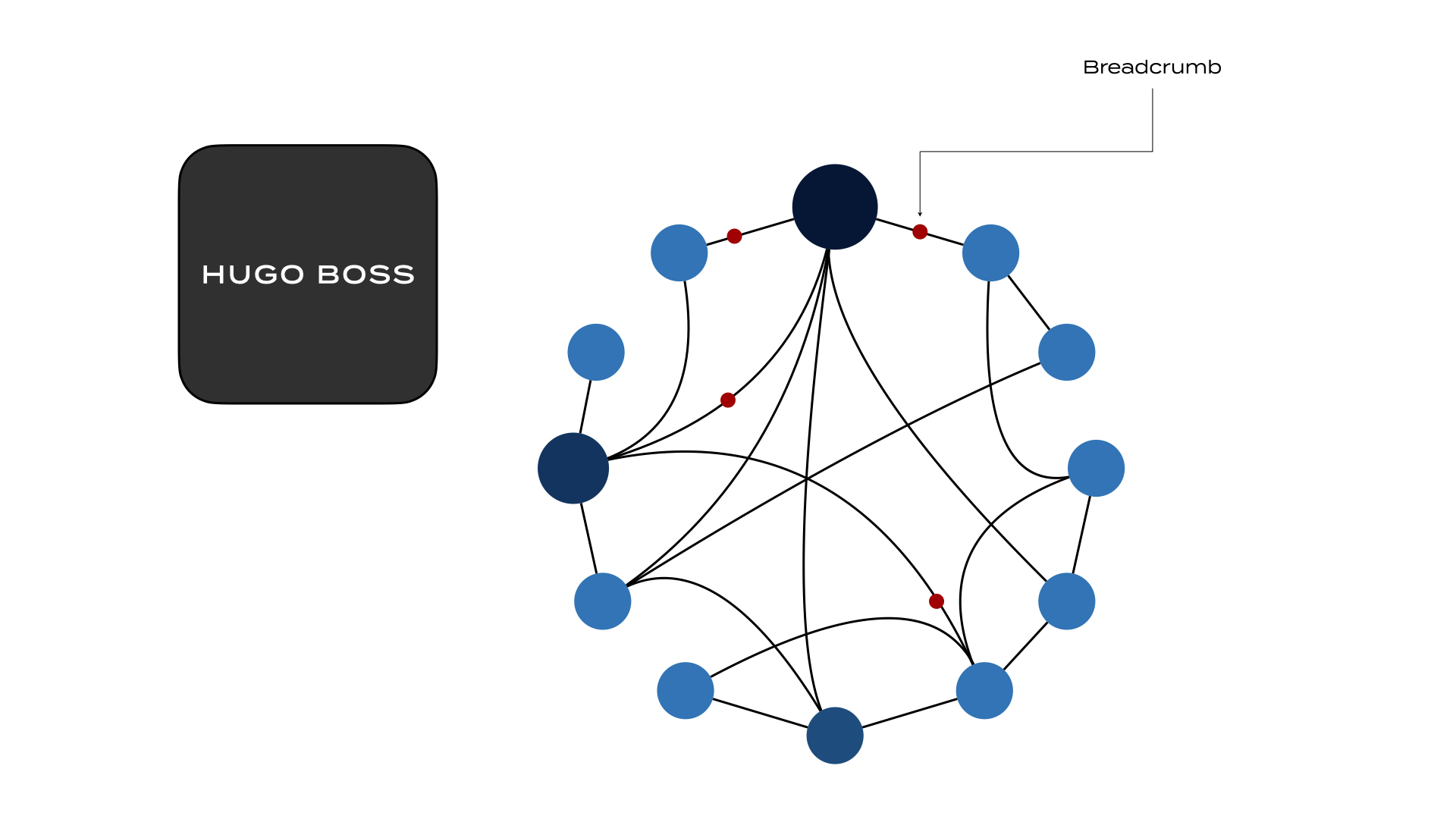
Our forensic analysis of the report’s digital footprint revealed that the “injection” occurred immediately. Within weeks of publication, nearly 2% of the report’s readership consisted of Hugo Boss insiders—specifically, directors and VPs.
The idea didn’t need to go viral globally; it just needed to infect the decision-making nucleus. Through private channels—the “Dark Social” network of saves and forwards—the diagnostic bypassed the “I don’t believe it” filter and landed on the strategy deck.
The Lesson: New Rulers for Old Problems
The HUGO BOSS case is not unique. It is simply the most visible validation of a universal truth:
“To see the invisible, we simply need new rulers.”−Morten J. Sørensen
The “Old Rulers” (traditional KPIs) told HUGO BOSS that womenswear was a difficult market. The “New Rulers” (Diagnostic Alpha) revealed it was a billion-euro opportunity disguised as a problem.
The company has now turned its streetlight toward that billion-euro opportunity. They have moved from “I don’t believe it” to “Let’s build it.”
For the rest of the market, the question remains:
What billion-euro “Invisible Gorilla” is walking through your business and investment right now, waiting for someone brave enough to turn on the lights?
READY TO TURN ON THE LIGHTS?
If your organisation is ready to move beyond “Organisational Homeostasis” and identify its own billion-value blind spot, initiate an Alpha Key™ Forensic Audit.
We apply the same methodology used to diagnose HUGO BOSS, PRADA, VINTED, TIMBERLAND, and PAUL SMITH.
INITIATE DIAGNOSTIC BRIEFING.
Root Cause Contagion: How Small Failures Drive Systemic Decay Within Organisations
A €1.7B loss began with a single €0.02 failure. Follow the breadcrumbs to how this "Root Cause Contagion" impacts every group revenue, margins, and market cap in the billions. It reveals the core principle: organisations miss unseen value by mistaking massive financial symptoms for a single, tiny, broken customer promise.

Following the €0.02 breadcrumb impacting group revenue, margins, market cap and enterprise value by billions
In our pursuit of understanding the grand and complex systems that govern our lives—economies, corporations, societies—we are trained to look for grand and complex causes.
We seek the macro-event, the dramatic failure, the singular catastrophic decision that explains a collapse. We scrutinise the financial statements, executive strategies, and market trends, believing that a €1.7 billion loss must have an equally enormous and visible cause. We are looking for the earthquake.
And in doing so, we miss the truth. We dismiss the humble, everyday clues, such as the €0.20 tea light, which had a successful €0.02 operational efficiency makeover. One that caused a silent earthquake. This is just such a true story.
This is the philosophical decay at the heart of our system. The proposition that a "Root Cause Contagion" begins with such an infinitesimal failure isn't just a "diagnostic"—it's the unbelievable, horrifying truth. It is a deep, ethereal, and epistemological challenge. I know; I followed that trail past and deep into the shadows.
The organisations we build are not the monolithic, top-down empires we imagine. Instead, they are a living, breathing network. The real strength of a brand is not its logo or its assets, but how it is built to live in people's minds—a fortress of memory, emotion, and meaning cultivated over time.
This is the true "small-world" constellation of customer perceptions, trust, and feelings. It's a reality that cannot be defined or shown from a balance sheet; it is the millions of different versions of the same brand. Each version lives in the mind of an individual customer, and collectively, this is what defines every brand and organisation.
The Breadcrumb and the Shadow: An Epistemological Crisis
The fairy tale of Hansel and Gretel is a fitting analogy here. Each failure, no matter how small, leaves an “invisible piece of thread”: a breadcrumb. It's the toothpick lying on the carpet outside the CEO's office in Subir Chowdhury's book The Difference: When Good Enough Isn't Enough. Why did no one who that day walked into the CEO's office stop, pick it up and put it in a bin? That tells you everything you need to know about that company. This presents an epistemological problem: how did we learn not to see what is visible?
The €1.7 billion loss in turnover from the €0.02 cost-saving program was the long symptom shadow that was cast—not the problem; the problem is the terrifying, large-scale projection of a much smaller, more tangible reality. We mistake the shadow for the object itself. That is wrong. The diagnostician is the one who dares to turn away from the flickering financial reports and trace the “invisible thread” back to its source—unravelling the truth behind the root causes. It's that one person who actually notices the toothpick. Stops. And picks it up to dispose of it in a bin.
What is the effect of that one person picking up the toothpick? It is the physical cure for the “gut feeling” contagion.
This single act is, first and foremost, one of prevention. By removing the "breadcrumb", the “invisible thread” is cut. Future visitors are never exposed to this tiny "broken promise". Their “gut feeling” of distrust is never triggered. The contagion is neutralised at its source.
More profoundly, it is an act of cultural reversal. The real problem is the culture of indifference that allows the toothpick to remain. The person who stops and picks it up provides a visible antidote: a micro-act of ownership and care. They don't just prevent decay; they actively mend the relational fabric, creating a positive “gut feeling” that this is a place where details matter.
This act of following the thread is the key. The diagnostician, in effect, employs a phenomenological method. This is the formal term for what they are doing: rejecting the abstract symptom (the €1.7 billion loss) and seeking the concrete, lived experience (the tea light that, in failing to burn, betrays a customer's simple trust).
This method, in turn, reveals the underlying structure of the contagion, which operates as a "Small-World Network". This network provides the map to understand exactly how a €0.02 cost-cutting strategy...drives a €1.7 billion loss in revenue. It demonstrates that financial decay is not the problem; it is merely the evidence of the problem. The fault itself is the millions of broken promises that remain unseen and unaddressed. In terms of the humble tea light, it is the failure of the operational efficiency (resulting in reduced quality) that becomes the brand's failure of trust.
The Iceberg of Ignorance: A Fortress of Hubris
Why does this happen? Why is the breadcrumb trail missed? Why is there a breadcrumb trail in the first place?
Because the leadership mindset is wrong. But this is not a simple blind spot. It is an active, self-reinforcing fortress: a "Hubris-Shield" built from the very people and processes meant to ensure success. It is the CEO Bubble, which takes two forms.
"People telling you what they think you want to hear, and people being fearful to tell you things they believe you don’t want to hear.”
—Walter Bettinger, Chief Executive Officer | Charles Schwab (2017).
It is a system built on two foundations:
The Trusted "Experts": This is the human echo chamber. They are the "experts" who are "fixated on fixing the visible and what appeared to work in the past". Because they are trusted, their entire purpose becomes to "convince you they are right", reinforcing the CEO's existing worldview. They are masters at fixing the "intangible shadows", which feels like progress.
The Leader's Ego: The leader's self-belief is tied to abstractions—the financial reports, the market cap, the "successful" cost-cutting program, the awards. To admit the €0.02 tea light matters is to admit their entire model of the world is wrong, which feels like a personal, catastrophic failure.
This shield creates the true "Iceberg of Ignorance”. The leadership team doesn't just miss the breadcrumb; their entire support structure and sense of self are conspiring to make it invisible.
This is a failure of deep knowledge; "they never ask to understand the why". Why do the shadows exist in the first place? It is a fixed mindset that only seeks to "improve this quarter's valuation metrics" or some other arbitrary, irrelevant number.
The misunderstood real problem? It’s the unseen broken promises—the unintended failures of operational improvements and ill-conceived strategies—that are the root causes. A tea light, which leaves 70% of its wax behind... becomes a tiny visible monument to a failed paradox: a 'successful' cost-cutting operational 'efficiency' program. The organisation celebrates the €0.02 saved...The paradox? The customers' “gut feelings” start leaving “invisible threads”...trace directly to €1.7 billion in quantified revenue collapse.
The Hidden Realm: A Small-World Network
Here is the methodical, step-by-step path from the €0.02 cost saving to the €1.7 billion loss. It is this hidden realm that the "experts" cannot see.
That first "breadcrumb"—a single customer comment, “See this, I can't believe the tea light left all that wax behind. What a waste!”—is not an isolated event. It is a node in a small-world network. This isn't a metaphor; it's a structural reality, a model, defined by Watts and Strogatz. These networks...have two specific, quantifiable properties that serve as the source of the contagion.
1. High Clustering Coefficient (The Local Fire):
In network science, this means that two friends of one person are highly likely to be friends themselves. This is the mathematical basis for Strong Ties. When our customer with the failed tea light feels that “personal betrayal”, the sentiment doesn't just go to one friend. It instantly saturates her entire local cluster of family and friends—a dense, high-trust clique. This is the mechanism that rots the core, high-value customer base from within.
2. Low Average Path Length (The Global Shortcut):
This is the "six degrees of separation" phenomenon (book authored by Duncan J. Watts, “Six Degrees: The Science of a Connected Age”). In the small-world network, any two nodes are connected by a shockingly short chain of human connections. The path length L doesn't grow linearly, but logarithmically with the number of nodes N (L ∝ log N). This is the mathematical basis for Weak Ties, and it connects that one customer to virtually the entire world.
That single, local comment—“70% of the wax is left”—doesn't stay local. It hits a "hub"...and instantly jumps the fence, broadcasting the failure globally. The contagion scales exponentially faster than the organisation's size or ability to prevent it.
This "Small-World Network" charted graph isn't some academic theory. It is the quantifiable financial impact of every unseen, unresolved customer issue... It is the “invisible thread” left behind by a system...that it has forgotten how to create lasting customer emotions. And when operational value creation is no longer possible, destruction is the only remaining option.
The Two Paths of Contagion: A Social Philosopher's Graph of Trust
Now that we can see and model the structure of the customers' “gut feeling” network, we can understand the two paths of contagion it enables. This "contagion" of distrust isn't abstract. It is a visceral, emotional force. ...It operates on two distinct philosophical planes...
First is the path of "Strong Ties". These are the high-trust, intimate bonds of loyalty... This is the realm of the personal. When a long-standing, loyal customer experiences a failure...it is a direct attack on the memory, emotion, and meaning that was the brand living in their mind.
The reaction is not one of mere inconvenience. It is a feeling of personal betrayal. This is not a transaction; it is an emotional relationship—a fact often invisible to leadership lacking emotional intelligence. But that personal betrayal, the customer's “gut feeling,” is very quantifiable. The resulting contagion is potent and hot.
It spreads not as a “bad review” but as a warning to loved ones, a lament... This is the erosion of the core brand's values, an ethical breach that rots the system from within. ...It is the ethical dry rot that silently compromises the core structural beams...
Second is the path of "Weak Ties." These are the long-range, abstract "shortcuts"... This is the realm of the public. Here, the failure of the tea light is no longer a personal story but a broadcasted "fact". It is instantly abstracted from a single experience into a global "brand issue". Sound familiar?
This contagion is cold, fast, and viral. ...It touches virtually the entire global population of eight billion. For what? A €0.02 cost-saving strategy. When the verified and quantified unintended consequences are traced to a €1.7 billion revenue loss.
The Relational Organisation
The ultimate philosophical lesson of the "Root Cause Contagion" is a brutal, metaphysical one. It forces us to ask: What is an organisation?
It is not its assets. It is not its market cap. It's not its executive team or its logo. These are merely attributes.
An organisation is the way it lives in people's minds. It is its network. It is its customers' collective perception; it is the sum total of its strong and weak ties—a complex web of promises, memories, and emotions held together by the fragile, invisible, and essential thread of trust.
To lead this requires true social intelligence—the ability to see and value this human web.
We are not suffering from thousands of disconnected problems. We are suffering from the amplification of a few core customer disconnects—a few broken threads, processes, and betrayed promises. Systemic decay...is the progressive dissolution of these relational and emotional customer bonds.
But how does a leader, insulated by the Hubris-Shield, find the "invisible thread"? They must adopt the diagnostician's method. They must have the courage to bypass their own "experts" and seek the "concrete, lived experience" themselves. This requires a new kind of tool—not just a spreadsheet, but a method of seeing that acts as a diagnostic scan of the entire relational network. A method that seeks the faint human signal—the “I feel let down”—and translates that “gut feeling” into the one language the "experts" and their spreadsheets cannot ignore: its quantifiable, billion euro impact on enterprise value.
The path to healing the €1.7 billion loss is not through more abstraction. Its simplicity lies in finding the breadcrumbs and having the humility to quantify the actual value of the innocent €0.02 tea light optimisation strategy, and mend the first broken promises because of it.
It's how leaders, innovators, and investors—those who cultivate deep knowledge, emotional intelligence, and social intelligence—can achieve untouchable growth... Follow the breadcrumbs beyond the Streetlight Effect, and have the unpretentiousness to follow the €0.20 tea light's optimisation path to €1.7 billion in verifiable value creation, mending the millions of invisible broken promises along the way.