
SYSTEMIC DIAGNOSTICS // FIDUCIARY ARCHIVE
THE FIDUCIARY REGISTRY
Independent, non-smoothable intelligence logs and systemic diagnostics compiled over more than a decade of tracing transaction metadata. This archive operates as a sovereign database built to strip away narrative seduction, exposing where portfolio assets are weaponised as pawns within private equity's opaque black box. It equips Level 1 allocators with the precise metrics required to enforce baseline accountability and cleanly separate authentic operational execution from debt-engineered luck.
The face of a £100m opportunity lost
A 153-year-old heritage brand survived two World Wars, only to be sold for the price of a London townhouse. This forensic audit of Russell & Bromley’s collapse reveals the "Corporate Doom Loop" of value engineering and appeasement that hollowed out £120M in turnover in just seven years.

She lent me her foot, but they’d lost their sole. The Russell & Bromley tragedy.
A week ago, my wife Victoria asked me, “Can you save Russell & Bromley?”
She’d read the 153-year-old family business was in trouble, a scenario I’d handled with another Italian luxury brand eight years ago.
My wife loves Russell & Bromley. I love my wife. So, I said, “Of course.”
Last year in London, I’d bought Victoria two pairs of trainers. Living in Europe, returns are impossible. The staff were impeccable. One assistant even lent me her bare feet to model the fit—a flawless service. So, why the crisis?
Too late. Russell & Bromley has been sold pre-pack to NEXT PLC. Only the IP and three stores are saved; the rest liquidated.
The price? £2.5 million.
A brand with a £120M turnover in 2014, sold for the price of a small London townhouse today. Confusing.
The Historical Reality Check
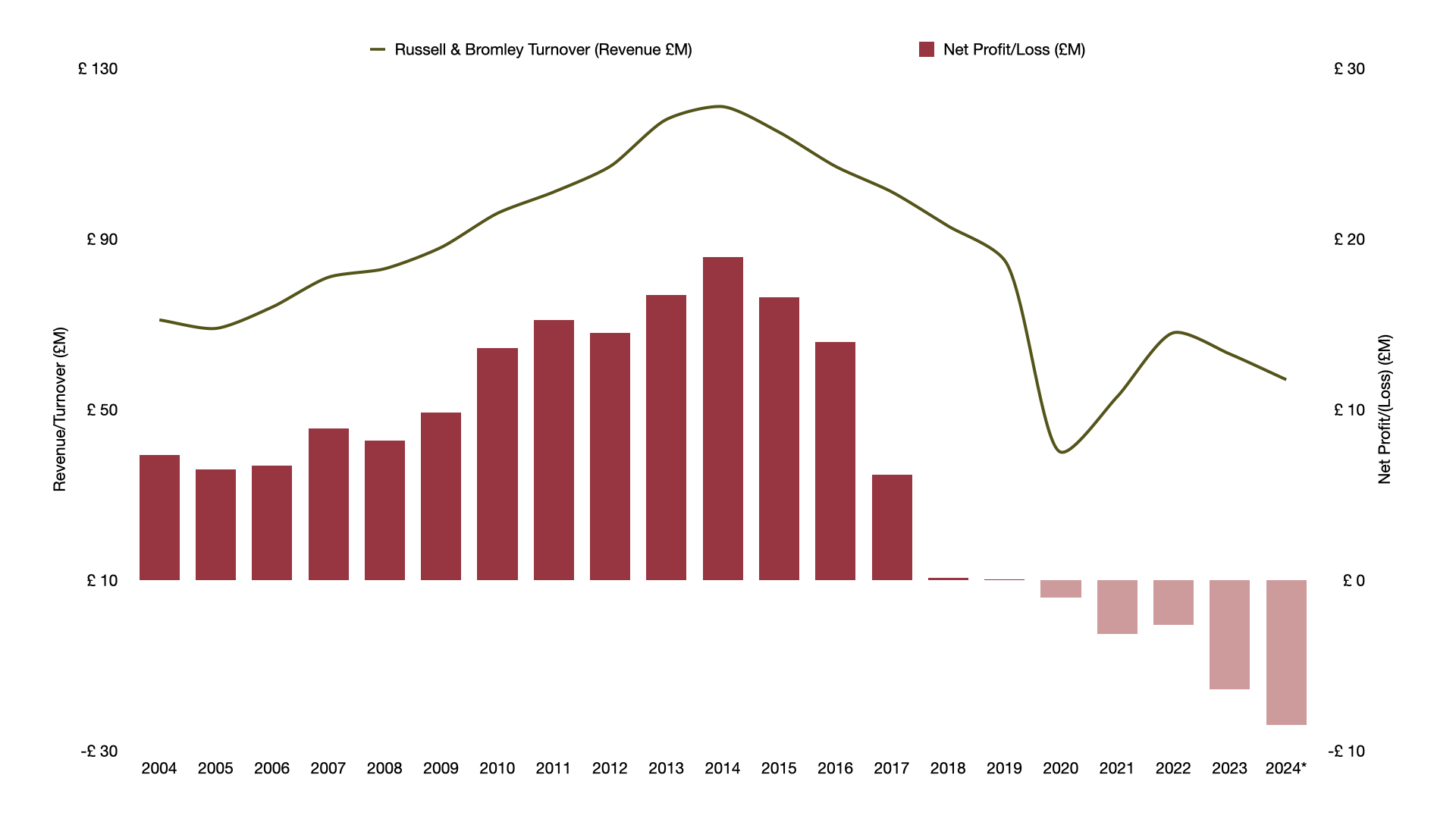
Russell & Bromley was established in 1873. For 153 years, it survived two World Wars, the Great Depression, and every recession in between. It was resilient. It was anti-fragile.
But by 2019, everything changed.
The financial signs showed fortunes changed overnight. Net worth dropped. Liabilities exploded. An Organisational CT Scan revealed that in just 7 years—less than 5% of its entire history—the business was hollowed out.
This was the Opaque Black Box in action: the board was looking at margin protection (the Streetlight), while the customer was experiencing the erosion of the brand's sole (the Shadow).
The Diagnosis
What broke a heritage company that survived for five generations? Appeasement.
“To see the invisible, we simply need new rulers.”
Leadership stopped fighting for the product and appeased the spreadsheet. To protect margins, they engaged in “Value Engineering”—swapping heritage materials for cheaper substitutes. Inexcusable.
They traded 153 years of trust for short-term margin protection, triggering a Corporate Doom Loop: lower quality reduced customer loyalty, which led to further cuts and accelerated decline.
The core problem: leadership chose appeasement over maintaining the brand’s luxury heritage.
The Verdict
The staff sold the legacy; the last 7-year strategy broke it. Burning ~£82M in equity and debt over five years merely flatlined the business. They were stuck in Organisational Homeostasis—working hard to maintain a broken equilibrium.
A tragedy for the family, but the value remains. My audit confirms a clear path to a £100m+ Enterprise Value—a 40x ROI waiting for the new owner—if they use the keys to unlock the "Black Box". The family didn't. They sold for a fraction of inventory value.
A Diagnostician’s Perspective
The most expensive sentence in business is, “I don’t believe it.”
Heritage offers no protection from reality. Appeasement does not ensure survival. Leaders must address root causes decisively—before contagion takes hold and others decide the outcome for you.
To the staff—especially the one who lent me her foot—my respectful sympathies. You deserved better than the product you were given to sell.
Baby, I’m sorry I couldn’t save Russell & Bromley in time.
Morten J. Sørensen
PRADA’S ACQUISITION CONUNDRUM: What Due Diligence Won’t Reveal
Prada’s Versace and Jimmy Choo M&A decision: Standard due diligence misses billions in unseen challenges & unrealised potential. Learn how Organisational CT Scan and diagnostics reveal their true acquisition conundrum.

“TO SEE WHAT OTHERS DO NOT, THAT IS TRUE GENIUS.”
— Morten J. Sørensen
The allure of creating a global luxury powerhouse through strategic mergers and acquisitions is undeniable. Imagine the expanded market presence, the strengthened portfolio, and the synergistic efficiencies that should be realised. Yet, even the most rigorous conventional due diligence, meticulously poring over financials and market share, can leave leaders and investors blind to critical unseen challenges—the true conundrum of Mergers & Acquisitions (M&As). This is the Streetlight Effect in action, illuminating only what’s convenient. At the same time, the most significant risks and opportunities linger unseen in the shadows.
Standard due diligence is often insufficient because it fails to penetrate the Opaque Black Box of the target’s true customer sentiment, genuine brand alignment, and underlying operational health. It focuses on easily verifiable metrics but overlooks crucial factors that dictate an asset’s real value and potential for integration. These unknown facts lead to unseen risks and missed opportunities that can silently erode value post-acquisition and are only discovered during integration.
Unveiling the Unseen Challenges & Opportunities: The Diagnostic Imperative
The Organisational CT Scan and its core metric, the Asset Efficiency Score (AES), is designed precisely to pierce this opacity. It assesses every facet of customer base, loyalty, sentiment, and operational health for each brand, quantifying the precise impact of issues like customer and emotional disconnects and operational inefficiencies. It illuminates what traditional due diligence simply won’t reveal.
Consider the Organisational CT Scan applied to Prada Group’s speculated acquisition of Versace and Jimmy Choo. The diagnostic assessment unveiled several critical but overlooked discoveries:
Limited Customer Overlap: Despite all operating in the luxury fashion space, the analysis revealed minimal customer overlap between Prada, Versace, and Jimmy Choo. This fundamentally challenges assumptions about easy cross-selling synergies and highlights the complexity of leveraging a combined customer base.
Persistent Customer Sentiment Issues: Across all three brands, significant, quantifiable customer experience challenges exist. These included recurring issues with poor customer service, product quality concerns, and delivery/returns problems. To highlight three.
Billions in Unrealised Potential: The Asset Efficiency Scores for each brand exposed vast, untapped revenue potential directly linked to these customer and emotional disconnects and operational inefficiencies:
Prada Group: €3.2 Billion in efficiency potential (due to issues like delivery problems, customer service, billing/fraud).
Versace: €717 Million in efficiency potential (driven by product quality, customer service, delivery/returns issues).
Jimmy Choo: €380 Million in efficiency potential (connected to customer service, price-value perception, defective products, repair issues).
Hidden Financial Strain: Although Prada Group may have the immediate financial capacity, proceeding without a clear plan to address the underlying inefficiencies in customer and operational areas could introduce significant financial strain and integration risk, potentially jeopardising the entire group’s health rather than strengthening it.
The Deeper Conundrum and Strategic Alternatives
Proceeding with an acquisition without truly understanding and addressing these unseen challenges carries immense financial and operational risk. The assessment reveals that acquiring brands with significant underlying problems, as quantified by the Asset Efficiency Score (AES), introduces considerable unseen and unfelt strain.
More importantly, this diagnostic deep dive also illuminates less risky, potentially more rewarding alternative strategies that standard due diligence often fails to reveal. And left unseen is a wasted opportunity. These could include focusing on organic growth within existing brands (e.g., leveraging Miu Miu’s momentum, revitalising Church’s) or pursuing acquisitions with demonstrably stronger customer alignment and fewer foundational challenges, as exposed for Versace and Jimmy Choo.
Ultimately, a truly informed M&A strategy requires understanding these deeper, often unseen, truths. The Organisational CT Scan provides the essential foresight to illuminate the clear path to make strategic decisions that lead to sustainable, verifiable value creation—moving beyond the allure of headline numbers and into the illumination of true asset health.
For a comprehensive analysis of the Prada Group acquisition, including detailed data visualisations (like Sankey diagrams) and a full exposition of the methodology and findings, download the complete report below: