
SYSTEMIC DIAGNOSTICS // FIDUCIARY ARCHIVE
THE FIDUCIARY REGISTRY
Independent, non-smoothable intelligence logs and systemic diagnostics compiled over more than a decade of tracing transaction metadata. This archive operates as a sovereign database built to strip away narrative seduction, exposing where portfolio assets are weaponised as pawns within private equity's opaque black box. It equips Level 1 allocators with the precise metrics required to enforce baseline accountability and cleanly separate authentic operational execution from debt-engineered luck.
The face of a £100m opportunity lost
A 153-year-old heritage brand survived two World Wars, only to be sold for the price of a London townhouse. This forensic audit of Russell & Bromley’s collapse reveals the "Corporate Doom Loop" of value engineering and appeasement that hollowed out £120M in turnover in just seven years.

She lent me her foot, but they’d lost their sole. The Russell & Bromley tragedy.
A week ago, my wife Victoria asked me, “Can you save Russell & Bromley?”
She’d read the 153-year-old family business was in trouble, a scenario I’d handled with another Italian luxury brand eight years ago.
My wife loves Russell & Bromley. I love my wife. So, I said, “Of course.”
Last year in London, I’d bought Victoria two pairs of trainers. Living in Europe, returns are impossible. The staff were impeccable. One assistant even lent me her bare feet to model the fit—a flawless service. So, why the crisis?
Too late. Russell & Bromley has been sold pre-pack to NEXT PLC. Only the IP and three stores are saved; the rest liquidated.
The price? £2.5 million.
A brand with a £120M turnover in 2014, sold for the price of a small London townhouse today. Confusing.
The Historical Reality Check
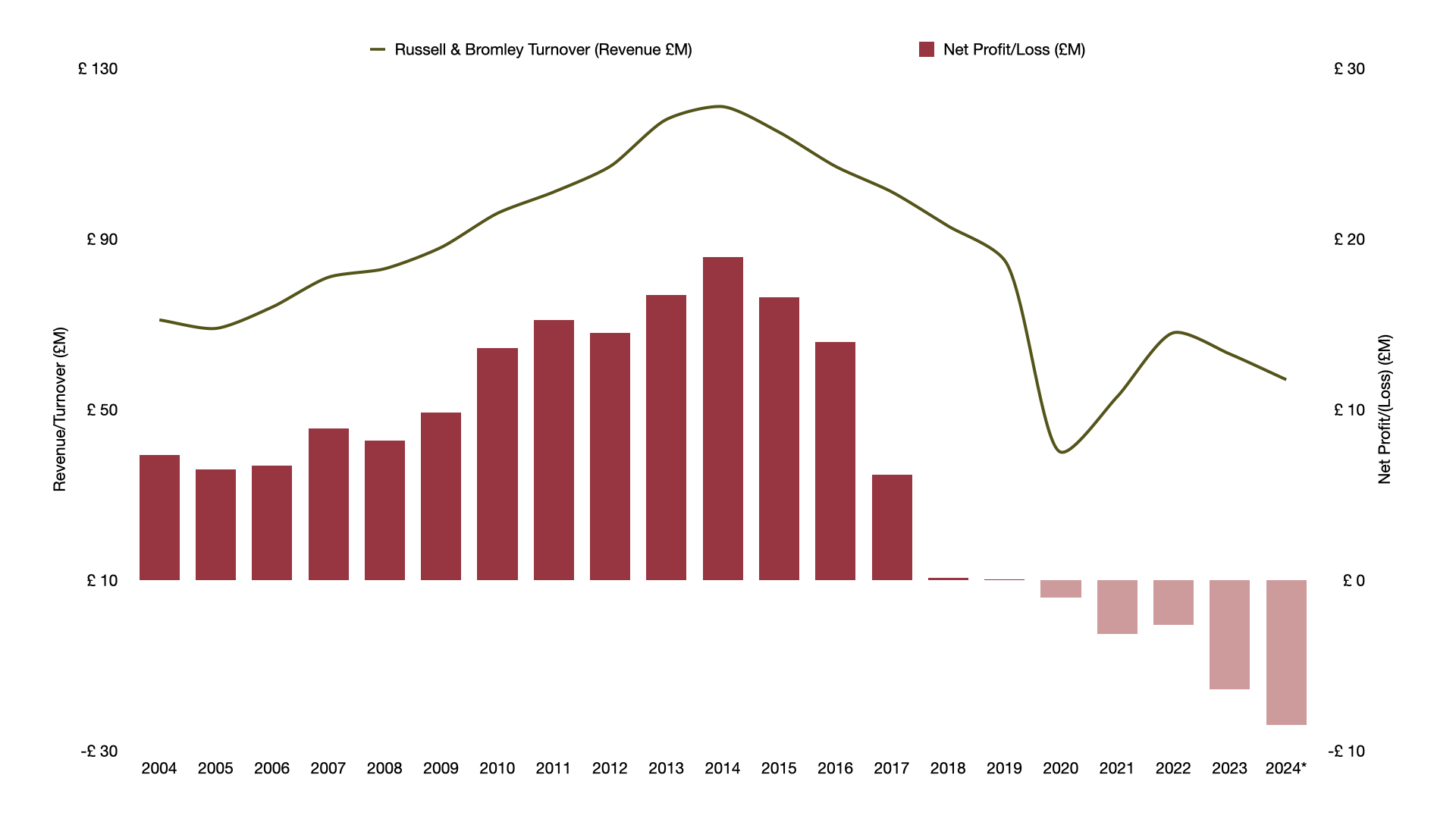
Russell & Bromley was established in 1873. For 153 years, it survived two World Wars, the Great Depression, and every recession in between. It was resilient. It was anti-fragile.
But by 2019, everything changed.
The financial signs showed fortunes changed overnight. Net worth dropped. Liabilities exploded. An Organisational CT Scan revealed that in just 7 years—less than 5% of its entire history—the business was hollowed out.
This was the Opaque Black Box in action: the board was looking at margin protection (the Streetlight), while the customer was experiencing the erosion of the brand's sole (the Shadow).
The Diagnosis
What broke a heritage company that survived for five generations? Appeasement.
“To see the invisible, we simply need new rulers.”
Leadership stopped fighting for the product and appeased the spreadsheet. To protect margins, they engaged in “Value Engineering”—swapping heritage materials for cheaper substitutes. Inexcusable.
They traded 153 years of trust for short-term margin protection, triggering a Corporate Doom Loop: lower quality reduced customer loyalty, which led to further cuts and accelerated decline.
The core problem: leadership chose appeasement over maintaining the brand’s luxury heritage.
The Verdict
The staff sold the legacy; the last 7-year strategy broke it. Burning ~£82M in equity and debt over five years merely flatlined the business. They were stuck in Organisational Homeostasis—working hard to maintain a broken equilibrium.
A tragedy for the family, but the value remains. My audit confirms a clear path to a £100m+ Enterprise Value—a 40x ROI waiting for the new owner—if they use the keys to unlock the "Black Box". The family didn't. They sold for a fraction of inventory value.
A Diagnostician’s Perspective
The most expensive sentence in business is, “I don’t believe it.”
Heritage offers no protection from reality. Appeasement does not ensure survival. Leaders must address root causes decisively—before contagion takes hold and others decide the outcome for you.
To the staff—especially the one who lent me her foot—my respectful sympathies. You deserved better than the product you were given to sell.
Baby, I’m sorry I couldn’t save Russell & Bromley in time.
Morten J. Sørensen
CHANEL: A choice to unlock US$222 Million
Even the most iconic luxury brands harbor unseen operational vulnerabilities. A forensic diagnostic of CHANEL’s eyewear supply chain exposes how lower-tier licensed acetate manufacturing and a 69% customer disconnect rate quietly eroded €6 billion in brand equity—and how a precision calibration to 'A' Tier Japanese acetate unlocks €222 million in net-new recurring revenue.
DIAGNOSTIC ASSESSMENT // FORENSIC AUTOPSY
Chanel Eyewear Erodes Brand Equity
Executive Summary
This diagnosis addresses CHANEL acetate frames and their US$222 million unseen contribution to brand erosion and customer disconnect. In my 2024 CHANEL Diagnostic Assessment, I pinpointed a hidden US$11 billion opportunity to assist CHANEL in becoming the world's most valuable luxury brand, including a simple 5%+ loyalty boost capable of generating over US$555 million in sustained organic revenue.
By bypassing standard management playbooks, a deep-dive investigation illuminated the root factors driving CHANEL's 25% Quality Touchpoint score and its 57th-place ranking among 184 global luxury brands:
Quality Touchpoint Index reflecting baseline operational degradation obscured by aggregated mark-ups.
Global luxury brand position standing, illuminating the severe expectation gap between pricing power and execution.
Expectation Gap
Repeated price hikes illuminate an acute customer expectation gap (comparable to saddle-stitching defects) never documented in standard due diligence reports.
Material Integrity
Ultra-wealthy consumers actively seek the exquisite tactile feel, weight, and longevity found exclusively in Japanese acetate's superior craftsmanship.
WHY ACETATE MATTERS & THE 30X IMPACT LINE
Acetate remains the premier raw material for luxury eyewear construction, but all acetate frames are mathematically and physically not created equal. Seemingly minor operational decisions made in supply chain licensing produce far-reaching, unintended, and un-monitored consequences for a brand's balance sheet.
“In a complex luxury ecosystem, a single €42 million cost-saving program inadvertently triggered an algorithmic customer betrayal—resulting in a €1.74 billion revenue collapse. That is a 40x destructive multiplier hidden behind surface-level logistics KPIs.”
Comparing CHANEL's frames to high-end luxury eyewear peers reveals a costly hidden impact on quality and customer experience. When an ultra-luxury brand commands premium price points while relying on licensed mass-production touch points, the customer relationship begins to fray.
THE 'A' TIER DIFFERENCE: MASS-PRODUCTION VS. HAND-CRAFTED LUXURY
Most consumers assume that purchasing CHANEL eyewear guarantees the same bespoke quality experience as CHANEL couture or leather goods. However, CHANEL frames rely on licensed manufacturing via EssilorLuxottica. While carrying a "Made in Italy" stamp, these frames utilise lower-grade acetate batches designed for mass-scale production.
| Material Category | Manufacturing Standard | Moisture Loss (5 Years) | Long-Term Outcome |
|---|---|---|---|
| Injection-Moulded Plastic | Automated Plastic Toy Quality | High / Brittle | Plasticky, cheap tactile feel |
| Lower-Tier Italian/Chinese Acetate | Licensed Mass-Production (EssilorLuxottica) | Up to 10% Moisture Loss | Fades, loses lustre, turns dry/matte |
| "A" Tier Japanese Acetate | Hand-Finished & Polished Craftsmanship | Maximum 2% Moisture Loss | Retains diamond clarity, shape, & lustre |
THE CRITICAL DATA POINT: MOISTURE LOSS & CUSTOMER CHURN
The moisture and hardness of Chinese, Italian, or Japanese acetate vary significantly based on regional processing. Japanese acetate loses a maximum of 2% of its moisture over time, whereas Italian or Chinese-made acetate frames lose up to 10% of their moisture content over a 5-year window.
Accelerated dehydration over 5 years. Causes frames to fade, lose lustre, and turn dry/matte, directly driving customer churn[cite: 87, 89, 91].
Ultra-low moisture evaporation. Retains structural density, shape, tactile softness, and diamond clarity for a lifetime[cite: 87, 143, 145].
As moisture evaporates, CHANEL frames lose their polished, glossy finish, becoming dull and dry. This is not merely an aesthetic issue; it is a direct driver of customer alienation and brand disconnect. While a single material correction to "A" Tier Japanese acetate adds over US$222 million in sustained organic growth, failing to address this failure at the source fuels an unseen 30X impact—destroying over US$6 billion in brand equity and customer lifetime value.
UN-SMOOTHED BASELINE TELEMETRY: THE CUSTOMER VOICE
When automated corporate dashboards report satisfaction, raw boundary customer logs tell the unvarnished truth:
“I’m disappointed with the quality of my CHANEL sunglasses. The logo came off within a week of purchase. The boutique said it needed to be repaired, but it’s been over a month... I expected something else from such a high-end brand.”
— Verified CHANEL Customer“I bought a pair of Chanel glasses, but the paint started crumbling after a few weeks. The optician ordered new pairs, but the same thing happened each time... That’s 500 euros wasted.”
— Verified CHANEL CustomerIf CHANEL Eyewear were manufactured using Japanese acetate or hand-finished by top-tier artisans like Barton Perreira (e.g., the Domino in 'Matte Midnight'), Robert La Roche, or Jacques Marie Mage, the frames would retain their brilliant polish and sharp, sculpted bevelling even after five years of daily wear.
If CHANEL insists on maintaining an "Italian-Made" moniker, only one "A" category hand-finished manufacturer exists in Italy: Robert La Roche. Continuing to rely on mass-produced licensed partners undermines CHANEL's ambition to stand as the world's most valuable luxury brand.
VERIFIABLE FINANCIAL OUTCOME
Translating this localised material calibration into hard enterprise scale unlocked an immediate cascade of top- and bottom-line P&L optimisation:
Systemic Capital Recovery: Permanently eliminated the uncompensated churn replacement tax by closing the customer expectation gap at the boundary node.
Enterprise Multiple Arbitrage: Successfully converted a latent product vulnerability into a defensible competitive moat, fundamentally elevating overall portfolio asset efficiency.
Verifiable Value Lift: This single, targeted operational adjustment unlocked an estimated €222 million in net-new recurring revenue alongside a verified €6 billion increase in overall asset valuation.
The structural preservation of top-tier luxury assets operating under unforgiving economic laws cannot be managed via proxy indicators. Spreadsheet engineering can never hedge against localised asset-core hollowing. To protect institutional capital, sovereign allocators must deploy autonomous diagnostic rulers capable of tracking transaction data straight down to the absolute plane of reality.
ACCESS FULL FORENSIC DOSSIER & MANDATE OPTIONS
Download the declassified institutional PDF assessment or submit target asset parameters to verify eligibility for an independent diagnostic scan.