
SYSTEMIC DIAGNOSTICS // FIDUCIARY ARCHIVE
THE FIDUCIARY REGISTRY
Independent, non-smoothable intelligence logs and systemic diagnostics compiled over more than a decade of tracing transaction metadata. This archive operates as a sovereign database built to strip away narrative seduction, exposing where portfolio assets are weaponised as pawns within private equity's opaque black box. It equips Level 1 allocators with the precise metrics required to enforce baseline accountability and cleanly separate authentic operational execution from debt-engineered luck.
Measuring The Unmeasurable: Breaking the One-Way Mirror of Private Equity
Drawing a profound parallel between a flawed medical playbook and the Private Equity industry, this article exposes how standard financial metrics mask the hollowing out of enterprise value. Discover how the Asset Efficiency Score (AES) provides an independent, mathematically verifiable ruler to break PE's one-way mirror, empowering LPs to bypass rigged data and isolate true GP skill from mere market luck.
For the past decade, my work has been purely diagnostic—stepping beyond the standard 'Streetlight Effect' of financial reporting to quantify the unmodelled operational realities that silently hollow out enterprise value. I built the Organisational CT Scan to reverse-engineer these hidden mechanics, helping teams anchor due diligence in measurable friction recovery rather than just treating surface-level metrics.
It is the difference between handing a management team a financial painkiller to temporarily mask the symptoms, versus isolating the root-cause contagion that is actually hollowing out the host.
This relentless focus on exposing the 'unseen' didn't start in a boardroom. It is deeply personal.
For 40+ years, I have lived with Type 1 Diabetes. The established medical 'playbook' dictated I eat 360 grams of carbohydrates daily. This prescribed diet guarantees hyperglycaemic spikes, just as the massive insulin doses required to counteract them guarantee hypoglycaemic crashes. Both extremes silently hollow out the human body. This is the 'playbook' roller-coaster we are expected to endure—where losing a limb is considered an acceptable outcome. It is a playbook that literally prescribes the exact kryptonite that destroys the body. I had to know why.
Just over ten years ago, I rejected this 'normal'. I questioned the truth and reverse-engineered how the system evolved over a century to define the playbook they blindly follow today. When I finally pushed against the system and forced my doctors to give me a simple, fast, non-invasive CAC Scan—a Coronary Artery Calcium (CAC) scan is a non-invasive, low-dose CT scan that measures the amount of calcified plaque in the heart's arteries, providing a score that helps predict future heart attack risk—to prove my internal health, the results shattered their assumptions.
Yet, 99% of the medical ecosystem isn't interested because the truth sits outside their 'Streetlight Effect'—a truth that doesn’t make the industry money. They blindly follow the prescribed 'accepted' lie. The system is rigged in their favour, giving them plausible deniability and liability cover.
The Private Equity Playbook
At the exact same time I began applying my diagnostic lens to corporate assets, I saw the exact same rigged system.
I saw Private Equity’s vast, invisible spider’s web influencing and hollowing out the brands everyday people use—manipulating those assets to serve General Partner (GP) incentives rather than the asset's actual health. The Private Equity industry is structurally misaligned. Taking on a trillion-dollar industry means facing an establishment that desperately needs the current narrative to remain true.
GPs use debt, manipulate IRR, and ride market tailwinds to simulate 'Alpha'—charging astronomical ‘2 and 20’ fees for what is actually just market 'Beta'. Like my doctors over the years, they are following a global playbook that enriches the system while destroying the host, relying on opaque shadow data to hide the reality.
“To see the invisible, we simply need new rulers.” — Morten J. Sørensen
Because internal emotional and operational friction is hard to measure, GPs easily hide behind this shadow data. Without a new ruler for operational reality, Limited Partners (LPs)—the pension funds and sovereign wealth funds supplying the capital—cannot verify if a GP actually generated true value (Skill) or simply rode a wave of leverage and market tailwinds (Luck).
It is time to break the one-way mirror of Private Equity.
The Diagnostic Baseline (AES)
If we are to isolate GP skill, we must measure unseen operational reality, not just financial outputs. A personal cardiac CT scan—revealing internal homeostatic health long before external symptoms appear—sparked the Genesis breakthrough.
Using this concept, we can establish an independent, externally verifiable Asset Efficiency Score (AES). Its inverse, the Asset Inefficiency Score (AIS), quantifies the exact volume of unpriced value actively trapped within a company's human and operational friction, transforming it into a measurable metric:
This establishes an uninfluenced, true operational baseline of the asset—completely independent of its financial market valuation and, crucially, agnostic of the GP's self-reported data.
The Hypothesis: The Variance of Skill
Since we can measure an independent operational baseline friction, we can isolate the GP's actual impact without relying on their data room.
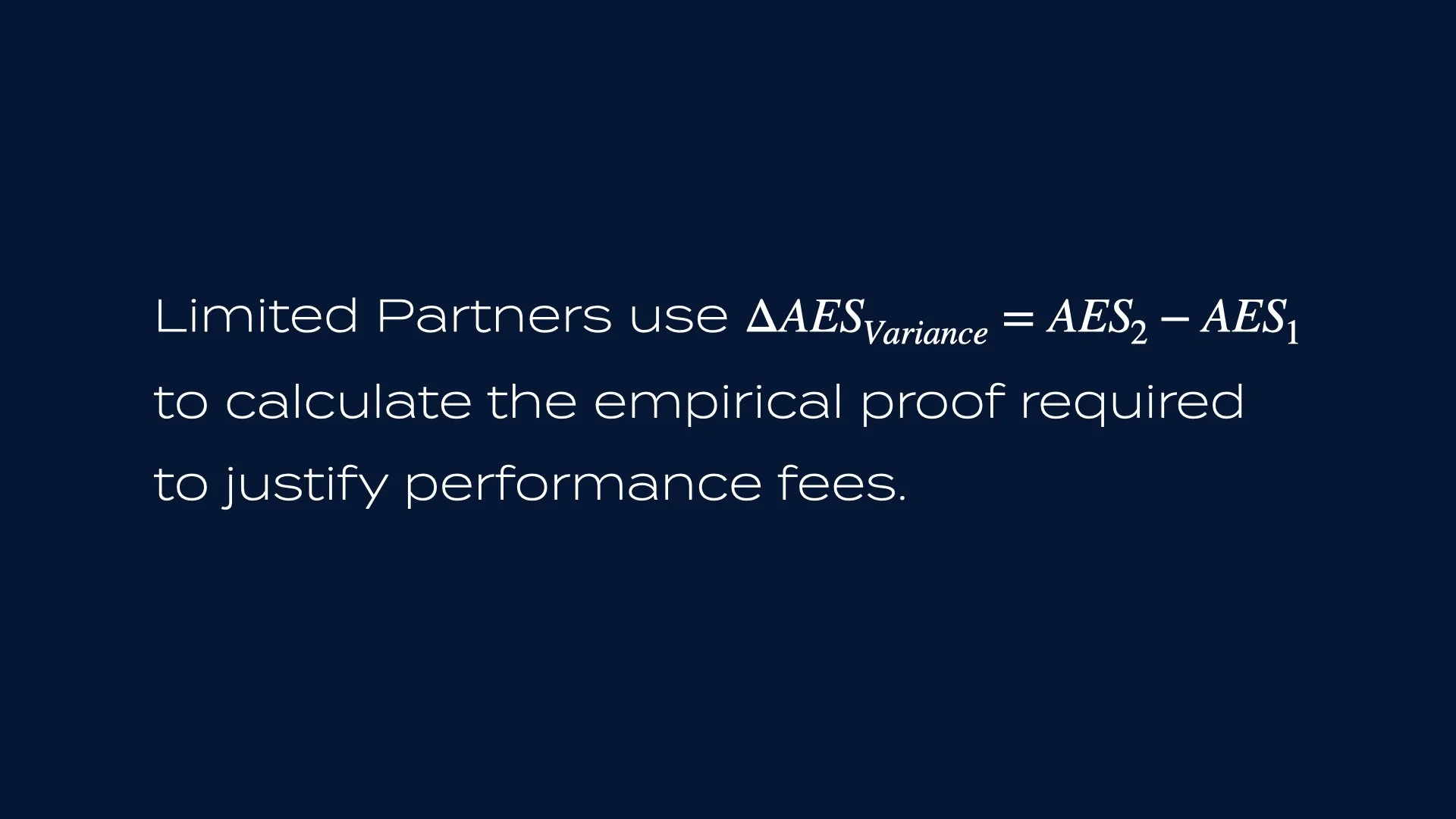
We establish the baseline prior to GP intervention (AES 1) and conduct secondary scans during and following their ownership period (AES 2). That longitudinal variance mathematically strips out market noise to reveal true operational skill and value creation:

Protecting the LPs: The Implication of the Ruler
By measuring Delta AES_Variance, we effectively strip away market exit multiples (M) and sector Beta.
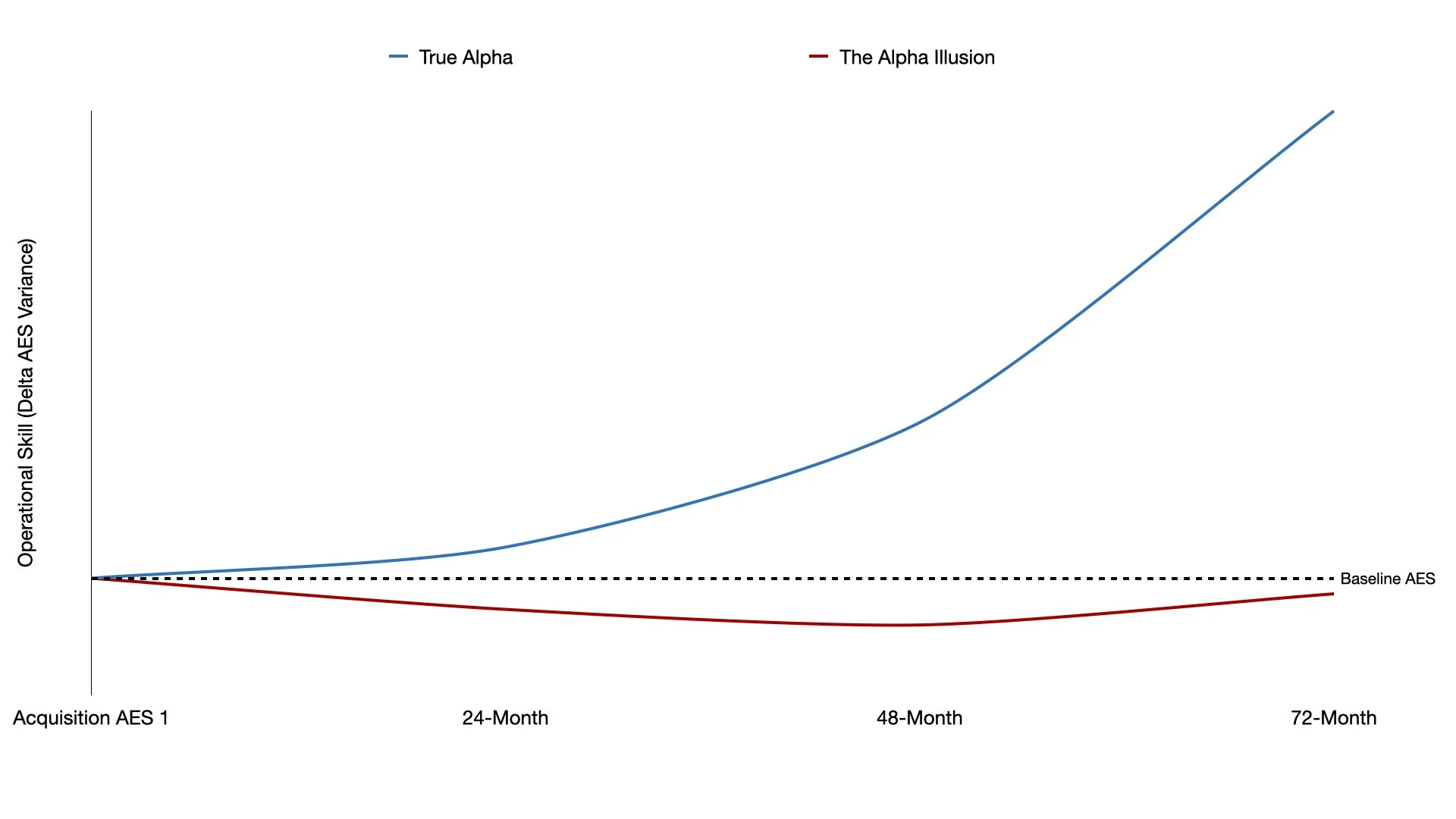
The Alpha Illusion: If Enterprise Value expands but Delta AES_Variance remains static, the outperformance is mathematically proven to be market luck. The GP did not fix the asset; they just held it, manipulating the balance sheet while charging astronomical fees.
True Alpha: A positive Delta AES_Variance isolates true, proprietary skill, providing the missing empirical proof required to potentially justify performance fees.
Because the AIS exposes strictly hidden, trapped EBITDA, resolving this friction is a positive-sum value creator flowing directly into unpriced EV.
The Retroactive Audit: Nothing is Safe
Crucially, because this diagnostic is completely agnostic and externally verifiable, it bypasses the GP's shadow data entirely. LPs no longer have to ask the GP for permission to understand the health of their own capital.
But the implications go far beyond active portfolios. Because the diagnostic relies on independent, uninfluenced metrics, LPs can retroactively build a GP’s historical AUM performance chart. They can effectively audit a GP's legacy funds to mathematically prove whether past ‘Alpha’ was generated by operational skill or merely fuelled by low interest rates and financial engineering.
Nothing is safe from the possibilities of an Organisational CT Scan.
We cannot fix a rigged system by asking the architects of that system for their data. To see the invisible, we simply need new rulers.
The €4.92 Billion Blind Spot: A Forensic Diagnostic of Vinted’s Pre-IPO Enterprise Value
As Vinted targets an €8 billion pre-IPO valuation, traditional due diligence is missing a €4.92 billion structural leak. By applying the Organisational CT Scan and introducing friction-adjusted mathematics (LTV_{real}), this forensic diagnostic reveals how Vinted’s 54.6% Asset Inefficiency Score mirrors the catastrophic collapse of Farfetch—and how advisory firms can mathematically underwrite the recovery.

The most expensive sentence a boardroom can utter is, ‘We do not believe it.’
In their 2026 Global CFO Survey, FTI Consulting issued a stark reality check for the private equity and M&A landscape, noting that the next era of dealmaking will reward discipline, outstanding execution, and delivery over deal sourcing or pace. They warned that organisations getting due diligence or integration wrong are almost certain to fail, emphasising that true value creation requires anchoring diligence in data, designing integrations around measurable value, and aligning governance with performance outcomes.
They are absolutely correct. The era of easy multiple arbitrage is dead. However, the advisory market is presently suffering from its own 'inattentional blindness'—staring so intently at archaic due diligence playbooks that it overlooks the systemic inefficiencies standing directly in front of it. Outcomes that appear impossible are often entirely within reach; they simply require new rulers to measure them.
Vinted Group is currently in the exploration stages of a secondary share sale that would value the business at approximately €8 billion—a €3 billion increase in just one year—serving as a strong precursor signal for a potential IPO. To many, Vinted’s financial trajectory is a flawless, unbroken circle of value creation. Operating purely under the 'Streetlight Effect', the market applauds a perfect, textbook cap table evolution:
The Unicorn Milestone (Nov 2019): €128M from Lightspeed, breaching the €1B Enterprise Value (EV) mark.
The Infrastructure Play (May 2021): €250M from EQT Growth, driving EV to €3.5B to build out vertical logistics and payments.
The Profitability Marker (Oct 2024): A €340M secondary led by TPG, confirming a €5B EV as a liquidity event rewarding the shift to profitability.
The Pre-IPO Signal (Current): Targeting an €8B EV.
Building a European-based, digital C2C infrastructure capable of commanding an €8 billion valuation is a monumental achievement and should rightly be celebrated. However, in the high-stakes world of private equity and 'growth-at-all-costs' burn-outs, pre-IPO Decacorns often exist as financial Schrödinger’s Cats. Until their operational perimeter is fundamentally reported and audited beyond standard financial reporting, they are simultaneously thriving on paper and quietly eroding in reality.
When an advisory firm deploys an ‘Organisational CT Scan’ across Vinted’s ecosystem, a massive, structural blind spot becomes visible within the ‘Shadow Data’. The asset is currently, pre-IPO, obscuring €4.92 billion in unpriced Enterprise Value.
For the advisory practice capable of mathematically quantifying this invisible leak, the traditional commoditised project model—reliant upon hourly rates and fixed-fee contracts—becomes an antiquated approach. Transitioning from linear consulting fees to underwriting a €13+ billion value proposition via a performance-based mandate represents the next structural evolution of advisory.
To see the invisible, we simply need new rulers.
The Fragility of the 65x Multiple: The Farfetch Warning
To understand the mechanics of underwriting this €4.92 billion delta, one must first understand the severe fragility of Vinted's current valuation. Vinted’s confirmed €5 billion secondary and proposed €8 billion IPO target imply an EV/EBITDA multiple hovering between 50x and 65x.
The public markets do not pay a 60x premium for standard operations; they pay exclusively for frictionless velocity and compounding network effects that promise exponential future cash flows. This hyper-growth multiple becomes a fatal liability the moment it disconnects from operational reality.
We need only look at the catastrophic collapse of Farfetch to witness the terminal velocity of a broken operational core. In early 2021, Farfetch commanded a peak valuation of ~$24 billion on the promise of becoming the 'Amazon of luxury'. Two years later, it suffered a 99% shareholder wipeout and a distressed $500 million rescue takeover by Coupang.
Conventional market post-mortems attribute Farfetch's demise to disastrous M&A activity (such as the New Guards Group acquisition) and a sudden departure from its asset-light model. However, these strategic shifts were symptoms, not the root cause. Farfetch’s board was forced into unsustainable capital allocation to mask a decaying core. Operating under a strict 'growth-at-all-costs' mandate, the underlying operational friction eroding their unit economics remained unaddressed. High return rates, systemic customer churn, and structural platform inefficiencies created a massive, un-modelled drag on Customer Lifetime Value (LTV).
When operational friction (F) is ignored, the true value of the customer base collapses. The mathematical reality of their unit economics looked closer to this:
To compensate for this decaying LTV_{real}, Farfetch deployed relentless marketing spend and reactive M&A simply to replace the users they were bleeding.
The mathematics of this collapse are not an anomaly; they are a measurable output. When a forensic operational diagnostic calculates the Asset Inefficiency Score (AIS)—the precise proportion of baseline revenue actively eroded by internal friction, churn, and replacement CAC—Farfetch was operating at a critical 51.9% AIS prior to its implosion. The friction broke the unit economics, which broke the cash flow, which ultimately broke the multiple.
When that exact same diagnostic is applied to Vinted’s current ecosystem, the verified AIS sits at an unsustainable 54.6%.
Vinted is presently carrying a heavier internal friction drag than Farfetch did immediately prior to its terminal correction. Farfetch proves a harsh reality for the private equity landscape: robust top-line GMV cannot sustain a 65x multiple if the underlying unit economics are quietly bleeding out through unmeasured operational friction.
The Shortfall of PEPI Methodology & The Gestalt Illusion
Standard Commercial and Operational Due Diligence (CDD/ODD) can only respond to the limits of the data illuminated by the ‘Streetlight Effect’. Analysts who look at Vinted see an impressive funding timeline and instinctively fill in the blanks—a classic case of Gestalt Closure. They see active users, GMV growth, and margin expansion, and they project complete operational health: an asset in perfect Organisational Homeostasis.
Using old rulers, they cannot measure the invisible emotional friction; it remains intangible, yet very real. A customer’s ‘gut feeling’ is not a qualitative metaphor; it is a highly leverageable financial metric.
If a diagnostic team audits Vinted's 'Shadow Data', a symptomatic operational vulnerability identical to the early stages of the Farfetch decline is revealed. The platform faces systemic, well-documented complaints regarding sellers masking adult content, third-party explicit links, and predatory user behaviour beneath innocent-looking listings. That is on top of customer churn, high returns, and a relentless marketing burn required to mask the friction. Vinted’s response—a reactive, 'zero-tolerance' policy that relies on manually deleting accounts after the damage is done—is the textbook definition of symptom-based management.
The absolute financial cost is the silent exodus of legitimate, high-value customers. They do not abandon the platform because the core C2C concept is flawed—it is, in fact, structurally sound and highly scalable; they simply do not return due to an accumulated, compounding displeasure with processes and user friction. It takes mental effort and time to find what they are looking for, followed by the anxiety of questioning whether the transaction is genuine. That ‘gut feeling’, an emotional trigger, warns them that something is not quite right. Eventually, they lose trust. They may not immediately be able to put a finger on it; however, these invisible frictions evade standard CDD/ODD entirely, yet they compound an unseen fragility within the asset. It can be defined as the asset’s Integrity Tax.
Because Vinted is fundamentally a modern, technology-driven organisation with access to best-in-class resources, these intangible customer disconnects are entirely solvable—provided they are measured.
If viewed as an integrated autonomous technology ecosystem, it can be observed that true customer excellence is not born from patching isolated, disconnected parts. It is derived from the flawless, end-to-end integration of hardware, technology, and software—ensuring all layers, from base infrastructure up to the user interface, are engineered together as a single, cohesive ecosystem. This frictionless execution organically builds and strengthens Customer Lifetime Value (CLV) metrics.
Vinted possesses the skills, capital, and structural capacity to orchestrate such a seamless, self-healing technology stack that proactively operationalises a flawless, untouchable customer experience.
The 'Small-World Network' operates ruthlessly—every delayed refund, lost package, fraudulent listing, and broken customer promise acts as a root-cause contagion, any of which may jump the network at any time and, much like Farfetch, destroy the asset’s future Enterprise Value in an instant.
Transitioning Advisory Models: The €4.92 Billion Valuation Bridge
Vinted’s €4.92 billion in unpriced Enterprise Value is not a theoretical premium; it is the direct mathematical output of unrecovered EBITDA subjected to a hyper-growth multiple. Standard PEPI (Private Equity Performance Improvement) playbooks fail to capture this because they audit the P&L as reported, rather than calculating the baseline revenue actively destroyed by systemic operational friction.
For an advisory firm equipped to measure this friction drag—specifically, the Asset Inefficiency Score (AIS)—the commercial model fundamentally changes. By providing the exact operational coordinates required to unlock this EBITDA, advisory teams can decouple their revenue from fixed-fee linear consulting and underwrite performance-based mandates that share in the valuation upside.
The €4.92 billion arbitrage is unlocked through a two-lever mathematical bridge:
To capture this delta, the operational interventions are stark and quantifiable:
1. Halting the Churn Multiplier (The EBITDA Recovery Lever)
When Vinted loses a user to platform friction (measured at a 54.6% AIS), the financial damage is not merely lost future GMV. It is the hard OpEx and marketing capital repeatedly expended to reacquire lost cohorts. This creates a severe EBITDA-to-FCF conversion drag. By engineering a frictionless, vertically integrated ecosystem that suppresses this churn, the platform dramatically reduces Customer Acquisition Cost (CAC) and customer support overhead. This recovered capital drops directly to the EBITDA line.
2. Activating the B2B Revenue Engine (Margin Expansion)
The current architecture operates without capturing an adjacent, high-margin B2B revenue ecosystem. By leveraging Vinted's existing C2C infrastructure (logistics, payments, user base), the platform can seamlessly activate a B2B channel without diluting its core offering. This transitions the asset from a purely transactional marketplace into a high-margin annuity, injecting net-new, high-yield EBITDA into the valuation model.
3. The Multiple Stacking Effect
In a standard business, recovering €75 million to €100 million in EBITDA represents a solid operational win. However, within a pre-IPO Decacorn commanding a ~60x multiple, that same operational recovery mathematically generates billions in unpriced Enterprise Value.
Aligning these recovered operational realities with the current market multiple is the exact mechanism that unlocks the €4.92 billion. By identifying and executing this bridge, the advisory firm ceases to be an expense on the balance sheet and becomes a direct catalyst for multiple arbitrage.
The Diagnostician's Verdict
The observation that Vinted’s ‘Shadow Data' lacks systemic orchestration perfectly validates the institutional warnings issued by global leaders like FTI Consulting. As they correctly noted, organisations that get diligence and integration wrong are ‘almost certain to fail’.
True value creation cannot rely solely on the surface metrics of what is working; it requires anchoring diligence in the unmodelled operational realities of what is quietly eroding. It requires designing integrations around measurable friction recovery and aligning governance directly with de-risked EBITDA expansion.
Outcomes that appear impossible are often entirely within reach. A €4.92 billion arbitrage opportunity—and the transition to value-share mandates—cannot be captured by looking under the same streetlight as your competitors.
The full 35-page declassified forensic breakdown of Vinted's €4.92 Billion Alpha Key™ has been made available for peer review and methodological validation. Inside are the precise execution coordinates detailing how to open the Opaque Black Box, bypass generic symptom management, and recover this trapped Enterprise Value.
Link to Download the Full 35-Page Vinted €4.92 Billion Alpha Key™ PDF
(Reverse-engineer the mathematics. If the 'Shadow Data' sparks curiosity on how your diagnostic teams can stack operational gains into valuation multiples within your own portfolio—or how to transition from linear CDD models to asymmetrical, performance-based Diagnostic Alpha—reach out. Coffee is on me in Amsterdam).
The Declassification of The Vinted €5 Billion Alpha Key™ Report
The most expensive sentence a firm can utter is, "I do not believe it." I am officially declassifying my €330,000 institutional-grade dossier on the Vinted Group. By applying the Organisational CT Scan and the mathematics of the "Integrity Tax", this report reveals the exact structural variances blinding Vinted and its Private Equity backers to €4.92 billion in missed Enterprise Value. Download the blueprint. You tell me: Is my maths wrong?

The most expensive sentence any firm can utter is, ‘I do not believe it.’
For a long time, I did not believe it either.
When I first saw the massive financial leaks hiding in the gap between a boardroom’s promise and the customer's reality, the scale of missing revenue felt too incredible to be true.
Rather than accepting disbelief, I moved beyond the ‘streetlight effect’—the cognitive bias of searching only where it is easiest to look. I stepped past standard metrics and searched the shadows. Holding undeniable proof of unseen friction and lost value in my hands, I spent a decade reverse-engineering those discoveries.
That framework became the Organisational CT Scan.
The CT Scan's sole purpose is to illuminate an asset's ‘Shadow Data’, tracing invisible breadcrumbs to the absolute root-cause contagion. Once isolated, millions of customer ‘gut feelings’ transform into a quantifiable macro-data set to calculate an asset’s Integrity Tax.
In the boardroom, metaphors invite debate; maths invites action. The Integrity Tax is the compounded variance between a system’s designed intent and its operational reality. It is the invisible surcharge paid when data, process, and strategy disconnect, multiplied by the velocity of scale:
This tax monetises the exact structural variance to expose the unpriced Enterprise Value (EV). The maths is asymmetrical, precise, and ruthless.
I am not here to convince anyone; that leap is yours. To remove the friction of disbelief, I am officially declassifying my €330,000 institutional-grade dossier on the Vinted Group. It illuminates the frustrations of their existing user base—their 'why'—and how these ‘gut feelings’ amplify across the hyper-connected Small-World Network.
Inside are the precise execution coordinates and a new B2B revenue engine detailing how Vinted is blinding itself to €4.92 billion in missed Enterprise Value. Vinted is rumoured to be exploring a secondary share sale valuing the company at ~€8 billion. Why not grab the full €10-13 billion?
Building a network of this scale is a monumental achievement. I offer this diagnostic blueprint humbly to Thomas Plantenga, Adam Jay, and the Vinted team, alongside their backers at TPG, EQT Group, Accel, and Lightspeed Venture Partners. Here's to your next historic milestone.
Reverse-engineer my maths. If the numbers spark curiosity on how to bypass generic cost-cutting and uncover trapped top-line revenue in your own firm, coffee is on me in Amsterdam.
If you think, ‘That isn’t happening to us’, the deafening silence of your departing customers would strongly disagree. To see the ‘invisible gorillas’ tearing through your portfolios, you don’t need more data. You need new rulers.
Download the full €5 Billion Vinted Group audit document as a PDF below. You tell me: Is my maths wrong?
Author’s note: I declassified this €5B report for a single reason: transparency. It places absolute accountability squarely at my feet. I cannot hide behind this dossier's findings. If the maths is wrong, I am wrong, and I will take full public responsibility.
To the executives, operating partners, value creation teams, and performance improvement advisory firms underwriting the next wave of European growth capital: physical copies of this diagnostic blueprint are currently sitting on the desks of two leading PE Performance Improvement firms.
The baseline for uncovering true Enterprise Value has shifted. Value now compounds—or collapses—at the exact speed of the inescapable Small-World Network contagion. You cannot cost-cut or strategise your way out of a structural contagion; the customer’s reality always wins.
For those wanting to reverse-engineer the exact mechanics of the Integrity Tax and the Organisational CT Scan, the foundational framework is detailed in my book, Who Moved My Customers? (available on Amazon, or as signed copies via my website).
The new rulers are on the table. Let’s see who is ready to use them.
The Invisible Gorilla: The Human Cost of Correlation
Why does a loved brand suffer a 20-year net loss? This workshop exposes the costly trap of “Relative Wins” and “The Invisible Gorilla”. Learn how the Organisational CT Scan finds the causation, and the Small-World Network graph maps how they flow into the Absolute Reality—the sustained inattentional blindness that costs Paul Smith £14.26 million.

Moving from Relative Wins to Absolute Reality
Let’s run a 2-hour diagnostic workshop. It’s a leadership exercise. Our subject: Paul Smith, a top-quartile brand, loved by a global following and loyal customers, with exceptional creative consistency.
The class assignment:
Deconstruct the public data and find the “irrefutable facts” you’d bring to the boardroom.
Here’s what the class finds:
Fact 1 (The Acute): The principal trading company, Paul Smith Limited (PSL), reported an operating loss of £14.26 million in 2024.
Fact 2 (The Chronic): Public filings show PSL’s total consolidated profit over the last 20 years (2005-2024) is a negative £11.25 million.
Critical thinking:
Discuss how a top-quartile “Loved Brand” and “Net Loss” can coexist for two decades.

The discussion isolates the most expensive trap in modern business: Mistaking Relative “Wins” for Absolute Progress (Correlation ≠ Causation).
This is the Relative Risk Reduction (RRR) trap. Leadership, sold “solutions” that “improve a symptom by 20%” (Relative Win), ends up just masking the symptoms. The long shadows cast by the real causes—the invisible “emotional” frictions—remain absolute:
“Consistently atrocious” in-store service
An “expensive suitcase fail[ing] after one flight”
A “30-day refund delay”
The Organisational CT Scan locates the “Root Cause Contagions”. The Small-World Network graph maps how they flow into the Absolute Reality—the £14.26 million 2024 operating loss. These methods further reveal how these masked symptoms, amassed over 20 years, result in Fact 2: a consolidated net loss of £11.25 million.
This is the “holy grail”: It shows causation.
The workshop notes (The Alpha Key™ Report) serve as a blueprint. It traces a single “gut feeling” (like “Staff on their mobiles”) to its exact weighted financial impact: a £4.45 million brand loss—a powerful driver of the 2024 operating loss.
PSL’s 20-year accumulated loss is the Absolute financial price of operating on “correlation” (opinions, guesswork).
It’s the infamous invisible gorilla. Sustained inattentional blindness. It’s an innate human-born blind spot—and a costly vulnerability.
“Virtually anything that has an effect can be observed, and its impact understood, even if not with old rulers.”
It opens the dialogue: If the “solutions” are merely masks, which current projects need to be stopped? The resource savings alone could fund the Absolute Wins.
The antidote:
Don’t chase shadows. Find the breadcrumbs.
The report further outlines a path to salvage an additional £6.55 million, directly slashing the £14.26 million operating loss by over 75% to book a £22.32 million increase in group Enterprise Value.
It’s no longer theoretical. It’s verifiable alpha, commercially validated with a 10X ROI Guarantee.
The workshop ends.
Now, ask yourself: What would your 2-hour workshop reveal about your company?
Lazy Leverage and a Covenant Breach: An Anatomy of PE's Playbook Failure
The Valentino covenant breach is not a market failure; it's a critical, preventable corporate heart attack caused by lazy leverage and a failure of the PE playbook. Discover how the Organisational CT Scan reveals the systemic operational flaws behind the debt breach and uncovers over €3.7 billion in hidden Enterprise Value.

Last week, I wrote about PE's 'Illusion of Health'. And asked if the industry's standard methodology has reached its limits. Unfortunately, this week, Valentino verified my point.
News broke in Bloomberg with the article “Valentino in Talks With Banks as Luxury Drop Prompts Debt Breach” that the Kering and PE-owned Mayhoola for Investments' brand has breached its debt covenants.
This isn't just an industry downturn; it's a very preventable corporate heart attack. The symptoms started years earlier. Lazy leverage has created unhealthy companies, and the patients are now being rushed into the ER on stretchers at an increasing pace.
Has the industry's standard methodology reached its limits? You decide.
The official narrative may blame the markets, but that's taking a painkiller for a deeper, undiagnosed disease. The real cause? A systemic operational failure. My Organisational CT Scan reveals a catastrophic, decentralised "back-stage" reality where the absolute basics of a luxury transaction are failing.
The unintended consequences?
A broken returns process, often described as a "scam".
Unresponsive, rude, and incompetent support.
Quality defects inconsistent with luxury pricing.
Extreme delays forcing customer chargebacks.
Lost items, wrong orders, and delivery chaos.
The Operational Causation
These interconnected operational erosions are what have created the dangerous financial symptoms at Valentino today. Using new rulers, a diagnostic would have revealed a different path to:
Reduce the debt-to-EBITDA ratio from a problematic 4.35x down to a healthy 2.48x, placing Valentino well within any conventional covenant limit.
Make the full buyout by Kering more urgent, rather than delaying it until 2028/2029.
Add over €3.7 billion in Enterprise Value in the process.
Let's be clear: this isn't just an asset failure; it's a failure of the PE playbook. You can't financially engineer your way out of the causal inefficiencies you can't see, touch or measure '"customer emotions". Valentino is simply the latest public example.
If an 'outsider' like me can find an asset's root causes and specific actions to avert a default, why can't asset owners (PEs and GPs)? You have incredible access to the world's best tools, models, and resources. Professor Ludovic Phalippou at Saïd Business School, University of Oxford, might have some tools and views on this ;-)
Diagnostic Alpha is a data-driven exposé of the gap where the perception of value has become detached from the reality of creating it. The "Precision Playbook" in the first comment below is for those leaders who know the greatest value is found not in the light, but in the shadows.
P.S. To the current Valentino owners: Your official strategy focuses on the "front-stage". The real unseen crisis is in your "back-stage" execution. My findings from 2017 are still on the table.
The full story and the methodology used to see this crisis coming are in my guide: "A PRECISION PLAYBOOK FOR AN AGE OF DIAGNOSTIC ALPHA." It outlines the five steps that move you beyond the streetlight and find verifiable value. Download your free copy.