SYSTEMIC DIAGNOSTICS // FIDUCIARY ARCHIVE
THE FIDUCIARY REGISTRY
Independent, non-smoothable intelligence logs and systemic diagnostics compiled over more than a decade of tracing transaction metadata. This archive operates as a sovereign database built to strip away narrative seduction, exposing where portfolio assets are weaponised as pawns within private equity's opaque black box. It equips Level 1 allocators with the precise metrics required to enforce baseline accountability and cleanly separate authentic operational execution from debt-engineered luck.
Beyond the Streetlight Effect: An Alternative Path to LP Autonomy in Continuation Vehicles
With 80% of LPs cashing out of Continuation Vehicles (CVs), the industry is demanding more GP transparency. However, asking for better spreadsheets is merely the “Streetlight Effect”. Discover how LPs can achieve true investment autonomy by bypassing GP narratives and deploying independent operational telemetry—an Organisational CT Scan—to measure invariant asset health.
Professor Claudia Zeisberger raises the Private Equity cycle's defining question: when a GP moves a trophy asset into a Continuation Vehicle (CV), “Do LPs actually understand what they're being offered to roll into?”
As a lead diagnostician, my answer is no—but the “why” offers a fascinating opportunity.
This uncertainty drives severe market friction. Alexandra Heal’s Financial Times report “Private equity investor body sounds alarm on ‘conflict vehicles’” highlights a structural symptom: 80% of LPs cash out of CVs, increasingly viewing them as “conflict vehicles”. Consequently, ILPA is rallying General Partners (GPs) for more “transparency”.
I view this challenge differently. Demanding transparency within the current system mirrors the “Streetlight Effect”—searching for the lost keys under a lamppost simply because that is where the light is.
Here, financial models and GP-authored memos are the lamppost. Limited Partners (LPs) ask GPs to turn up the brightness (transparency). Yet, if an asset’s root-cause contagions lie outside that illuminated circle, brighter engineered metrics will not locate the missing keys.
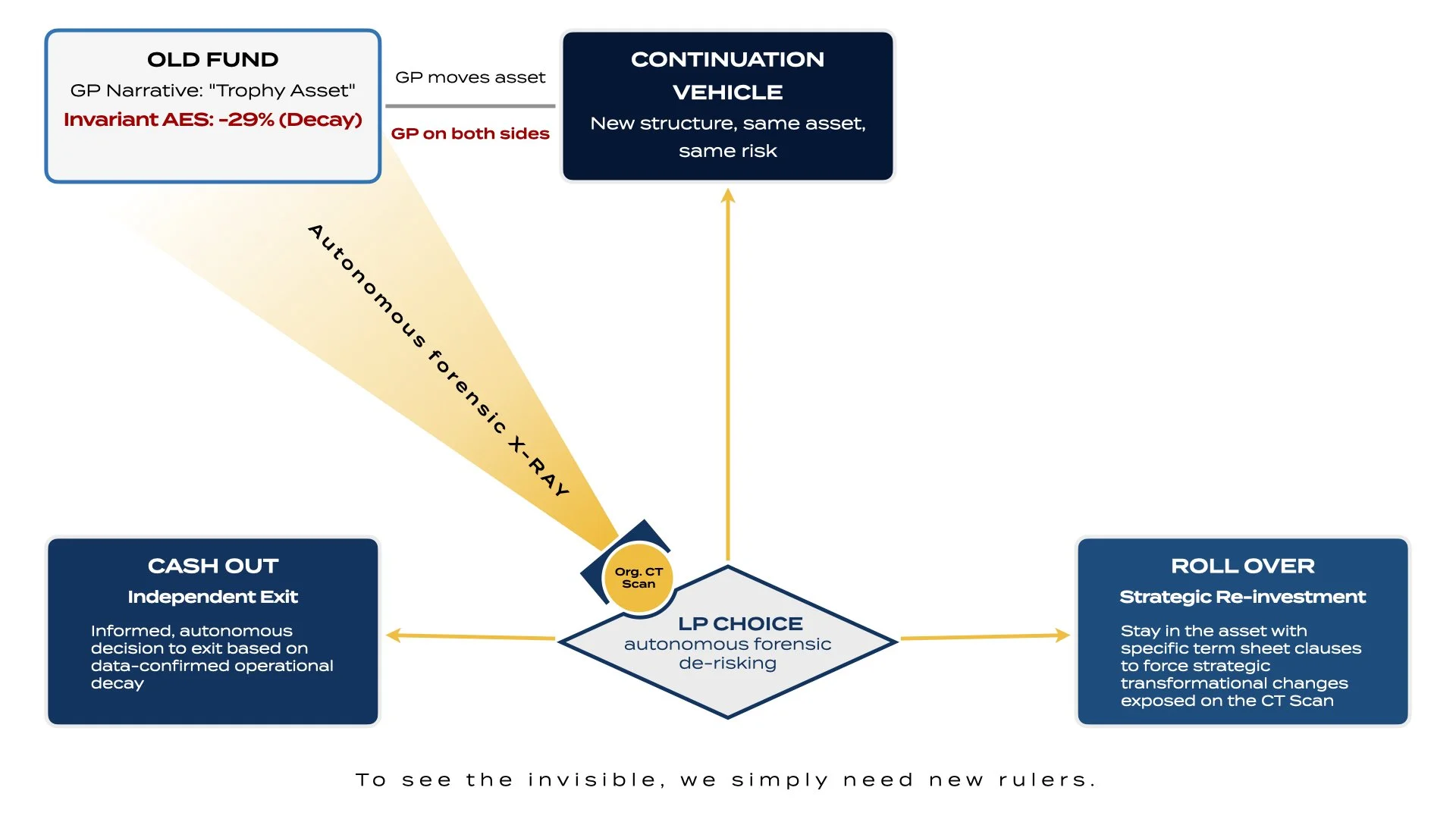
To see the invisible opportunity, we must assess asset health exactly as a cardiologist examines a patient:
The patient “looks” fine (the GP’s “Trophy Asset” narrative).
The doctor prescribes standard treatment (conventional CV pricing and memos).
The scan exposes undeniable arterial plaque as a percentage, confidently providing a risk assessment (hidden structural decay).
A CAC scan bypasses surface symptoms to measure physical reality. If an asset hides a 29% structural decay beneath its financial façade, asking GPs for better spreadsheets will not uncover it.
A suggestion perhaps is move beyond prescribed guidelines hoping for GP collaboration, and instead explore autonomous PE “CAC Scores”.
LPs could hold such a key today. By running an CAC scan equivalent—using external shadow data to trace operational telemetry—LPs tangibly could calculate invariant health without demanding transparency or GP permission.
Shifting to such autonomy, would open an alternative path for LPs in Continuation Vehicles, without conflict. Independent telemetry evolves LPs into autonomous decision-makers.
To see the impossible, we simply bring a new ruler.